
CV-BC Certification: Requirements, Pass Rate & Best Study Plan
 The ANCC Cardiac-Vascular Nursing Board Certification (CV-BC) validates specialized knowledge in caring for patients with heart and vascular conditions. The exam contains 150 questions (125 scored plus 25 unscored pretest items), allows 3 hours, and costs $395 for non-members or $295 for ANA members. With cardiovascular disease causing 919,032 deaths in the United States in 2023 alone — roughly 1 in every 3 deaths — demand for certified CV nurses continues to grow (CDC Heart Disease Facts). This guide covers every detail you need to earn the CV-BC credential in 2026.
|
Key Fact |
Details |
|---|---|
|
Certifying body |
American Nurses Credentialing Center (ANCC) |
|
Credential awarded |
CV-BC (Cardiac-Vascular Nurse – Board Certified) |
|
Total questions |
150 (125 scored + 25 pretest) |
|
Time limit |
3 hours |
|
Passing score |
350 on a scaled score (out of 500) |
|
Cost (non-member / ANA member) |
$395 / $295 |
|
Certification validity |
5 years |
|
Renewal requirement |
75 continuing-education hours |
|
Testing format |
Computer-based at Prometric centers |
|
Active credential holders |
Approximately 6,211 nurses (2024 ANCC data) |
|
Reported pass rate |
Approximately 73% |
What Is the CV-BC Certification?
The CV-BC is a nationally recognized specialty certification offered by ANCC, a subsidiary of the American Nurses Association. It confirms that a registered nurse has demonstrated entry-level competence in cardiac-vascular nursing after initial RN licensure. The Accreditation Board for Specialty Nursing Certification (ABSNC) accredits this credential, adding a layer of independent quality assurance.
Certified CV-BC nurses typically work in cardiac step-down units, telemetry floors, cardiac catheterization labs, cardiovascular ICUs, vascular surgery units, and perioperative settings with a strong cardiac focus. With coronary heart disease costing an estimated $129.3 billion annually in the United States and someone experiencing a myocardial infarction approximately every 40 seconds, the clinical impact of skilled cardiovascular nurses is substantial.
Who Is Eligible for the CV-BC Exam?
Eligibility is straightforward but requires documented clinical experience. According to ANCC, candidates must meet all four of the following requirements:
-
Active RN license — Hold a current, active registered nurse license in a U.S. state or territory, or hold the legally recognized equivalent in another country.
-
Two years of full-time RN experience — Have practiced the equivalent of 2 years full-time as a registered nurse (any setting counts toward this general requirement).
-
2,000 hours of CV clinical practice — Have completed a minimum of 2,000 hours of clinical practice specifically in cardiac-vascular nursing within the last 3 years.
-
30 continuing-education hours — Have completed 30 hours of continuing education (CE) in cardiac-vascular nursing within the last 3 years.
Qualifying Practice Settings
Hours may come from direct patient care in any setting where cardiovascular patients are managed. Common qualifying environments include:
-
Cardiac catheterization and electrophysiology labs
-
Cardiovascular intensive care and coronary care units
-
Telemetry and cardiac step-down units
-
Vascular surgery and peripheral vascular labs
-
Heart failure clinics and cardiac rehabilitation programs
-
Anticoagulation management clinics
No specific degree beyond an RN license is required. Both associate-degree and baccalaureate-prepared nurses are eligible, provided they meet the practice-hour and CE thresholds.
What Are the Four CV-BC Exam Domains?
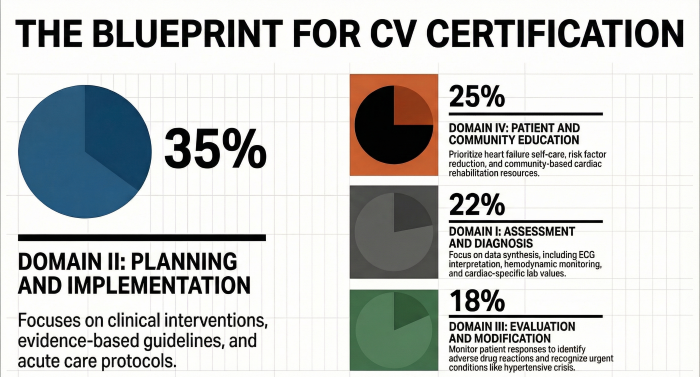
|
Domain |
Questions (Scored) |
Percentage |
|---|---|---|
|
I. Assessment and Diagnosis |
27 |
22% |
|
II. Planning and Implementation |
44 |
35% |
|
III. Evaluation and Modification |
23 |
18% |
|
IV. Patient and Community Education |
31 |
25% |
|
Total |
125 |
100% |
Planning and Implementation is the largest domain at 35%, making it the single highest-yield area for study. Patient and Community Education, at 25%, is the second-largest — a detail many candidates underestimate.
What Does Each Domain Cover?
Domain I: Assessment and Diagnosis (22% — 27 Questions)
This domain tests your ability to gather, interpret, and synthesize patient data. Key knowledge and skill areas include:
-
Anatomy, physiology, and pathophysiology of the cardiovascular system
-
Nursing diagnosis identification based on assessment findings
-
Patient interview techniques — history, chief complaint, social determinants of health
-
Cardiac-vascular assessment tools — Doppler studies, stroke scales, hemodynamic monitoring
-
Data collection and interpretation — diagnostic tests, lab values, cardiac rhythm analysis
High-yield topics: ECG interpretation, hemodynamic waveforms, troponin and BNP levels, peripheral vascular assessment with ankle-brachial index.
Domain II: Planning and Implementation (35% — 44 Questions)
The largest domain covers care planning and clinical interventions across the full spectrum of cardiovascular conditions:
-
Evidence-based practice guidelines — ACC/AHA guidelines, quality measures
-
Scope and standards of practice for cardiovascular nursing
-
Legal and ethical considerations — informed consent, advance directives
-
Invasive and non-invasive procedures — peripheral interventions, cardiac catheterization, structural heart procedures
-
Surgeries — coronary artery bypass grafting (CABG), vascular bypass, heart transplant
-
Pharmacologic therapies — antiarrhythmics, anticoagulants, vasopressors, thrombolytics
-
Non-pharmacologic and complementary therapies
-
Risk-reduction measures — VTE prophylaxis, infection prevention
-
Prioritization and care coordination — interdisciplinary teams, discharge planning
-
Interventions — targeted temperature management, cardioversion, defibrillation
High-yield topics: Heart failure management (HFrEF vs HFpEF), acute coronary syndrome protocols, anticoagulation management for atrial fibrillation, post-PCI care, CABG recovery pathways.
Domain III: Evaluation and Modification (18% — 23 Questions)
This domain assesses your ability to evaluate patient responses and modify care plans:
-
Expected outcomes and benchmarks for cardiovascular interventions
-
Drug interactions — drug-drug and drug-food interactions (e.g., warfarin-vitamin K)
-
Adverse reactions — recognition and treatment of heparin-induced thrombocytopenia (HIT), hypotension, bleeding complications
-
Urgent conditions — pseudoaneurysm, hypertensive crisis, cardiac tamponade
-
Emergent conditions — pulmonary embolism, acute stroke, cardiogenic shock
High-yield topics: HIT management, signs of post-catheterization vascular complications, recognition of deteriorating heart failure.
Domain IV: Patient and Community Education (25% — 31 Questions)
The second-largest domain focuses on health teaching, self-management support, and community outreach:
-
Cardiac-vascular risk factors — ethnicity-related disparities, smoking, hypertension, diabetes, obesity
-
Chronic disease management — long-term heart failure care, living with an implantable device
-
Education topics — pre- and post-procedure teaching, medication adherence
-
Self-management strategies — daily weights, blood pressure logs, symptom diaries
-
Community resources — cardiac rehabilitation programs, anticoagulation clinics, support groups
-
Individualized education planning — addressing barriers, health literacy, teach-back method
-
Outpatient monitoring — remote telemetry, point-of-care testing
-
Health promotion — wellness counseling, community health fairs
High-yield topics: Heart failure self-care education (daily weights, sodium restriction, fluid management), cardiac rehab referral criteria, smoking cessation strategies.
How Does the CV-BC Compare to the CCRN?
Nurses in cardiac settings often debate whether to pursue the CV-BC or the CCRN (Critical Care Registered Nurse). Both are valuable, but they serve different purposes.
|
Feature |
CV-BC (ANCC) |
CCRN – Adult |
|---|---|---|
|
Focus |
Cardiac-vascular nursing across the care continuum |
Acute/critical care for adult patients (all body systems) |
|
Certifying body |
ANCC |
AACN |
|
Total questions |
150 (125 scored) |
150 (125 scored) |
|
Time limit |
3 hours |
3 hours |
|
Cost (member / non-member) |
$295 / $395 |
$255 / $370 |
|
Best fit |
Telemetry, cath lab, cardiac rehab, vascular care |
ICU, CICU, critical care transport |
|
Renewal cycle |
5 years |
3 years |
|
Education emphasis |
Cardiac-specific disease management and patient education |
Multi-system critical care physiology |
|
Scope |
Across inpatient and outpatient CV care |
Intensive care settings only |
|
Exam blueprint style |
4 domains |
Adult critical care blueprint |
Which Should You Choose?
Choose CV-BC if your practice is primarily cardiac-vascular (telemetry, cath lab, cardiac rehab, vascular surgery) and you want deep recognition in that specialty.
Choose CCRN if you work in a general ICU or critical care transport and manage patients across multiple organ systems.
Both are valuable. Some cardiac ICU nurses earn both credentials to demonstrate breadth and depth. As one cardiac cath lab nurse noted on a professional forum, "I took the CV-BC first because I'm an RN who lives and breathes cardiac care, not general ICU care."
How Much Does the CV-BC Exam Cost?
The total exam fee includes a $140 non-refundable administrative fee. Pricing tiers for initial certification as listed by ANCC are:
|
Membership Status |
Initial Exam Fee |
|---|---|
|
Non-member |
$395 |
|
ANA member |
$295 |
|
Society for Vascular Nursing (SVN) member |
$340 |
|
Preventive Cardiovascular Nurses Association (PCNA) member |
$340 |
Renewal fees (every 5 years) are:
|
Membership Status |
Renewal Fee |
|---|---|
|
Non-member |
$350 |
|
ANA member |
$250 |
|
SVN member |
$295 |
|
PCNA member |
$295 |
Membership discounts must be claimed within 5 business days of ANCC receiving your application. Many employers reimburse the full exam fee upon passing — check with your nursing education or professional development department.
What Is the Best Study Plan for the CV-BC Exam?
A structured 8- to 12-week plan, organized by domain weight, maximizes your preparation efficiency. Allocate study time proportional to each domain's share of the exam.
Recommended 10-Week Study Plan
|
Weeks |
Focus Area |
Domain Weight |
|---|---|---|
|
1–2 |
Assessment and Diagnosis — anatomy review, ECG interpretation, hemodynamics, lab values |
22% |
|
3–5 |
Planning and Implementation — ACC/AHA guidelines, pharmacology, procedures, surgical care, care coordination |
35% |
|
6–7 |
Patient and Community Education — risk factor modification, self-management, health literacy, cardiac rehab |
25% |
|
8–9 |
Evaluation and Modification — drug interactions, adverse events, urgent/emergent recognition |
18% |
|
10 |
Full-length practice exams, weak-area review, test-day logistics |
— |
Top Study Resources
-
ANCC Test Content Outline — Free download from nursingworld.org. This is your exam blueprint.
-
Cardiovascular Nursing Review Courses — Targeted review programs from recognized cardiovascular nursing organizations.
-
ACC/AHA Clinical Practice Guidelines — Particularly for heart failure, atrial fibrillation, and coronary artery disease.
-
Braunwald's Heart Disease — Standard reference for cardiovascular pathophysiology.
-
Practice question banks — Simulation-based practice tests help you build stamina and identify weak areas. MedicoExam's CV-BC practice tests mirror the ANCC exam format with timed, 150-question sessions.
Expert Insight: "The biggest mistake I see candidates make is under-studying the Patient and Community Education domain. At 25% of the exam, it carries more weight than Evaluation and Modification. Yet many nurses over-focus on ECGs and pharmacology while neglecting teaching strategies and self-management."
What Clinical Topics Should You Prioritize?
Based on the TCO and common exam feedback, the following cardiovascular conditions and concepts appear most frequently:
Cardiac Conditions
-
Heart failure (HFrEF and HFpEF) — classification, management, patient education
-
Coronary artery disease (CAD) and acute coronary syndromes (STEMI, NSTEMI, unstable angina)
-
Arrhythmias — atrial fibrillation, ventricular tachycardia, heart blocks, SVT
-
Valvular heart disease — aortic stenosis, mitral regurgitation, prosthetic valve management
-
Cardiomyopathies — dilated, hypertrophic, restrictive
Vascular Conditions
-
Peripheral arterial disease (PAD) and critical limb ischemia
-
Deep vein thrombosis (DVT) and pulmonary embolism (PE)
-
Aortic aneurysm and aortic dissection
-
Carotid artery disease and stroke prevention
Procedures and Interventions
-
Percutaneous coronary intervention (PCI) — pre-, intra-, and post-procedure care
-
Coronary artery bypass grafting (CABG)
-
Cardiac catheterization complications and management
-
Pacemaker and ICD implantation and troubleshooting
-
Cardioversion and defibrillation protocols
Pharmacology Essentials
-
Anticoagulants (heparin, warfarin, DOACs) and reversal agents
-
Antiarrhythmics (amiodarone, lidocaine, adenosine)
-
Heart failure medications (ACE inhibitors, ARBs, ARNI, beta-blockers, diuretics, SGLT2 inhibitors)
-
Antiplatelets (aspirin, clopidogrel, ticagrelor) and dual antiplatelet therapy post-PCI
How Do You Register and Schedule the Exam?
The registration process follows a clear path through ANCC and Prometric:
-
Submit your application online at nursingworld.org with documentation of RN license, practice hours, and CE hours.
-
Receive approval — ANCC reviews applications and notifies candidates of eligibility.
-
Schedule at Prometric — Visit prometric.com/ancc using your certification number. You have a 120-day scheduling window after approval.
-
Test day — Arrive with valid government-issued photo ID. The computer-based exam allows 3 hours for 150 questions.
If you do not pass, ANCC allows retesting after a 60-day waiting period. There is no limit on the number of attempts, but each retest requires a new application fee.
What Happens After You Pass?
Once you pass, ANCC awards the CV-BC credential, valid for 5 years from the date you passed. To maintain certification:
-
Complete 75 hours of continuing professional development during the 5-year cycle, with activities relevant to cardiac-vascular nursing.
-
Submit a renewal application up to 1 year before your expiration date.
-
Pay the renewal fee ($350 non-member / $250 ANA member).
-
Log professional development activities in your ANCC online account before starting the renewal application.
-
Alternatively, you may retake the exam to renew instead of submitting CE hours.
Is the CV-BC Worth It for Your Career?
The CV-BC delivers measurable professional benefits. According to research compiled by the AACN Value of Certification Resource Center, specialty-certified nurses earn an average of $9,200 more annually than their non-certified peers. In competitive hospital systems, certification can also improve eligibility for clinical ladder advancement, charge nurse roles, educator positions, and Magnet-related incentives.
Beyond salary, the CV-BC strengthens your clinical credibility. It signals to patients and interdisciplinary teams that you have met a rigorous national standard in cardiovascular care. For nurses considering future NP, CNS, educator, or leadership pathways, the credential adds a visible specialty marker to your résumé.
For more ANCC specialty certifications, explore the full range at the MedicoExam ANCC Hub, including the MEDSURG-BC for medical-surgical nurses and the PMH-BC for psychiatric-mental health RN certification.
Frequently Asked Questions
Q1. How many questions are on the CV-BC exam?
-
The CV-BC exam contains 150 total questions. Of these, 125 are scored and 25 are unscored pretest items used for future exam development. You cannot tell which questions are pretest items during the exam.
Q2. What is the passing score for the CV-BC?
-
The passing score is 350 on a scaled score ranging from 100 to 500. This scaled scoring method accounts for slight differences in difficulty across exam forms, so the number of correct answers needed is not identical on every version.
Q3. How long is the CV-BC exam?
-
You have 3 hours to complete all 150 questions. That works out to approximately 1 minute and 12 seconds per question. Most candidates report having adequate time if they maintain a steady pace.
Q4. What is the CV-BC pass rate?
-
According to 2024 ANCC certification data, the CV-BC exam pass rate is approximately 73%. Roughly 6,211 nurses currently hold the CV-BC credential in the United States.
Q5. Can I take the CV-BC without a BSN?
-
Yes. The CV-BC requires an active RN license, 2 years of full-time RN experience, 2,000 hours of CV nursing practice in the last 3 years, and 30 CE hours in CV nursing. A BSN is not required.
Q6. How is the CV-BC different from the CCRN?
-
The CV-BC focuses exclusively on cardiac-vascular nursing across all care settings, while the CCRN covers all body systems within acute/critical care. Choose the one that matches your daily practice.
Q7. How do I renew my CV-BC certification?
-
The CV-BC is valid for 5 years. To renew, complete 75 hours of continuing professional development relevant to cardiac-vascular nursing, log activities in your ANCC account, submit a renewal application, and pay the renewal fee. You may also retake the exam instead.
Q8. What study resources does ANCC recommend for the CV-BC?
-
ANCC publishes a free Test Content Outline and reference list on its website. Additional recommended resources include ACC/AHA clinical practice guidelines, Braunwald's Heart Disease, and specialty review courses.
Q9. Does the CV-BC help with Magnet hospital employment?
-
Yes. Magnet-designated hospitals actively encourage and often require specialty certification. Research shows that 45 of 52 Magnet hospitals surveyed provide incentives for certified nurses.
Q10. Can I take the CV-BC exam outside the United States?
-
Yes, but additional requirements apply. Candidates outside the U.S. must hold the professional, legally recognized equivalent of a U.S. RN license and may need to test at an approved international Prometric site if available.
Start Your CV-BC Preparation Today
Earning the CV-BC certification positions you as a recognized expert in one of nursing's most in-demand specialties. With cardiovascular disease remaining the leading cause of death in the United States, employers increasingly value nurses who can demonstrate validated expertise in heart and vascular care.
Ready to practice? MedicoExam's CV-BC practice exams simulate the real ANCC test environment with timed, 150-question sessions covering all four domains. Build confidence, identify knowledge gaps, and prepare smarter with MedicoExam.
Disclaimer: This article is for informational purposes only and does not constitute professional medical or career advice. Exam content, eligibility requirements, and fees are subject to change. Always verify the latest details directly with ANCC.
Written by the MedicoExam Content Team — Healthcare Education Specialists at MedicoExam.com
- ANCC CV-BC Question Bank |
- ANCC CV-BC Eligibility & Requirements |
- ANCC Cardiac-Vascular Nursing Practice Test |
- ANCC CV-BC Exam Cost |
- ANCC CV-BC Registration Process |
- ANCC Cardiac-Vascular Nursing Study Guide |
- ANCC CV-BC Recertification |
- ANCC CV-BC Certification Overview |
- ANCC Cardiac-Vascular Nursing Syllabus |
- ANCC CV-BC Preparation Time |
- ANCC CV-BC Passing Score |
- ANCC CV-BC Exam Format |
- ANCC Cardiac-Vascular Nursing Sample Questions |
- ANCC CV-BC Career Opportunities


