To help you prepare effectively for the ANCC CV-BC, MedicoExam provides a structured, simulation-based Practice Exam aligned with the ANCC Cardiac-Vascular Nurse-Board Certified (CV-BC) credential offered by American Nurses Credentialing Center (ANCC). Our practice exams follow the official exam framework and emphasize applied skills such as Cardiovascular patient assessment, Cardiac disease management and interventions, Cardiovascular nursing care coordination, helping you build familiarity, confidence, and stronger readiness through realistic, scenario-based practice rather than relying on rote memorization. You can review the detailed ANCC CV-BC syllabus to understand the scope of this certification.
Experience our exam interface and question style with an online demo practice exam. The demo includes introductory-level questions to help you first understand how the ANCC CV-BC exam is structured, and then how MedicoExam simulations support your preparation.
Try Sample Exam »
The demo introduces core concepts, while full-length premium simulations provide deeper, scenario-based coverage that more closely reflects the actual cognitive demands of the ANCC Cardiac-Vascular Nursing Certification exam. You can also review sample questions for the ANCC CV-BC exam to see how scenarios, answer choices, and clinical reasoning are presented.

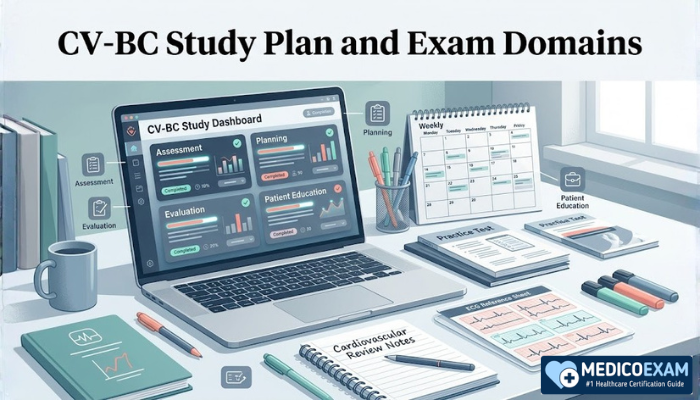 The ANCC Cardiac-Vascular Nursing Board Certification (CV-BC) validates specialized knowledge in caring for patients with heart and vascular conditions. The exam contains 150 questions (125 scored plus 25 unscored pretest items), allows 3 hours, and costs $395 for non-members or $295 for ANA members. With cardiovascular disease causing 919,032 deaths in the United States in 2023 alone — roughly 1 in every 3 deaths — demand for certified CV nurses continues to grow (CDC Heart Disease Facts). This guide covers every detail you need to earn the CV-BC credential in 2026.