
FNP-BC vs AGPCNP-BC: Which NP Certification Should You Choose?
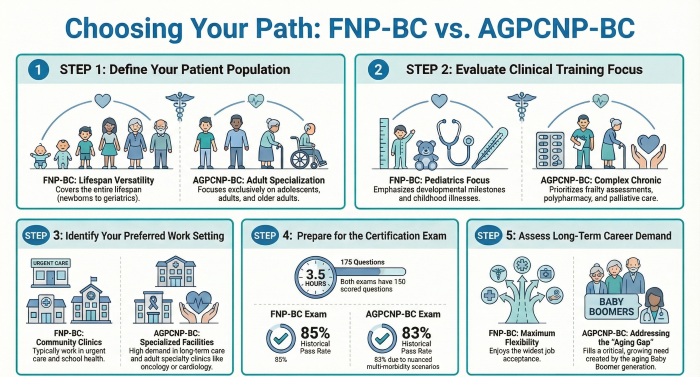
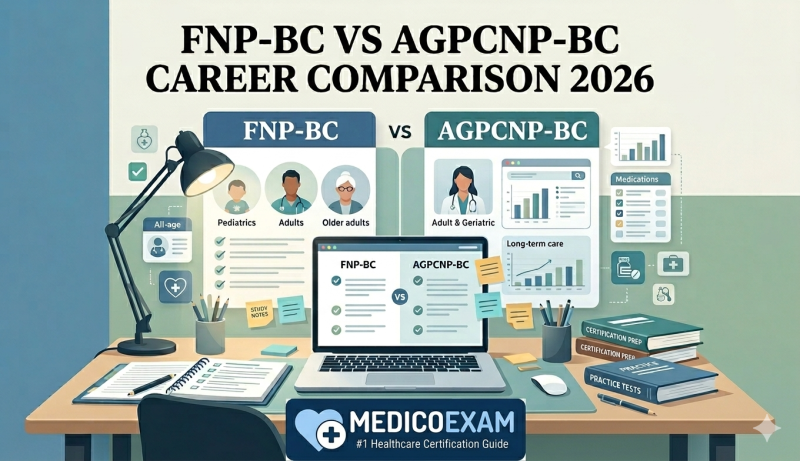 The single most important differentiator between the FNP-BC and AGPCNP-BC is patient population. Family Nurse Practitioners (FNP-BC) are trained to treat patients across the entire lifespan from newborns to elderly adults. Adult-Gerontology Primary Care Nurse Practitionners (AGPCNP-BC) specialize exclusively in adolescents, adults, and older adults. This one distinction shapes your clinical settings, job options, and career trajectory for decades. Both credentials are administered by the American Nurses Credentialing Center (ANCC), both share a projected 40% job growth rate through 2034, and both offer a median salary of $132,050. The right choice depends entirely on who you want to treat.
Key Facts Box
-
Certifying Body: Both administered by the ANCC
-
FNP-BC Population: Birth to death (entire lifespan)
-
AGPCNP-BC Population: Adolescents (age 13+), adults, and older adults
-
Median NP Salary: $132,050 annually
-
Job Growth: 40% projected (2024–2034)
-
Exam Format: Both are 175 questions, 3.5 hours
-
Full Practice Authority: 27 states + D.C. grant NPs independent practice
FNP-BC vs AGPCNP-BC: Side-by-Side Comparison Table
| Criteria | FNP-BC (Family NP) | AGPCNP-BC (Adult-Gerontology NP) |
|---|---|---|
| Patient Population | Birth through death (full lifespan) | Adolescents (13+), adults, and older adults |
| Pediatric Training | Required — significant curriculum focus | None |
| Geriatric Training | General coverage across lifespan | Deep specialization: frailty, polypharmacy, palliative care, end-of-life |
| Typical Practice Settings | Family practice, urgent care, retail clinics, rural health, school-based clinics | Internal medicine, geriatrics, long-term care, adult specialty clinics |
| Exam Questions | 175 (150 scored, 25 pretest) | 175 (150 scored, 25 pretest) |
| Exam Time | 3.5 hours | 3.5 hours |
| Exam Cost | $295 (ANA member) / $395 (non-member) | $295 (ANA member) / $395 (non-member) |
| Historical Pass Rate | ~85% | ~83% |
Sources:
What Is the FNP-BC Certification?
The FNP-BC (Family Nurse Practitioner — Board Certified) is the most popular nurse practitioner credential in the United States. Nearly 8 in 10 nurse practitioners are certified as either FNPs or AGPCNPs, with FNPs representing the majority. The FNP-BC is designed for NPs who want to provide primary care across the entire lifespan, from newborn well-child visits to geriatric chronic disease management.
FNP programs include extensive pediatric content: developmental milestones, childhood immunization schedules, growth chart interpretation, common childhood illnesses (otitis media, strep pharyngitis, asthma), and adolescent health. This training enables FNPs to work in any clinical setting that treats patients of any age — family medicine offices, urgent care centers, school-based health clinics, retail clinics, emergency room fast-track departments, and community health centers.
The FNP-BC exam consists of 175 questions (150 scored) administered over 3.5 hours. Content domains include Assessment (21%), Diagnosis (26%), Clinical Management (43%), and Professional Role (10%). The broad scope of this exam means candidates must know pharmacology, pathophysiology, and clinical guidelines for conditions affecting infants, children, pregnant women, adults, and elderly patients. The historical pass rate is approximately 85%.
For nurses who value maximum career flexibility and want to keep all doors open, the FNP-BC is the default choice. It is the most widely accepted NP credential in the U.S. job market.
What Is the AGPCNP-BC Certification?
The AGPCNP-BC (Adult-Gerontology Primary Care Nurse Practitioner — Board Certified) is a specialized credential for NPs who focus exclusively on adolescent, adult, and older adult primary care. It sacrifices pediatric and obstetric breadth in exchange for significantly deeper expertise in complex adult disease management, geriatric syndromes, and aging-related care.
AGPCNP programs dedicate substantially more hours to adult chronic disease management — hypertension, heart failure, COPD, diabetes, arthritis, dementia — and to geriatric-specific topics including frailty assessment, polypharmacy management, fall prevention, palliative care, and end-of-life decision-making. As the Baby Boomer generation continues to age, AGPCNPs fill a critical gap in the healthcare system that generalist providers cannot.
The AGPCNP-BC exam also contains 175 questions (150 scored) over 3.5 hours. The exam emphasizes complex adult pathophysiology, chronic disease management, and gerontological care in greater depth than the FNP-BC. The historical pass rate is approximately 83% — slightly lower than the FNP-BC, which may reflect the exam's focus on nuanced clinical scenarios involving multi-morbidity in aging patients.
AGPCNPs are in unprecedented demand in long-term care facilities, skilled nursing facilities, home health agencies, internal medicine practices, and adult specialty clinics (cardiology, endocrinology, oncology). Their specialized training makes them ideally suited for settings where every patient is an adult with complex, chronic conditions.
How Do Their Patient Populations Differ?
This is the most operationally significant difference between the two credentials. The FNP-BC scope includes patients from birth through death. The AGPCNP-BC scope begins at adolescence (typically age 13) and extends through older adulthood. There is no pediatric component.
This distinction has real legal implications. If you hold an AGPCNP-BC and a 7-year-old child presents at your urgent care, you cannot treat that patient — it falls outside your scope of practice. Conversely, an FNP-BC can legally treat that same child, their teenager, and their grandmother in consecutive appointments. Because of this, many urgent care chains, retail clinics, and rural health centers exclusively hire FNPs to ensure they can serve all walk-in patients regardless of age.
However, the AGPCNP-BC's narrower population focus enables a level of depth that FNPs typically do not achieve in their generalist training. AGPCNPs spend more educational hours on managing patients with 5+ comorbidities, navigating complex drug interactions in patients on 10+ medications, and integrating palliative and end-of-life care into primary care practice.
How Do Scope of Practice Laws Affect Your Choice?
State-level scope of practice laws significantly affect both NP roles, but they do not differentiate between FNP-BC and AGPCNP-BC in terms of authority level. As of 2026, 27 states plus the District of Columbia grant NPs full practice authority — the ability to evaluate, diagnose, order tests, and prescribe medications (including controlled substances) without physician oversight or a collaborative agreement.
However, every state enforces a fundamental principle: you can only practice within the scope of your education and certification. An AGPCNP-BC in a full practice authority state still cannot legally treat a 5-year-old patient. An FNP-BC in a reduced practice authority state still needs a collaborative agreement with a physician but can treat patients of all ages within that agreement.
If you plan to work in a state with reduced or restricted practice authority, the choice between FNP and AGPCNP matters less for autonomy (both need physician oversight) and more for patient population access. If you plan to work in a full practice authority state — especially in a solo or independent practice setting — the FNP-BC offers broader population coverage.
Which Has Better Job Market Demand?
Both credentials share the same extraordinary job market, with a 40% projected growth rate from 2024 to 2034. However, the distribution of demand differs by setting:
FNP-BC demand is strongest in:
-
Urgent care centers (need providers for all ages)
-
Retail health clinics
-
Rural and underserved primary care (often the sole provider for entire communities)
-
School-based health centers
-
Family medicine group practices
AGPCNP-BC demand is strongest in:
-
Long-term care and skilled nursing facilities (aging population driving explosive growth)
-
Internal medicine and hospitalist groups
-
Geriatric specialty practices
-
Adult oncology, cardiology, endocrinology, and pulmonology clinics
-
Home health and hospice organizations
FNPs see slightly more total job postings because their scope covers a wider range of settings. AGPCNPs face virtually zero unemployment because the aging population crisis creates constant demand for providers specialized in complex adult care. Both roles are considered "shortage professions" by workforce analysts.
How Do Salaries Compare?
Overall, the median salary for both FNP-BC and AGPCNP-BC holders is nearly identical at approximately $132,050 per year. Salary differences between the two are driven more by setting, location, and experience than by the specific credential.
State-level variation is the largest salary factor. California NPs earn the highest average at $173,190, followed by New York at $148,410 and Oregon at $148,030. Even the lowest-paying states — Tennessee at $108,180 and Alabama at $109,650 — offer strong six-figure incomes.
NPs with 10–19 years of experience average $117,000, while entry-level NPs earn approximately $99,000. Practice setting also matters: NPs in private urgent care and specialty clinics tend to earn more than those in academic medical centers, which pay 8–12% less but offer stronger benefits and research opportunities.
AGPCNPs may have a slight edge in long-term care facility compensation, where specialized geriatric expertise commands premium pay. FNPs may earn more in high-volume urgent care settings with productivity bonuses.
Which Exam Is Harder?
Difficulty is subjective and depends on your clinical background and study approach. Both exams have 175 questions and a 3.5-hour time limit. The historical pass rate for the FNP-BC is approximately 85%, compared to approximately 83% for the AGPCNP-BC.
The FNP-BC exam tests broad knowledge across all age groups. You must memorize pediatric developmental milestones, normal vital sign ranges for each age group, childhood immunization schedules, pregnancy management, and geriatric care — all in one exam. The challenge is breadth.
The AGPCNP-BC exam tests deep knowledge of adult and geriatric pathophysiology. You will face questions about managing patients with 5+ comorbidities, complex polypharmacy decisions, distinguishing between types of dementia, and integrating palliative care. The challenge is depth and complexity.
If you are coming from a pediatric or family medicine clinical background, the FNP-BC may feel more natural. If you spent your clinical rotations in internal medicine or geriatrics, the AGPCNP-BC may align better with your experience.
“Choosing between FNP and AGPCNP comes down to who you want to treat. If you want the freedom to work in any urgent care where half your patients are kids with strep throat, you need FNP. If you want to deeply manage complex chronic conditions in aging adults, AGPCNP is your path.” — Jessica Wright, DNP, APRN
Choose FNP-BC If…
-
You want maximum career flexibility and the broadest possible scope of practice
-
You enjoy treating patients of all ages, including infants, children, and pregnant women
-
You plan to work in urgent care, retail clinics, or rural health where you must treat walk-in patients of any age
-
You want the most widely recognized NP credential in the U.S. job market
-
You may want to practice independently in a full practice authority state serving an entire community
-
You are drawn to family medicine and enjoy the variety of seeing a toddler and a grandparent in the same morning
Choose AGPCNP-BC If…
-
You have zero interest in pediatrics or obstetrics and want to specialize from day one
-
You are passionate about internal medicine, gerontology, or palliative care
-
You want to work in long-term care facilities, nursing homes, or adult specialty clinics (cardiology, oncology, endocrinology)
-
You are drawn to the complexity of managing multiple comorbidities and polypharmacy in aging populations
-
You want deeper training in end-of-life care, advance directive counseling, and hospice integration
-
You plan to round in skilled nursing or assisted living facilities where every patient is an adult with complex needs
Frequently Asked Questions (FAQ)
1. Can an FNP work in a nursing home or long-term care facility?
-
Yes. Because the FNP scope covers the entire lifespan, FNPs can legally treat geriatric patients in any setting. However, an AGPCNP has significantly more specialized training in geriatric syndromes, frailty, polypharmacy, and end-of-life care — making them the preferred hire in many long-term care organizations.
2. Can an AGPCNP treat a 12-year-old patient?
-
Generally, no. The AGPCNP scope begins at adolescence, typically defined as age 13 and older. Treating a patient younger than 13 falls outside the AGPCNP's educational preparation and scope of practice. Always consult your state board of nursing for specific age cutoffs in your jurisdiction.
3. Do FNPs earn more than AGPCNPs?
-
The median salaries are virtually identical at approximately $132,050. Salary differences are driven primarily by geographic location, practice setting, experience, and negotiation — not by the specific NP credential.
4. Are both exams administered by the ANCC?
-
Yes. The ANCC administers both the FNP-BC and the AGPCNP-BC. The American Academy of Nurse Practitioners Certification Board also offers alternative FNP and AGNP certification exams that are widely accepted.
5. Can I get dual certified in both FNP-BC and AGPCNP-BC?
-
Yes, though it is uncommon and typically unnecessary. If you already hold AGPCNP-BC and want to add pediatric capabilities, you would return to school for a post-master's certificate in family nursing to fulfill the pediatric clinical hour requirements before sitting for the FNP-BC exam.
6. Which credential is better for starting an independent practice?
-
In full practice authority states, the FNP-BC offers broader patient access since you can treat all ages. If you plan to open a geriatrics-focused practice, the AGPCNP-BC signals deeper specialization to referral sources and patients. Choose based on your target patient population.
7. How do renewal requirements compare?
-
Both credentials require identical renewal: 75 continuing education hours (including 25 in pharmacotherapeutics), an active RN license, and fulfillment of an ANCC professional development category — all within a 5-year certification cycle.
8. Which credential has higher long-term job security?
-
Both enjoy exceptional job security with 40% projected growth through 2034. FNPs have slightly more total job postings due to urgent care and retail clinic demand. AGPCNPs face virtually zero unemployment because the aging Baby Boomer population creates constant, growing demand for adult-specialized NPs. Neither credential carries meaningful unemployment risk in the current or projected market.
Ace Your Chosen NP Exam
Whether you choose to treat the whole family or specialize in adult and geriatric care, passing the board exam is your final step to clinical autonomy. Both exams demand mastery of advanced pharmacology, diagnostic reasoning, and clinical management.
Try MedicoExam's simulation-based practice tests for both FNP-BC and AGPCNP-BC to build exam-day confidence, identify weak domains, and pass on your first attempt.
Written by the MedicoExam Content Team — Healthcare Education Specialists at MedicoExam.com
Last Updated: April 2026
Disclaimer: This article is for informational purposes only. Scope of practice laws vary by state. Always consult your state board of nursing for current legal guidelines. MedicoExam does not provide leaked questions or exam recalls.
- ANCC Family Nurse Practitioner Practice Test |
- ANCC FNP-BC Question Bank |
- ANCC FNP-BC Eligibility & Requirements |
- ANCC FNP-BC Exam Cost |
- ANCC FNP-BC Registration Process |
- ANCC Family Nurse Practitioner Study Guide |
- ANCC FNP-BC Recertification |
- ANCC FNP-BC Certification Overview |
- ANCC AGPCNP-BC Question Bank |
- ANCC AGPCNP-BC Eligibility & Requirements |
- ANCC Adult-Gerontology PRIMARY Care Nurse Practitioner Practice Test |
- ANCC AGPCNP-BC Exam Cost |
- ANCC AGPCNP-BC Registration Process |
- ANCC Adult-Gerontology PRIMARY Care Nurse Practitioner Study Guide |
- ANCC AGPCNP-BC Recertification |
- ANCC AGPCNP-BC Certification Overview


