
Healthcare Certification Exam Renewal Guide: Deadlines & Recertification Tips
 Healthcare certifications are not permanent — every credential from CPC to CEN to FNP-BC requires periodic renewal through continuing education (CE), and missing a deadline can cost you hundreds of dollars in reinstatement fees or force you to retake an exam entirely. This guide covers the renewal requirements for all eight major healthcare certification bodies in 2026, including CE hour minimums, renewal fees, cycle lengths, and strategies for staying current without breaking the bank.
Key Facts: Healthcare Certification Renewal at a Glance
|
Data Point |
Detail |
|---|---|
|
Certification bodies covered |
AAPC, AHIMA, ANCC, BCEN, NREMT, NHA, CBIC, AANPCB |
|
Shortest renewal cycle |
2 years (AAPC, AHIMA, NHA, NREMT) |
|
Longest renewal cycle |
5 years (ANCC, AANPCB, CBIC) |
|
Lowest CE requirement |
10 CE credits (NHA) |
|
Highest CE requirement |
100 contact hours (AANPCB, BCEN) |
|
Lowest renewal fee |
$25 (NREMT EMT level) |
|
Highest renewal fee |
$445 (CBIC CIC — high-income countries, effective 2026) |
What Are the Renewal Requirements for Each Certification Body?
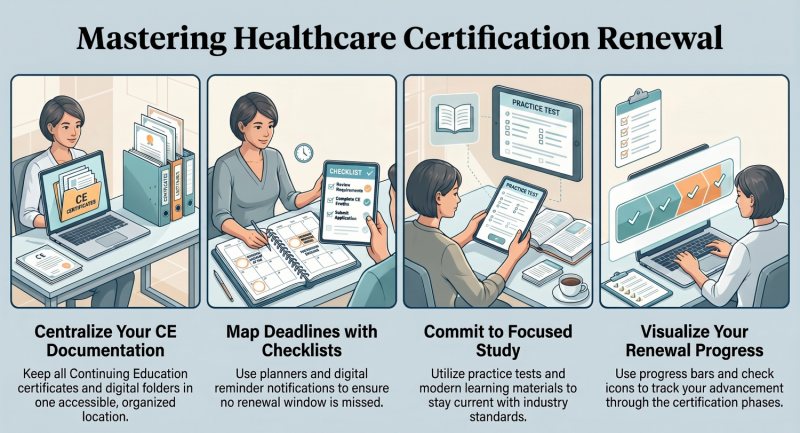
The requirements vary significantly across organizations. Below is a master comparison table followed by a detailed breakdown for each body. According to AAPC, AHIMA, ANCC, BCEN, NREMT, NHA, CBIC, and AANPCB, the following table summarizes each body's current policies.
Master Comparison Table: 2026 Certification Renewal Requirements
|
Certification Body |
Renewal Cycle |
CE Requirement |
Renewal Fee |
Special Conditions |
|---|---|---|---|---|
|
AAPC (CPC, COC, CRC, etc.) |
2 years |
36 CEUs (1 credential); up to 52 for 5+ credentials |
$229/year membership |
66% must be Curriculum A (core); CEUs reported every other year |
|
AHIMA (CCS, CCA, RHIT, RHIA) |
2 years |
20 CEUs (CCS, CCA, RHIT, CCS-P); 30 CEUs (RHIA, CHDA, CHPS, CDIP) |
Members: $100; Non-members: $249 |
80% of CEUs must relate to AHIMA's HIM domains; add 10 CEUs per additional credential (max 50) |
|
ANCC (FNP-BC, PMHNP-BC, AGPCNP-BC) |
5 years |
75 contact hours + 1 professional development category |
ANA members: $275; Non-members: $375 |
NPs/CNSs must complete 25 pharmacology hours within the 75; 60 of 75 must be formally approved |
|
BCEN (CEN, CPEN, CFRN, TCRN) |
4 years |
100 contact hours |
$280 (ENA members: $210) |
75 hours must be clinical; 50 from accredited sources; CE attestation or retake exam |
|
NREMT (EMR, EMT, AEMT, Paramedic) |
2 years |
EMT: 40 hours; AEMT: 50 hours; Paramedic: 60 hours |
EMT: $25; AEMT: $26; Paramedic: $32 |
Hours split into National, State/Local, and Individual components; CAPCE-approved education required |
|
NHA (CCMA, CPhT, CBCS, etc.) |
2 years |
10 CE credits (CPhT: 20 hours) |
$185 (additional certs: $60 each) |
Same 10 credits cover multiple certifications; CPhT requires 1 hour of pharmacy law |
|
CBIC (CIC) |
5 years |
40 IPUs (Infection Prevention Units) or re-examination |
$445 (high-income countries, effective 2026) |
Must cover 6 of 8 knowledge domains; 20 IPUs from accredited sources; portfolio submission by Dec. 1 |
|
AANPCB (FNP-C, AGPCNP-C, PMHNP) |
5 years |
100 contact hours + 1,000 practice hours |
AANP members: $120; Non-members: $195 |
25 hours must be pharmacology; practice hours in population focus of certification |
How Does AAPC Certification Renewal Work?
AAPC requires 36 CEUs every two years for holders of a single credential such as the CPC. According to AAPC's CEU policy, if you hold multiple certifications, the requirement scales: 40 CEUs for two credentials, 44 for three, 48 for four, and 52 for five or more. The requirement caps at 52 CEUs per cycle.
AAPC membership costs $229 per year, and you must maintain active membership to keep your certifications valid. CEUs are submitted every other year — either on even or odd years depending on your membership renewal month. At least 66% of your CEUs (two-thirds) must come from Curriculum A (core coding and billing content), while up to 33% can be Curriculum B (professional development topics like management or communication skills).
Free and low-cost AAPC CEU sources include:
-
AAPC the Magazine quizzes: 1 CEU per issue, totaling 12 per year
-
Free AAPC webinars: approximately 4 per year
-
CMS-sponsored webinars and workshops: 1 CEU per hour with attendance documentation
-
Local chapter meetings: CEU opportunities vary by chapter
If your membership lapses for more than 90 days without payment or CEU submission, your credential is revoked. A $50 extension fee applies if you need extra time to submit CEUs. Explore MedicoExam's AAPC practice resources to prepare for any AAPC exam.
What Are AHIMA's Recertification Requirements?
AHIMA credentials — including CCS, CCA, RHIT, and RHIA — follow a two-year recertification cycle. The CEU requirement depends on your credential level. According to AHIMA's recertification information, CCS, CCA, CCS-P, and RHIT holders need 20 CEUs per cycle, while RHIA, CHDA, CHPS, and CDIP holders need 30 CEUs. Holding additional credentials adds 10 CEUs each, up to a maximum of 50.
At least 80% of your CEUs must relate to one of AHIMA's specified Health Information Management (HIM) domains. For AHIMA members, the recertification fee is $100 for a single credential. Non-members pay $249 per credential cycle, with each additional credential costing $50. A late fee of $50 per credential applies if you miss your deadline. If your certification lapses entirely, reinstatement costs $368 per credential.
AHIMA members receive complimentary CEUs as part of their membership, and journal quizzes and webinars provide affordable options for meeting requirements. Visit MedicoExam's AHIMA section for practice tests to maintain your coding and HIM knowledge.
How Do You Renew an ANCC Nursing Certification?
ANCC certifications — including FNP-BC, PMHNP-BC, and AGPCNP-BC — must be renewed every five years. According to the ANCC Certification Renewal Handbook and renewal page, renewal requires 75 contact hours of CE plus completion of at least one professional development category from a list of eight options (such as academic credit, publications, research, professional presentations, preceptorship, or 1,000 practice hours).
All NPs and CNSs must complete 25 hours of pharmacology within their 75 required contact hours. At least 60 of the 75 hours must be formally approved — meaning they come from an accredited nursing or medical education provider. Repeat courses cannot be counted, and all content must be directly related to your certification specialty.
Renewal fees depend on membership status. ANA members pay $275, AANP members pay $295, and non-members pay $375. An expired certification can be reactivated for an additional $125 reactivation fee, but certifications expired for two or more years require retesting.
ANCC conducts random audits. You should maintain all CE documentation through your next renewal cycle. Prepare for ANCC certification exams with MedicoExam's simulation-based practice tests.
What Does BCEN Recertification Require?
BCEN certifications such as the CEN (Certified Emergency Nurse), CPEN, CFRN, CTRN, and TCRN are valid for four years. Recertification requires either 100 contact hours of nursing continuing education or passing the certification exam again. According to BCEN's recertification guidelines, at least 75 of the 100 contact hours must be clinical content specific to your specialty, and at least 50 hours must come from accredited sources such as ANCC, ENA, AACN, or ASTNA.
The recertification fee is $280 at full price, with ENA members receiving a discount to $210 and military members paying $195. BCEN uses a CE attestation model — you affirm that you have completed the required hours. However, BCEN audits 10% of renewal applications and requires proof of all 100 contact hours within 30 days if selected.
All education must be at the nursing practice level or higher. BCEN does not accept CE credits approved solely by EMS providers such as CAPCE. For resources to prepare for your BCEN certification, visit MedicoExam.
How Does NREMT Recertification Work for EMS Providers?
According to the National Registry of Emergency Medical Technicians recertification guide, NREMT certifications must be renewed every two years. The CE requirements follow the National Continued Competency Program (NCCP) and scale by certification level: EMTs need 40 hours, AEMTs need 50 hours, and Paramedics need 60 hours. EMR recertification requires a separate set of hours on a different cycle.
CE hours are divided into three components:
-
National Component: prescribed core topics (Airway, Cardiovascular, Trauma, Medical, and Operations) — 20 hours for EMTs, 25 for AEMTs, 30 for Paramedics
-
State/Local Component: trauma, pediatric, stroke care, and cardiac (Paramedic) — 10 hours for EMTs, 12.5 for AEMTs, 15 for Paramedics
-
Individual Component: elective topics — 10 hours for EMTs, 12.5 for AEMTs, 15 for Paramedics
According to NREMT's recertification dates page, EMT/AEMT/Paramedic certifications expire on March 31 of the expiration year. The CE application window opens October 1 (six months before expiration). Recertification fees are among the lowest in healthcare: $25 for EMTs, $26 for AEMTs, and $32 for Paramedics. Late renewal incurs a $50 reinstatement fee during the one-month grace period (April for EMTs). After the grace period, you must retake the cognitive exam ($104 for EMT, $136 for AEMT, $160 for Paramedic).
All CE must be approved by the Commission on Accreditation for Prehospital Continuing Education (CAPCE) or a state EMS office. As of 2022, there are no limits on distributive (online/pre-recorded) education hours.
What Is Required to Renew NHA Certifications?
NHA certifications — including the CCMA, CBCS, and CPhT — follow a two-year renewal cycle. According to NHA's renewal page, the standard requirement is just 10 CE credits, making NHA one of the simplest certifications to maintain. If you hold multiple NHA certifications, you still only need 10 CE credits total — the same 10 credits apply to all your NHA credentials.
The renewal fee is $185, with each additional certification costing $60. CPhT (Certified Pharmacy Technician) holders have a higher CE requirement of 20 hours, including at least 1 hour of pharmacy law.
NHA offers its own CE library through the nhanow.com platform, and you can also earn credits from external sources and upload documentation. If your certification expired less than 30 days ago, you can renew normally. Between 30 days and one year past expiration, reinstatement requires 15 CE credits plus a $99 reinstatement fee (total: $376.50). After one year, you must retake the certification exam.
Visit MedicoExam's NHA section for practice tests and study resources.
How Do You Recertify a CBIC CIC Certification?
The CIC (Certification in Infection Control) from CBIC is valid for five years. According to CBIC, effective January 1, 2026, CIC holders can recertify either by retaking the proctored exam or by submitting a portfolio of 40 Infection Prevention Units (IPUs). This dual pathway is a significant update — prior to 2026, the CIC could only be renewed through re-examination.
According to the CBIC 2026 fee schedule, the CIC recertification fee (by exam or IPU portfolio) is $445 for candidates in high-income countries. The IPU portfolio requires at least 40 units earned during the five-year certification period, with a minimum of 20 IPUs from accredited sources. Portfolio submissions must cover at least 6 of the 8 CIC knowledge domains. Portfolios are due by December 1 of the recertification year, with a late submission window until November 30 (plus a 25% late fee). According to CBIC's IPU FAQ, 1 hour of approved education equals 1 IPU (a 1:1 conversion from CNEs/CMEs).
Current CIC holders due to recertify between 2025 and 2029 receive prorated IPU requirements since the CE pathway is new. For 2026 expirations, only 12 IPUs are required.
What Are AANPCB's Recertification Requirements?
AANPCB certifications — including the FNP-C, AGPCNP-C, ENP-C, and PMHNP — are valid for five years. According to AANPCB's recertification page, renewal through practice hours and CE requires a minimum of 1,000 practice hours as an NP in the population focus of your certification, plus 100 contact hours of advanced CE. Of those 100 hours, at least 25 must be in advanced practice pharmacology.
Practice hours now include direct patient care, administrative roles overseeing advanced practice providers, educational roles in NP programs, and research activities — a policy expansion effective April 2023. Up to 25 non-pharmacology CE credits can be replaced by clinical preceptor hours (maximum 120 preceptor hours to replace 25 CE credits).
According to AANPCB's fee schedule, recertification by practice hours and CE costs $120 for AANP members and $195 for non-members. Recertification by examination costs $240 (members) or $315 (non-members). Paper applications add a $50 processing fee. Email reminders are sent at 1 year, 6 months, and 6 weeks before expiration.
Prepare for AANPCB certification exams with MedicoExam practice questions.
Where Can You Earn CE Credits Affordably?
Continuing education does not have to be expensive. Here are proven CE sources across certification types:
Free and Low-Cost Options:
-
Certification body resources: AAPC the Magazine quizzes (12 free CEUs/year), AAPC webinars (4 free/year), AHIMA member webinars, and NHA's built-in CE library
-
CMS-sponsored training: Free webinars and workshops from CMS national and MAC offices earn 1 CEU per hour for AAPC members
-
Employer in-service training: Many healthcare employers provide approved CE through internal training programs
-
Professional conferences: Organizations like ENA, APIC, AANP, and AHIMA hold annual conferences with large CE offerings
-
Academic coursework: ANCC converts 1 semester credit to 15 contact hours; AAPC awards 10 CEUs per credit hour
-
Local chapter meetings: AAPC and AHIMA local chapters often host affordable CE events
-
Payer-sponsored training: Medicare Administrative Contractors like Novitas and Noridian offer free coding education
Paid CE Providers:
-
Organization-specific platforms (BCEN Learn, NHA CE Library, AAPC's online courses)
-
Third-party CE providers accredited by the relevant body
-
University extension programs and online healthcare education platforms
"The biggest mistake I see professionals make is waiting until the last two months of their renewal cycle to start earning CEs," says Dr. Patricia Gonzalez, DNP, FNP-BC, a nurse practitioner and CE program director. "Spread your learning across the entire cycle — you'll retain more, stress less, and never face a last-minute scramble."
What Are the Best Tips for Tracking CE Credits?
Staying organized prevents costly lapses. Follow these strategies:
-
Use your certification body's built-in tracker. AAPC, NHA, BCEN, and ANCC all offer online CE tracking within your member account. Log credits immediately after completion.
-
Set calendar reminders. Add your renewal deadline and six-month/three-month warning dates to your calendar the day you receive or renew a certification.
-
Upload certificates immediately. Do not wait — scan or download every CE certificate and upload it to your tracker or save it in a dedicated folder. AAPC audits 25% of submissions. BCEN audits 10%.
-
Create a spreadsheet backup. Track the date, provider, topic, credit hours, and certificate location for each activity. This is invaluable during audits.
-
Front-load your CE hours. Complete at least half your required hours in the first year of your cycle. This creates a buffer for unexpected busy periods.
-
Check domain requirements early. CBIC requires 6 of 8 domains. AAPC requires 66% Curriculum A. AHIMA requires 80% HIM-related. Know these rules before you start accumulating credits.
-
Verify accreditation before attending. AAPC CEUs must come from AAPC-approved vendors with an index number. ANCC hours must be from accredited nursing CE providers. A course approved by one body may not count for another.
-
Leverage dual-credit opportunities. Some programs are approved by multiple bodies simultaneously (e.g., courses approved by both ANCC and BCEN). This is especially useful if you hold certifications from different organizations.
Renewal Deadlines Calendar: Key Dates to Know
|
Certification Body |
Renewal Cycle |
Deadline Details |
|---|---|---|
|
AAPC |
Every 2 years |
Based on membership renewal month; CEUs due every other year by membership expiration date |
|
AHIMA |
Every 2 years |
Based on individual recertification cycle dates; check MyAHIMA hub |
|
ANCC |
Every 5 years |
Renewal can be submitted up to 1 year before expiration |
|
BCEN |
Every 4 years |
Check My Dashboard in BCEN account for your specific dates |
|
NREMT (EMT/AEMT/Paramedic) |
Every 2 years |
Application window: Oct 1 – Mar 31; grace period with $50 fee: April 1–30 |
|
NHA |
Every 2 years |
Specific to date of initial certification; 30-day grace period after expiration |
|
CBIC (CIC) |
Every 5 years |
IPU portfolio due Dec 1; exam must be passed by Dec 31 of expiration year |
|
AANPCB |
Every 5 years |
Reminders sent at 1 year, 6 months, and 6 weeks before expiration |
Frequently Asked Questions
1. What happens if I let my healthcare certification expire?
Consequences vary by body. AAPC revokes credentials after 90 days without payment or CEUs. AHIMA moves certifications to inactive status with a $50 late fee option, or $368 for full reinstatement. NHA allows reinstatement within one year for $376.50 but requires retesting after one year. NREMT requires retaking the cognitive exam if you miss the grace period. ANCC charges a $125 reactivation fee for expired certifications.
2. Can I earn CE credits from a different certification body?
Not automatically. AAPC does not accept AHIMA-approved CEUs unless the program also has AAPC approval with an index number. BCEN does not accept CE approved solely by EMS providers like CAPCE. However, many programs carry dual accreditation. Always verify that the specific course is approved by your certification body.
3. How much does it cost to renew all my certifications annually?
The total cost varies. AAPC members pay $229/year for membership (covers all credentials). AHIMA members pay $100 per two-year cycle. NHA charges $185 every two years. NREMT costs as little as $25 per cycle. ANCC and AANPCB run $120–$375 every five years. Budget $150–$500 per year depending on which certifications you hold.
4. Do CE credits carry over to the next renewal cycle?
For most bodies, no. AAPC explicitly states that excess CEUs do not roll over. BCEN requires all 100 hours to be earned within the current four-year cycle. NREMT CE must be completed within the current certification cycle. Always verify your specific body's carry-over policy.
5. Can I renew my certification by retaking the exam instead of completing CE?
Yes, for several bodies. BCEN offers recertification by exam as an alternative to 100 contact hours. NREMT allows recertification by examination. CBIC's CIC can be renewed by retaking the initial proctored exam. AANPCB also allows recertification by exam. AAPC and NHA require CEUs and do not offer an exam-only renewal pathway.
6. Are pharmacology CE hours required for nursing certifications?
Yes. Both ANCC and AANPCB require 25 hours of pharmacology CE out of their total requirements (75 hours for ANCC, 100 hours for AANPCB). These pharmacology hours must be specific to advanced practice and completed within the certification period.
7. What CE tracking tools do certification bodies provide?
AAPC offers a CEU Tracker within your online account. NHA tracks CE through its launchpad at nhanow.com. BCEN provides a CE Tracker tool. ANCC uses a My Account Professional Development Record. AHIMA tracks through the MyAHIMA hub CEU center. CBIC accepts IPU documentation through its online portfolio system.
8. How often are CE submissions audited?
AAPC audits 25% of all CEU submissions randomly. BCEN audits 10% of renewal applications. ANCC conducts random audits of renewal applications. AHIMA requires documentation to be uploaded and retained. Always keep original certificates for at least one full renewal cycle after submission.
9. Can employer-provided training count toward CE requirements?
In many cases, yes. AAPC accepts employer in-service training if pre-approved with an AAPC index number. NHA accepts external CE with uploaded documentation. NREMT accepts training approved by CAPCE or state EMS offices. The training must meet the specific approval criteria of your certification body — informal on-the-job learning typically does not count.
10. What is the cheapest way to maintain healthcare certifications?
Maximize free resources: AAPC magazine quizzes (12 free CEUs/year), CMS webinars, local chapter meetings, AHIMA member CEUs, and employer-sponsored training. NHA's 10-credit requirement can often be met through the free NHA CE library. For nursing certifications, check whether your employer provides ANCC-accredited education as part of professional development.
Start Preparing Today with MedicoExam
Whether you are preparing for your first certification exam or studying to stay sharp for renewal, simulation-based practice tests are one of the most effective ways to reinforce your knowledge. MedicoExam offers practice exams for AAPC, AHIMA, ANCC, BCEN, NHA, and AANPCB certifications. Practicing regularly throughout your renewal cycle keeps your skills current and can double as effective CE preparation.
Visit MedicoExam.com to explore practice tests across all major healthcare certification bodies.
Disclaimer: This article is for informational purposes only. Always verify current requirements directly with your certification body's official website. MedicoExam does not provide actual certification exam questions and has no affiliation with AAPC, AHIMA, ANCC, BCEN, NREMT, NHA, CBIC, or AANPCB.
Written by the MedicoExam Content Team — Healthcare Education Specialists at MedicoExam.com
Last Updated: April 2026


