Explore 7 resources related to AHIMA on MedicoExam. These resources help certification candidates understand key aspects of exam preparation, including exam structure, study strategies, and expectations for scenario-based or applied assessments. Reviewing these materials can help improve readiness and confidence before attempting the certification exam.
Failing a healthcare certification exam does not end your career — it redirects your preparation. Thousands of candidates fail certification exams every year, with first-attempt pass rates ranging from 50% to 91% depending on the exam, and the vast majority pass on their second or third try using a focused retake strategy.
This guide covers retake policies for every major certification body, explains how to analyze your score report, and gives you a step-by-step recovery study plan. Whether you failed the CPC, CCS, FNP-BC, CEN, NREMT, CCMA, or any other healthcare exam, this recovery framework will get you back on track.
Healthcare certification exams use hundreds of specialized terms, abbreviations, and acronyms that can overwhelm first-time candidates. This glossary defines over 150 healthcare certification terms organized by category — covering 12 major certification bodies, dozens of credential abbreviations, exam-day terminology, study and prep concepts, and career and salary terms used across the healthcare credentialing landscape.
Whether you are preparing for the CPC, CCS, FNP-BC, CCMA, or any other healthcare credential, this reference guide ensures you understand every term you encounter during your certification journey.
"Understanding the language of certification is the first step toward exam success. Candidates who know exactly what terms like CAT, CEU, and NCCA mean before they start studying are already ahead." — Dr. Lisa Hernandez, DNP, RN, Healthcare Education Consultant
What Are the Major Healthcare Certification Bodies?
The United States has 12 primary healthcare certification bodies that administer credentials across medical coding, nursing, allied health, respiratory therapy, emergency medicine, infection control, and clinical research. Each organization sets its own eligibility requirements, exam formats, and renewal standards.
The right healthcare certification depends on your career stage, professional field, budget, and available study time. This decision framework walks you through a five-step process to identify the certification that delivers the highest return on investment for your situation.
According to the Bureau of Labor Statistics, healthcare is projected to grow 8.4% from 2024 to 2034, adding roughly 2.0 million new jobs. Certified professionals consistently earn more: AAPC salary data shows certified medical coders earn approximately 8.5% more than non-certified counterparts, while clinical research employers report paying 15–25% higher salaries to credentialed professionals.
Practice testing is the single most effective study strategy for healthcare certification exams, according to over a century of cognitive science research. Retrieval practice — the act of pulling information from memory rather than passively reviewing it — improves long-term retention by more than 150% compared to repeated studying, and simulation-based practice exams let you apply that science in a format that mirrors your actual test day.
Healthcare certifications are not permanent — every credential from CPC to CEN to FNP-BC requires periodic renewal through continuing education (CE), and missing a deadline can cost you hundreds of dollars in reinstatement fees or force you to retake an exam entirely. This guide covers the renewal requirements for all eight major healthcare certification bodies in 2026, including CE hour minimums, renewal fees, cycle lengths, and strategies for staying current without breaking the bank.
Key Facts: Healthcare Certification Renewal at a Glance
Your healthcare certification exam day determines months of preparation — and the logistics matter as much as the studying. This universal checklist covers every major testing platform used by healthcare certification bodies in 2026, including Pearson VUE, PSI, and OnVUE remote proctoring. Whether you are sitting for the CPC, NCLEX-RN, FNP-BC, CCMA, or any other healthcare credential, follow this checklist to walk in prepared and walk out confident.
Key Facts: Healthcare Certification Exam Day at a Glance
Testing Platforms: Pearson VUE, PSI, Prometric, and OnVUE remote proctoring
Arrival Time: 30 minutes before your scheduled appointment at in-person centers
ID Required: 1–2 forms of valid, unexpired ID depending on sponsor policy
Prohibited Items: Mobile phones, smartwatches, notes, food/drinks in the testing room
Check-in Process: Photo capture, digital signature, and biometric scan where applicable
Result Delivery: Ranges from immediate to 7–10 business days depending on certification body
Remote Testing Option: Available for select exams via OnVUE with webcam, microphone, and stable internet
There are over 35 major healthcare certification exams in the United States in 2026, administered by 12 certification bodies spanning medical coding, nursing, allied health, respiratory therapy, emergency medical services, clinical research, and infection control. This database compiles every exam's cost, format, pass rate, renewal period, and eligibility requirements in one place — the most comprehensive single-source reference available for healthcare professionals planning their certification journey.
Whether you are a medical coding student evaluating AAPC credentials, a nurse practitioner comparing ANCC and AANPCB options, or an allied health professional exploring NHA certifications, this guide provides the verified data you need to make an informed decision.
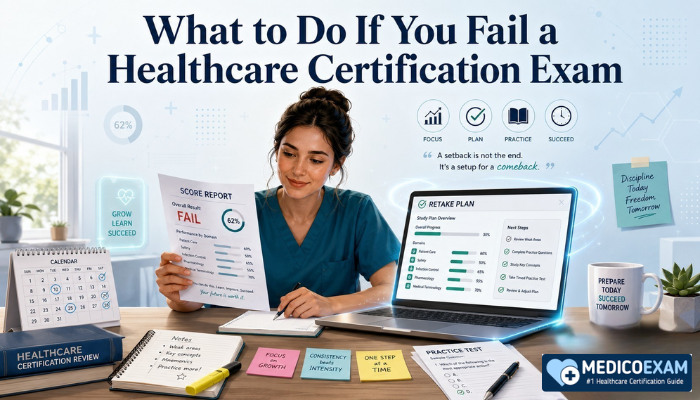 Failing a healthcare certification exam does not end your career — it redirects your preparation. Thousands of candidates fail certification exams every year, with first-attempt pass rates ranging from 50% to 91% depending on the exam, and the vast majority pass on their second or third try using a focused retake strategy.
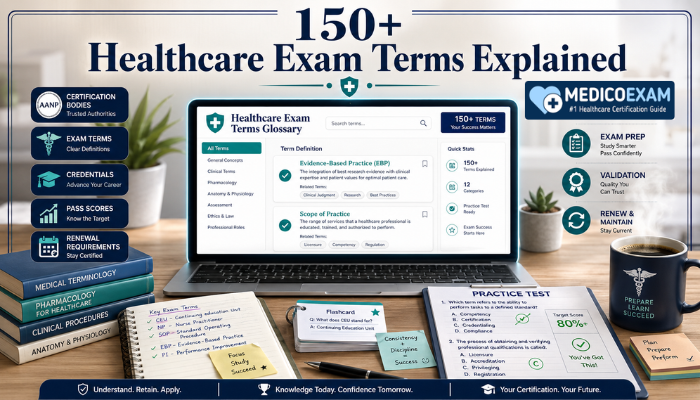 Healthcare certification exams use hundreds of specialized terms, abbreviations, and acronyms that can overwhelm first-time candidates. This glossary defines over 150 healthcare certification terms organized by category — covering 12 major certification bodies, dozens of credential abbreviations, exam-day terminology, study and prep concepts, and career and salary terms used across the healthcare credentialing landscape.
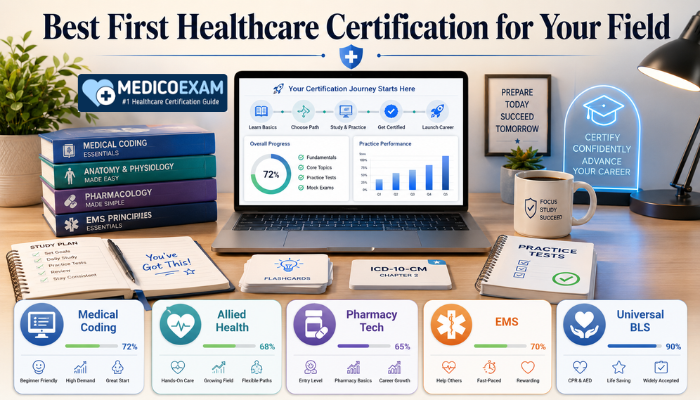 The right healthcare certification depends on your career stage, professional field, budget, and available study time. This decision framework walks you through a five-step process to identify the certification that delivers the highest return on investment for your situation.
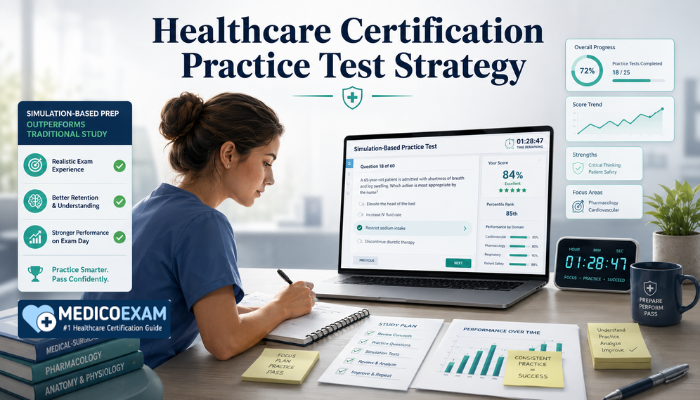 Practice testing is the single most effective study strategy for healthcare certification exams, according to over a century of cognitive science research. Retrieval practice — the act of pulling information from memory rather than passively reviewing it — improves long-term retention by more than 150% compared to repeated studying, and simulation-based practice exams let you apply that science in a format that mirrors your actual test day.
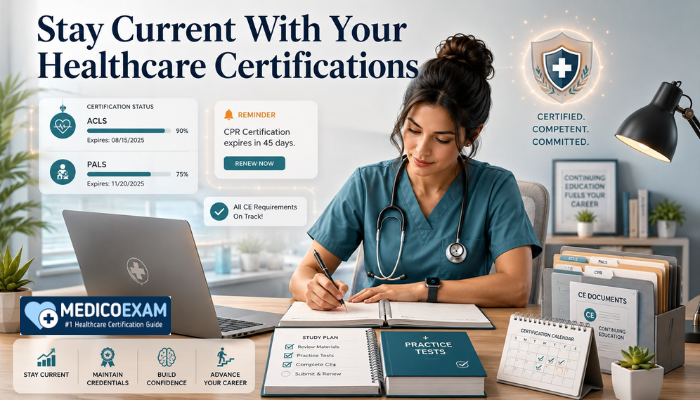 Healthcare certifications are not permanent — every credential from CPC to CEN to FNP-BC requires periodic renewal through continuing education (CE), and missing a deadline can cost you hundreds of dollars in reinstatement fees or force you to retake an exam entirely. This guide covers the renewal requirements for all eight major healthcare certification bodies in 2026, including CE hour minimums, renewal fees, cycle lengths, and strategies for staying current without breaking the bank.
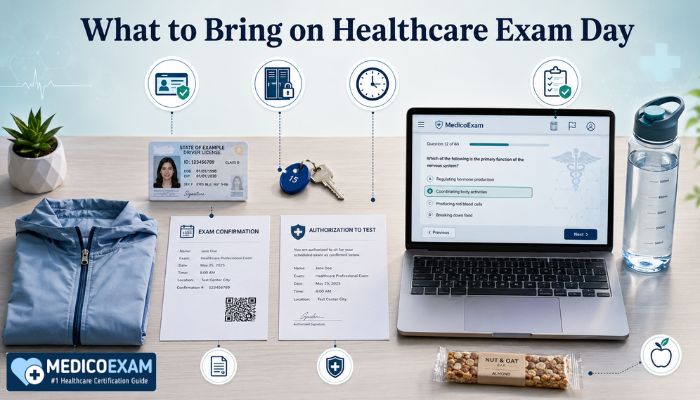 Your healthcare certification exam day determines months of preparation — and the logistics matter as much as the studying. This universal checklist covers every major testing platform used by healthcare certification bodies in 2026, including Pearson VUE, PSI, and OnVUE remote proctoring. Whether you are sitting for the CPC, NCLEX-RN, FNP-BC, CCMA, or any other healthcare credential, follow this checklist to walk in prepared and walk out confident.
 There are over 35 major healthcare certification exams in the United States in 2026, administered by 12 certification bodies spanning medical coding, nursing, allied health, respiratory therapy, emergency medical services, clinical research, and infection control. This database compiles every exam's cost, format, pass rate, renewal period, and eligibility requirements in one place — the most comprehensive single-source reference available for healthcare professionals planning their certification journey.


