
Healthcare Certification Practice Test Strategy: Why Simulation-Based Prep Works
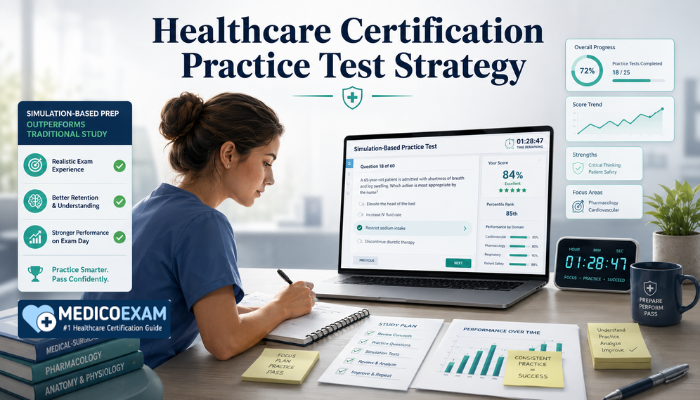 Practice testing is the single most effective study strategy for healthcare certification exams, according to over a century of cognitive science research. Retrieval practice — the act of pulling information from memory rather than passively reviewing it — improves long-term retention by more than 150% compared to repeated studying, and simulation-based practice exams let you apply that science in a format that mirrors your actual test day.
Key Facts: Practice Testing by the Numbers
| Metric | Data |
|---|---|
| Retention improvement from retrieval practice vs. restudying | 150%+ after 1 week (Karpicke & Roediger, 2008) |
| Forgetting without retrieval practice | 75% of material lost within 6 days (Ebbinghaus, 1885; replicated Murre & Dros, 2015) |
| Dunlosky (2013) utility rating for practice testing | "High utility" — most effective of 10 strategies reviewed |
| NCSBN simulation study outcome | Up to 50% of clinical hours replaced by simulation with equivalent results |
| First-attempt pass rate with 3+ practice exams | Up to 94% (industry benchmark data) |
| Recommended practice test score before exam day | 85%+ consistently on full-length timed exams |
| Students who use retrieval practice while studying | Only 11% (Karpicke, Butler, & Roediger, 2009) |
What Is the Testing Effect, and Why Does It Matter for Certification Prep?
The testing effect is a well-documented cognitive phenomenon: actively retrieving information from memory strengthens that memory far more than passively re-reading or highlighting the same material. This is not a marginal improvement — it is one of the largest effects in all of learning science.
In a landmark 2008 study published in Science, researchers Karpicke and Roediger found that students who used repeated retrieval practice recalled approximately 80% of learned material after one week, while students who dropped items from further testing recalled only 33–36%. That gap — a greater-than-150% improvement — held even though both groups showed identical learning curves during the initial study session. The researchers concluded: "Repeated retrieval practice enhanced long-term retention, whereas repeated studying produced essentially no benefit."
A comprehensive 2013 review by Dunlosky and colleagues, published in Psychological Science in the Public Interest, evaluated 10 common study techniques and rated practice testing as one of only two strategies earning a "high utility" designation. The review noted that practice testing "can help students regardless of age" and "boost student achievement" across a wide range of materials and testing formats.
Despite this evidence, only 11% of students report using retrieval practice while studying, according to a 2009 survey by Karpicke, Butler, and Roediger published in Memory. The majority — 55% — default to rereading notes, a strategy with limited long-term benefit. For healthcare certification candidates, this gap between what works and what most people do represents a major opportunity.
How Does Simulation-Based Prep Compare to Traditional Study Methods?
Simulation-based practice — completing timed, exam-format questions that replicate real testing conditions — outperforms traditional study methods across every measurable outcome. The table below summarizes the key differences.
| Factor | Traditional Study (Rereading, Highlighting, Flashcards) | Simulation-Based Practice Tests |
|---|---|---|
| Cognitive mechanism | Passive review; recognition-based | Active retrieval; recall-based |
| Long-term retention after 1 week | 40–42% (Roediger & Karpicke, 2006) | 56–61% (Roediger & Karpicke, 2006) |
| Time management training | None | Built into timed exam format |
| Anxiety reduction | Minimal | Significant — familiarity with test conditions |
| Weak-area identification | Subjective self-assessment | Objective, data-driven domain scores |
| Dunlosky (2013) utility rating | Low (highlighting) to moderate (flashcards) | High (practice testing) |
| Feedback loop | Delayed or absent | Immediate, with answer explanations |
The 2006 study by Roediger and Karpicke, published in Psychological Science, demonstrated this clearly. Students who re-read a prose passage recalled 81% on an immediate test — but only 42% after one week. Students who took a practice test instead recalled 75% immediately but retained 56% after one week. Testing produced 33% more retention on the delayed measure, even though it looked worse in the short term.
In healthcare education specifically, simulation has earned strong institutional support. A landmark 2014 study by the National Council of State Boards of Nursing (NCSBN) followed 666 nursing students across 10 programs and found that replacing up to 50% of traditional clinical hours with high-quality simulation produced "no statistically significant differences in clinical competency" at six weeks, three months, or six months post-graduation. NCLEX pass rates were equivalent across groups.
"Simulation-based education provides a setting where mistakes can be made without the repercussions of patient harm. The ultimate goal is to create a learner-centered educational experience that fosters optimal outcomes." — Dr. Jennifer Hayden, NCSBN National Simulation Study Lead Investigator
For certification exam prep, simulation-based practice tests extend this principle: they create a controlled environment where you can make mistakes, receive feedback, and build competence — without the consequences of failing the real exam.
When Should You Start Taking Practice Tests in Your Study Timeline?
Start your first practice test before you begin studying — not after. This is counterintuitive but firmly supported by the research on the testing effect.
A diagnostic practice test taken before any study serves three purposes:
-
Baseline measurement. It establishes where you are so you can measure progress objectively. Most candidates score 30–50% on a pre-study diagnostic. That score is expected and useful.
-
Knowledge gap identification. Your domain-by-domain breakdown reveals exactly which content areas need the most attention, allowing you to allocate study time proportionally.
-
The forward testing effect. Research by Pastötter and Bäuml (2014), published in Frontiers in Psychology, demonstrated that taking a recall test before studying new material actually enhances encoding of that new information. Tested students recalled "about twice as much" of subsequent material compared to non-tested groups.
Here is a recommended timeline for integrating practice tests across a typical 6–8 week certification study plan:
| Week | Practice Test Activity | Purpose |
|---|---|---|
| Week 1 | Full-length diagnostic exam (untimed) | Establish baseline, identify weak domains |
| Weeks 2–5 | 25-question domain-specific quizzes after each topic | Reinforce learning, target 80%+ per domain |
| Week 6 | Full-length timed practice exam #1 + full review | Simulate exam conditions, identify remaining gaps |
| Week 7 | Full-length timed practice exam #2 + targeted restudy | Confirm improvement, refine weak areas |
| Week 8 | Full-length timed practice exam #3 (final benchmark) | Verify readiness, build confidence |
The key is spacing. According to the Ebbinghaus forgetting curve — first documented in 1885 and replicated by Murre and Dros in a 2015 PLOS ONE study — learners forget approximately 75% of material within six days without reinforcement. Practice tests spaced across your study timeline act as retrieval checkpoints that reset this curve and lock information into long-term memory.
For any healthcare certification — whether you are preparing for the CPC, CCMA, FNP-BC, or CCS — this phased approach ensures you are building on retrieval practice from day one.
How Should You Analyze Practice Test Results Effectively?
Taking practice tests without analyzing results is like running a diagnostic panel and ignoring the findings. The analysis step is where learning actually happens.
Follow this four-step review protocol after every practice test:
-
Step 1: Review every question — including correct answers. Confirming why correct answers are correct reinforces the retrieval pathway. Skipping questions you answered right leaves partial understanding unchallenged.
-
Step 2: Categorize errors by type. Not all wrong answers are equal. Classify each missed question into one of four categories:
| Error Type | Description | Fix |
|---|---|---|
| Knowledge gap | You did not know the content | Study the topic, then retest |
| Misapplication | You knew the concept but applied it incorrectly | Practice scenario-based questions |
| Misread/careless | You understood the content but misread the question | Practice reading stems carefully under timed conditions |
| Test-taking error | You changed a correct answer or ran out of time | Work on pacing and confidence strategies |
-
Step 3: Map errors to exam domains. Overlay your missed questions onto the exam's official content domain blueprint. If the PMHNP-BC exam weights Diagnosis and Treatment at 47 scored questions, and you are missing 40% of those practice items, that domain needs immediate attention.
-
Step 4: Track scores over time. Plot your scores from each practice test on a simple chart. You should see upward movement. If a domain score plateaus, change your study method for that content area — switch from rereading to active recall with flashcards, teach-back, or worked examples.
Research from the Perspectives in Health Information Management journal found a moderate positive correlation (R = 0.50) between mock exam scores and first-attempt RHIA exam scores. Students scoring above 92% on mock exams passed at an 87.9% rate, while those scoring below had a 76.5% failure rate on the first attempt.
What Practice Test Score Means You Are Ready for the Real Exam?
Aim for a consistent score of 85% or higher on full-length, timed practice exams before scheduling your certification test.
Here is why 85% is the benchmark:
-
Exam-day performance drop. Nerves, unfamiliar testing environments, and adaptive question formats (such as CAT on the NREMT) typically reduce performance by 5–10% compared to practice conditions.
-
Question variability. Practice test questions, even high-quality simulations, differ from real exam items. A margin of safety accounts for this.
-
Most passing thresholds fall between 65–75%. An 85% practice score gives you a 10–20 point cushion above the cut score.
The table below maps common healthcare certification passing requirements to recommended practice test benchmarks:
| Certification | Passing Threshold | Recommended Practice Score |
|---|---|---|
| AAPC CPC | 70% (70/100) | 85%+ |
| NHA CCMA | 390–430 scaled score | 85%+ |
| ANCC FNP-BC | 350/500 scaled | 85%+ |
| AHIMA CCS | Scaled passing score | 85%+ |
| NBRC TMC | Scaled cut scores (low/high) | 85%+ (high cut threshold target) |
| BCEN CEN | Scaled passing score | 85%+ |
Critical rule: You must hit 85% on at least two to three separate full-length practice exams, not just one. A single high score can reflect a fortunate question set. Consistency across multiple exams demonstrates genuine readiness.
Industry data suggests that candidates who complete three or more full-length practice exams achieve first-attempt pass rates of up to 94%, compared to 52% for those who take only one practice exam. The jump from one to three exams is the most significant factor in first-attempt success.
Why Do Most Students Avoid the Strategy That Works Best?
The answer lies in what psychologists call an "illusion of competence." When you reread notes, the material feels familiar — and familiarity is easily mistaken for mastery. Karpicke and Roediger (2008) found that students in all study conditions predicted they would recall about 50% of material after one week. In reality, the retrieval practice group recalled 80%, while the restudy group recalled only 33–36%.
This illusion explains why 55% of students default to rereading as their primary study strategy and only 8% of students report self-testing because they believe it actually helps learning. Most students who do use practice tests say they do so to "figure out what they know and don't know" — not because they understand that the act of testing itself strengthens memory.
For healthcare certification candidates, breaking through this illusion is the single highest-leverage change you can make. Replacing even one hour of passive review per day with one hour of simulation-based practice testing will produce measurably better results on exam day.
Frequently Asked Questions
Q1. How many practice tests should I take before my healthcare certification exam?
Take at least three full-length, timed practice tests. Research indicates that candidates who complete three or more practice exams achieve first-attempt pass rates of up to 94%, compared to 52% for those who take only one. Space your practice exams across the final two to three weeks of study, with targeted review between each attempt.
Q2. Is it worth taking a practice test before I start studying?
Yes. A pre-study diagnostic test establishes your baseline score, identifies your weakest domains, and triggers the forward testing effect — a research-backed phenomenon where test-taking before study enhances subsequent learning. Expect to score 30–50% on this initial test. That is normal and provides valuable data for your study plan.
Q3. What score on practice tests means I am ready for the real exam?
Aim for 85% or higher consistently on at least two to three separate full-length, timed practice exams. This threshold accounts for the typical 5–10% performance drop on exam day due to nerves and question variability, giving you a comfortable margin above most healthcare certification passing scores of 65–75%.
Q4. Should I review questions I answered correctly on practice tests?
Yes. Reviewing correct answers reinforces the retrieval pathway and confirms that you understood the reasoning, not just the answer. Research shows that feedback after retrieval practice — whether the answer was right or wrong — enhances the testing effect and improves long-term retention.
Q5. How is simulation-based practice different from using flashcards?
Simulation-based practice tests replicate real exam conditions — timed sections, question formats, and domain-weighted content. Flashcards support recall of individual facts but do not train application, clinical reasoning, time management, or test-taking stamina. Dunlosky's 2013 review rated practice testing "high utility" while flashcard-based strategies rated lower for complex material.
Q6. Can I over-study with practice tests?
If you are memorizing answers to specific practice questions rather than understanding underlying concepts, you are building recognition memory instead of retrieval memory. Use multiple different practice exams with varied question banks. The goal is to practice the process of retrieval, not to memorize a fixed set of answers.
Q7. When should I schedule my exam after my last practice test?
Schedule your exam within one to two weeks of your final practice test. Research on the forgetting curve shows that retention drops significantly after six days without reinforcement. Waiting too long after reaching readiness can erode the gains you made through retrieval practice. Studies on the RHIA exam found that candidates who delayed testing 12–15 months after graduation had significantly lower pass rates.
Q8. Do practice tests help with test anxiety?
Yes. Repeated exposure to exam-like conditions reduces novelty and uncertainty — two primary drivers of test anxiety. The 2014 research by Szpunar and colleagues found that retrieval practice during learning "reduced both test anxiety and subjectively experienced mental effort." By the time you sit for the real exam, the format, pacing, and pressure should feel familiar.
Start Your Simulation-Based Practice Today
The research is unambiguous: practice testing is the most effective way to prepare for a healthcare certification exam. Every hour you spend in simulation-based practice builds stronger, more durable memory traces than hours of passive review.
MedicoExam's simulation-based practice tests are designed to replicate real exam conditions — timed sections, domain-weighted question pools, detailed answer explanations, and score tracking across attempts. Whether you are preparing for the CPC, CCMA, FNP-BC, PMHNP-BC, CCS, or CEN, MedicoExam gives you the retrieval practice engine that cognitive science says you need.
Explore MedicoExam's practice tests and start building the kind of memory that lasts through exam day and into your career.
Disclaimer: MedicoExam practice tests are study tools based on publicly available exam content outlines. They do not contain actual exam questions, recalled items, or proprietary content from any certification body. Always refer to your certification organization's official resources for the most current exam information.
Written by the MedicoExam Content Team — Healthcare Education Specialists at MedicoExam.com
Last Updated: April 2026


