
How to Pass the CPC Exam on Your First Attempt: 12-Week Study Plan for 2026
 The AAPC Certified Professional Coder (CPC) exam has an estimated first-time pass rate of only 50–60%, meaning roughly 4 to 5 out of every 10 first-time test-takers fail. The exam costs $425 for a single attempt (or $499 for two attempts) plus $222 for mandatory AAPC membership, making a first-attempt pass worth over $600 in avoided retake costs. This guide provides a detailed, week-by-week study plan, daily schedule template, proven strategies, and the specific mistakes you need to avoid to join the successful half on exam day.
Key Facts: CPC Exam 2026
| Fact | Detail |
|---|---|
| Exam Cost | $425 (one attempt) / $499 (two attempts) |
| AAPC Membership | $222 annually (required) |
| Number of Questions | 100 multiple-choice |
| Time Limit | 4 hours (2.4 minutes per question) |
| Passing Score | 70% (70 out of 100 correct) |
| Format | Open-book; approved coding manuals only |
| Testing Method | Pearson VUE (in-person) or online proctored |
| Content Areas | 17 sections covering all major medical specialties |
| Estimated First-Time Pass Rate | 50–60% |
| Pass Rate with Formal Training | 65–75% |
What Is the Best 12-Week Study Plan for the CPC Exam?
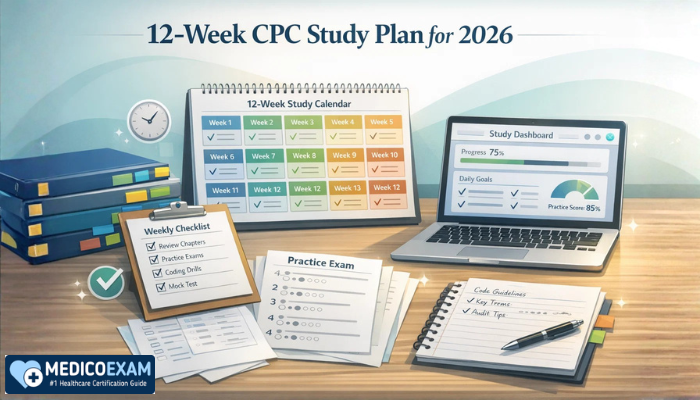
A structured, week-by-week study plan is the single most important factor separating candidates who pass from those who fail. Candidates who complete formal training programs pass at 65–75%, compared to just 35–50% for self-study candidates. The plan below allocates time proportionally to each domain's weight on the exam and builds from foundational knowledge to full-length timed practice.
Detailed 12-Week CPC Study Plan
| Week | Focus Area | Study Activities | Hours/Day | Key Resources |
|---|---|---|---|---|
| 1 | Medical Terminology & Anatomy | Review roots, prefixes, suffixes; study major organ systems; complete anatomy labeling exercises | 1.5 | AAPC Study Guide Ch. 1–2; anatomy flashcards |
| 2 | ICD-10-CM Guidelines & Basics | Read ICD-10-CM Official Guidelines (Sections I–IV); practice alphabetic index navigation; code 10 diagnosis scenarios daily | 1.5 | ICD-10-CM code book; AAPC Study Guide Ch. 3 |
| 3 | ICD-10-CM Advanced Scenarios | Practice complex coding: neoplasms, diabetes with manifestations, pregnancy codes, injuries/external causes; drill sequencing rules | 2.0 | ICD-10-CM code book; practice worksheets |
| 4 | CPT Guidelines & E/M Coding | Master 2021+ E/M guidelines; learn MDM levels (straightforward through high complexity); practice E/M code selection from clinical vignettes | 2.0 | CPT Professional Edition; AAPC Study Guide Ch. 4–5 |
| 5 | Surgery: Integumentary & Musculoskeletal | Study wound repair rules, excision vs shaving, fracture treatment coding, arthroscopy codes; practice modifier application (-59, -25, -51) | 2.0 | CPT Surgery section; practice scenarios |
| 6 | Surgery: Respiratory, Cardiovascular & Hemic/Lymphatic | Review CABG coding, pacemaker/defibrillator insertions, vascular access, bronchoscopy rules; practice component coding | 2.0 | CPT Surgery section; MedicoExam practice tests |
| 7 | Surgery: Digestive, Urinary, Male/Female Reproductive | Master GI endoscopy hierarchy, colonoscopy/EGD coding, urodynamics, maternity care global packages; drill separate procedure rules | 2.0 | CPT Surgery section; coding workbook |
| 8 | Nervous System, Eye/Ear & Radiology | Study spinal injection coding, nerve blocks, cataract surgery codes; master radiology component coding (professional vs technical, -26/-TC) | 1.5 | CPT Surgery + Radiology sections |
| 9 | Pathology, Laboratory & Medicine | Review panel rules, drug testing hierarchies, immunization administration; study infusion/injection coding hierarchies; practice HCPCS Level II | 1.5 | CPT Path/Lab + Medicine; HCPCS manual |
| 10 | HCPCS Level II, Modifiers & Compliance | Deep-dive into modifier rules (-25, -59, -76, -77, -91); study medical necessity, NCCI edits, Medicare guidelines, fraud/abuse laws | 1.5 | HCPCS Level II manual; AAPC Study Guide compliance chapters |
| 11 | Full-Length Practice Exams (Timed) | Take two complete 100-question practice exams under strict 4-hour timed conditions; review every missed question; update error log; identify weak domains | 2.5 | AAPC official practice exams; MedicoExam CPC simulations |
| 12 | Weakness Review & Book Preparation | Focus exclusively on domains where you scored below 70%; finalize coding manual tabs; take one final practice exam; rest 1–2 days before test day | 1.5 | Personal error log; tabbed coding manuals |
What Does a Successful Daily Study Schedule Look Like?
Consistency outperforms intensity. Studying 90 minutes daily for 12 weeks produces better exam results than sporadic 6-hour weekend cramming sessions. The following daily schedule template can be adapted to morning, afternoon, or evening study blocks based on your personal schedule.
Daily Study Schedule Template (90 Minutes)
| Time Block | Activity | Duration | Purpose |
|---|---|---|---|
| Block 1: Warm-Up | Review medical terminology flashcards; quiz yourself on anatomy for the current week's body system | 15 minutes | Activate recall; reinforce foundational knowledge |
| Block 2: Concept Study | Read the coding guidelines and chapter notes for the current week's focus area (e.g., Cardiovascular Surgery guidelines) | 30 minutes | Build understanding of rules before applying them |
| Block 3: Active Practice | Code 5–10 practice scenarios using your physical CPT and ICD-10-CM manuals; simulate exam conditions (no digital searches) | 30 minutes | Develop manual navigation speed and code-selection accuracy |
| Block 4: Review & Log | Check answers against rationales; highlight missed guidelines in your coding manuals; update your personal error log | 15 minutes | Identify patterns in mistakes; reinforce correct approaches |
Weekend bonus session (optional, 60 minutes): Take a 25-question timed mini-exam covering the current week's material and the previous week's material. This reinforces retention and simulates exam pressure on a smaller scale.
What Are the Top 5 CPC Study Mistakes?
Data from training programs and candidate discussions reveals consistent patterns among candidates who fail the CPC. Avoiding these five mistakes can meaningfully shift your odds from the failing 40–50% to the passing majority.
Mistake #1: Not taking full-length timed practice exams.
The CPC is a 4-hour marathon, not a sprint. Many candidates study content thoroughly but never practice sitting for 4 continuous hours with their coding manuals. The result is fatigue-related errors in the final 60–90 minutes of the actual exam. Candidates who take at least two full-length timed practice exams before their test date pass at significantly higher rates. Schedule your first full-length practice exam no later than Week 11 of your study plan.
Mistake #2: Over-tabbing coding manuals.
You are allowed to tab, highlight, and write notes in your coding manuals. However, inserting 200+ tabs turns your books into a confusing maze rather than a navigation tool. Effective tabbing uses 30–40 tabs maximum: one for each major CPT section, one for each ICD-10-CM chapter you frequently reference, and a handful for high-yield guidelines (E/M, modifiers, surgical package rules). Prioritize tabs for sections you look up most often during practice exams.
Mistake #3: Ignoring the official coding guidelines.
The guidelines printed at the front of the CPT and ICD-10-CM manuals contain the answers to many of the exam's hardest questions. Candidates who skip these guidelines and jump straight to code lookup miss critical rules about bundling, unbundling, sequencing, and modifier usage. The ICD-10-CM Official Guidelines for Coding and Reporting (Sections I–IV) and the CPT section-specific guidelines are required reading—not optional supplements.
Mistake #4: Poor time management during the exam.
Spending 5–10 minutes on a single difficult question is the most common reason candidates run out of time. With only 2.4 minutes per question on average, you must set a personal time limit of 3 minutes maximum per question. If you cannot solve a question within 3 minutes, mark it for review and move on. Using a two-pass strategy (answer easy questions first, return to marked questions second) is the approach used by most successful candidates.
Mistake #5: Using outdated coding manuals.
The CPC exam strictly tests current-year codes. CPT, ICD-10-CM, and HCPCS codes are updated annually, with hundreds of additions, deletions, and revisions each year. Using last year's manuals guarantees you will encounter questions where your books do not contain the correct answer. Always purchase current-year editions and verify the ISBN numbers against AAPC's approved book list before exam day.
Which CPC Study Materials Should You Use?
Not all study materials are equally effective. The table below compares the most widely used CPC preparation resources by type, cost, and best use case.
CPC Study Resource Comparison Table
| Resource | Type | Cost | Best For | Key Strengths |
|---|---|---|---|---|
| AAPC Official CPC Study Guide | Textbook | ~$149.95 | Chapter-by-chapter content review | Aligned to exam blueprint; includes practice questions per chapter |
| AMA CPT Professional Edition (2026) | Code Manual (Required) | ~$109.95 | Exam-day reference; daily practice | Official CPT code book; must bring to exam |
| ICD-10-CM Code Book (2026) | Code Manual (Required) | ~$89.95–$109.95 | Exam-day reference; daily practice | Diagnosis code lookup and guidelines |
| HCPCS Level II (2026) | Code Manual (Required) | ~$69.95–$89.95 | Exam-day reference; supply/DME coding | Covers supplies, drugs, DME codes |
| AAPC Official CPC Practice Exams | Practice Test | ~$59.95–$119.95 | Benchmarking readiness (Weeks 11–12) | Most exam-accurate; official source |
| MedicoExam CPC Practice Tests | Online Simulation | Varies | Ongoing practice (Weeks 1–12) | Simulation-based with detailed rationales; tracks weak areas |
| Medical Coding Training: CPC (Blitz Videos) | Video Course | ~$50–$200 | Visual learners; supplemental review | Explains complex topics with visual examples |
| Coding Workbooks (Practice Scenarios) | Workbook | ~$30–$60 | Active practice during Weeks 4–10 | Hands-on coding exercises by specialty |
Minimum investment for first-attempt success:
You need the three current-year coding manuals (CPT, ICD-10-CM, HCPCS Level II), a study guide, and at least one set of full-length practice exams. Total cost ranges from approximately $400–$550 for materials, plus the $425–$499 exam fee and $222 AAPC membership.
"The secret to passing the CPC exam isn't memorizing codes—it's mastering the index and understanding the chapter guidelines. Your books have the answers; you just need to know how to find them efficiently." — David Thompson, CPC, CPMA, Senior Auditing Specialist
How Do You Navigate Your Coding Manuals Efficiently?
Manual navigation speed is the hidden skill that separates CPC passers from failures. On an open-book exam with only 2.4 minutes per question, you cannot afford to flip pages aimlessly. Here is how to optimize each of your three coding manuals:
CPT Professional Edition:
Always start with the Index (located at the back of the book). Look up the procedure by the main term (e.g., "Repair," "Excision," "Insertion"), then verify the code in the Tabular List. Never search the Tabular List directly—this wastes critical time. Tab the beginning of each major section (E/M, Anesthesia, Surgery subsections, Radiology, Pathology, Medicine) and mark high-yield guidelines such as the Surgical Package definition, global surgery rules, and the separate procedure concept. Place sticky tabs on modifier tables and frequently referenced add-on code lists.
ICD-10-CM:
Use the Alphabetic Index (Volume 2) first to locate the code category, then confirm the full code in the Tabular List (Volume 1). Pay attention to "See" and "See Also" cross-references, instructional notes ("Code first," "Use additional code," "Code also"), and excludes notes (Excludes1 vs Excludes2). Tab the Official Guidelines at the front of the book—Sections I.A through I.C are tested heavily. Mark the conventions page (symbols for 7th character requirements, placeholder "x" rules, etc.).
HCPCS Level II:
This manual covers supplies, drugs, durable medical equipment, and ambulance services. It is organized alphabetically by letter (A through V codes). Tab the beginning of each major code range (A codes for ambulance/DME, J codes for drugs, L codes for orthotics/prosthetics). HCPCS questions on the CPC exam are typically straightforward—the challenge is finding the code quickly rather than interpreting complex clinical scenarios.
Practice tip:
During weeks 1–10, time yourself on manual lookups. Set a goal of finding any code within 60 seconds by Week 8. During your full-length practice exams in Weeks 11–12, note which lookups take the longest and add tabs accordingly.
What Is the Best Test-Day Strategy?
Your test-day strategy should be planned before you arrive at the testing center. The CPC exam rewards systematic time management and emotional discipline over raw knowledge.
The Two-Pass Strategy:
Pass 1 (First 2.5 hours / 150 minutes): Work through all 100 questions sequentially. Answer every question you can solve in under 2.5 minutes immediately. For questions that require complex lookups or are unfamiliar, mark them for review and move to the next question. Your goal is to complete 60–75 questions during this first pass, banking "easy" points and building confidence.
Pass 2 (Final 1.5 hours / 90 minutes): Return to all marked questions. Start with questions you partially figured out during Pass 1 (you likely have a code range in mind, just need to confirm). Use your coding manual indexes strategically. If you have fewer than 5 minutes remaining and questions still unanswered, make educated guesses—there is no penalty for wrong answers, and a 25% chance of guessing correctly is better than 0%.
Pacing checkpoints
- After 1 hour: You should have completed approximately 25–30 questions.
- After 2 hours: You should have completed approximately 50–60 questions.
- After 3 hours: You should have completed approximately 75–85 questions.
- Final hour: Reserved for remaining questions and review.
What Should Be on Your Test-Day Preparation Checklist?
Arrive at the testing center prepared and stress-free by completing this checklist the night before and morning of your exam:
The Night Before
- Confirm your exam time, testing center address, and driving/transit route.
- Pack your coding manuals (CPT, ICD-10-CM, HCPCS Level II)—verify all are current-year editions.
- Check that all manual tabs are securely attached (loose pages or tabs may be flagged).
- Prepare your valid, government-issued photo ID (name must match AAPC registration exactly).
- If testing in-person: pack #2 pencils, a silent non-programmable calculator, and a clear water bottle.
- If testing online proctored: test your internet connection, webcam, and microphone; clear your desk of all materials except coding manuals.
- Set two alarms for the morning.
- Get 7–8 hours of sleep—fatigue is a documented factor in exam failures.
Morning of Exam
- Eat a balanced meal (protein and complex carbs; avoid sugar crashes).
- Arrive at the testing center 30 minutes early (or log into the online proctoring system 15 minutes early).
- Use the restroom before the exam begins—bathroom breaks count against your 4-hour time limit.
- Take 5 deep breaths before starting to reduce initial anxiety.
- Remind yourself: you can miss 30 questions and still pass (70/100).
What Score Do You Need and How Is It Calculated?
The CPC exam requires a score of 70% to pass—that means answering at least 70 out of 100 questions correctly. Every question is worth exactly one point, and there is no penalty for incorrect answers. Your score report indicates only your overall percentage; AAPC does not provide a section-by-section breakdown.
| Scoring Detail | CPC Exam Policy |
|---|---|
| Passing Score | 70% (70 out of 100) |
| Points per Question | 1 point each, equally weighted |
| Penalty for Wrong Answers | None |
| Score Report | Pass/fail with overall percentage only |
| Section Breakdown | Not provided |
| Online Results Timeline | 3–5 business days |
| In-Person Results Timeline | 7–10 business days |
| Retake Wait Period | None (can schedule immediately) |
| Retake Fee | $425 per attempt (or use second attempt from bundle) |
If you fail, your score report will show your overall percentage, which helps you estimate how far below 70% you scored. AAPC recommends waiting at least 2–4 weeks before retaking to allow focused review of weak areas. If you purchased the $499 two-attempt bundle, your second attempt is included at no additional fee, saving $351 compared to purchasing two single attempts. Before scheduling a retake, aim to score 80–85% on practice exams to ensure adequate preparation.
Frequently Asked Questions
1. What is the passing score for the CPC exam?
-
You must answer 70 out of 100 questions correctly (70%) to pass the CPC exam. All questions are equally weighted at one point each, and there is no penalty for guessing. This means you can miss up to 30 questions and still pass—a useful mindset to maintain during the exam if you encounter difficult questions.
2. Is the CPC exam multiple-choice?
-
Yes. All 100 questions are multiple-choice, typically offering four possible answer options. Each question presents a clinical scenario or coding situation and asks you to select the correct code or combination of codes. You must use your physical coding manuals to look up codes during the exam.
3. Can I bring notes into the CPC exam?
-
You cannot bring loose notes, printed reference sheets, or separate study materials. However, you are permitted to write notes, highlight text, and attach tabs directly on the pages of your approved coding manuals. This is one of the most powerful advantages of the CPC exam—your manuals become personalized reference tools if you prepare them properly during your study period.
4. How long does it take to get CPC exam results?
-
If you take the exam online, results are typically available within 3–5 business days. In-person exam results may take 7–10 business days. Results are posted in your AAPC online account. Your score report shows pass/fail status and your overall percentage score but does not include a section-by-section breakdown.
5. How much time should I spend studying for the CPC exam?
-
Most successful candidates study for 8–12 weeks, dedicating 10–15 hours per week to preparation. This translates to roughly 100–180 total study hours. Candidates with strong anatomy and medical terminology backgrounds may need less time, while career changers with no healthcare experience should plan for the full 12 weeks. The critical benchmark: schedule your official exam only after you consistently score 80% or higher on full-length timed practice exams.
6. What happens if I fail the CPC exam?
-
If you purchased the $499 two-attempt bundle, you can schedule your second attempt immediately—there is no mandatory waiting period. If you purchased a single attempt ($425), you must pay $425 again for each subsequent attempt. AAPC allows unlimited retakes. Before retaking, review your score percentage to estimate which content areas need the most improvement, take additional practice exams, and aim for 80–85% on practice tests before rescheduling.
7. Do I have to memorize all the medical codes?
-
No. The CPC is an open-book exam specifically designed to test your ability to navigate coding manuals and apply guidelines, not to test memorization. However, you should be familiar enough with CPT section layouts, ICD-10-CM chapter organization, and common code ranges that you can locate codes quickly. Memorizing the index structure and high-frequency guidelines will save more time than memorizing individual codes.
8. What is the most difficult section of the CPC exam?
-
Based on candidate feedback, the most frequently cited difficult sections are Evaluation and Management (E/M) coding due to the complexity of medical decision-making levels, and Surgery subsections—particularly Integumentary (wound repair rules), Musculoskeletal (fracture coding), and Cardiovascular (bypass graft and catheterization coding). The Anesthesia section, while only 4% of the exam, also challenges many candidates due to its unique base-plus-time units formula.
Ready to Start Practicing?
Take the guesswork out of your CPC preparation. Try MedicoExam's simulation-based CPC practice tests to drill down on specific weak areas, practice under realistic timed conditions, and receive detailed rationales for every question. MedicoExam's AAPC exam preparation covers all 17 CPC content domains with questions designed to mirror the difficulty and format of the actual exam. Combine MedicoExam with the 12-week study plan above, and you will walk into test day prepared, confident, and ready to pass on your first attempt.
Written by the MedicoExam Content Team — Healthcare Education Specialists at MedicoExam.com
Last Updated: April 2026
Disclaimer: This article is for informational purposes only. MedicoExam does not provide leaked questions, exam recalls, or proprietary AAPC content. Always refer to the AAPC for the most current examination rules and policies.


