
NHA CBCS Exam: Certified Billing & Coding Specialist Complete Study Guide & FAQ
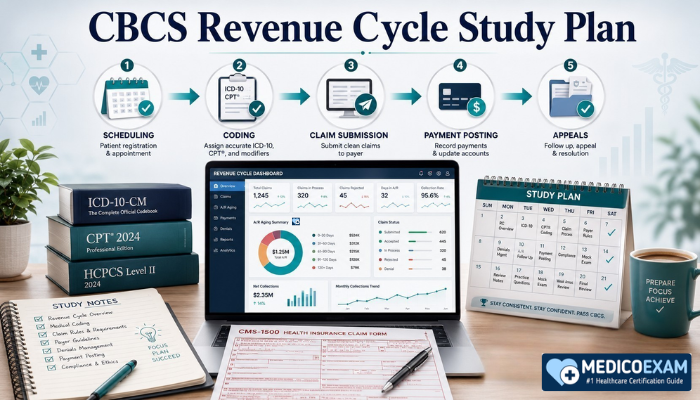 The NHA Certified Billing & Coding Specialist (CBCS) exam is a multiple-choice certification exam administered by the National Healthcareer Association (NHA) for entry-level medical billing and coding professionals. Based on NHA's current public CBCS test plan and 2024 CBCS FAQ, the exam includes 100 scored items plus 25 pretest items, has a 3-hour testing window, and no longer allows candidates to bring coding manuals into the exam room. All code information needed for application-style coding items is provided within the exam question.
The CBCS validates your ability to support the complete healthcare revenue cycle, including patient intake, insurance verification, coding guidelines, claims submission, reimbursement, denial management, and compliance. According to NHA's 2024 pass-rate report, the CBCS had a 73.82% passing percentage across 6,905 exams administered, with 16,700 active certifications as of December 31, 2024. This guide covers the current official domain outline, eligibility requirements, scoring, CMS-1500 and 837P basics, coding systems, salary data, and an 8-week study plan.
CBCS Exam at a Glance — Key Facts
| Detail | Data |
|---|---|
| Full Name | Certified Billing & Coding Specialist |
| Certifying Body | National Healthcareer Association (NHA) |
| Total Questions | 125 total items: 100 scored + 25 pretest |
| Time Limit | 3 hours |
| Exam Fee | Current NHA store listings show $129; verify final pricing during registration |
| Scoring | Scaled 200–500; passing score 390 |
| 2024 Passing Percentage | 73.82% across 6,905 exams administered |
| Reference Materials | Coding manuals are not permitted for exams on or after September 24, 2024 |
| Testing Options | School-sponsored, PSI testing center, or live remote proctoring where available |
| Renewal | Every 2 years; 10 CE credits required |
| Active Certifications | 16,700 as of December 31, 2024 |
What Is the NHA CBCS Certification?
The CBCS is an entry-level certification offered by the National Healthcareer Association that validates competency in both medical billing and foundational coding tasks. Unlike credentials that focus only on code assignment, the CBCS covers the full revenue cycle — from verifying patient insurance at the front desk to submitting claims, posting payments, and managing denials.
According to NHA's 2025 Industry Outlook, 94% of employers require or encourage certification for medical billing and coding specialists. The CBCS credential is NCCA-accredited, meaning it meets nationally recognized standards for personnel certification programs. NHA was founded in 1989, is headquartered in Leawood, Kansas, and has supported more than 1.25 million allied health certifications.
Certified billing and coding specialists work in physician offices, hospitals, surgery centers, nursing homes, home healthcare agencies, mental health facilities, dental offices, insurance companies, and third-party billing firms. For a full comparison of NHA certification paths, see the MedicoExam NHA certification hub.
Who Is Eligible to Take the CBCS Exam?
Candidates must meet one of two eligibility pathways to sit for the CBCS exam. Both pathways require a high school diploma or GED, or scheduled completion of high school/GED equivalency within the allowed NHA window.
Pathway 1 — Education Route:
- Possess a high school diploma or GED, or be scheduled to earn one within 12 months.
- Complete a medical billing and coding training or education program within the last 5 years.
Pathway 2 — Experience Route:
- Possess a high school diploma or GED.
- Complete 1 year of supervised work experience in medical billing and coding within the last 3 years, or 2 years of supervised work experience within the last 5 years.
No associate degree or bachelor's degree is required. This makes the CBCS one of the fastest entry points into the healthcare revenue cycle field. High school health science students may also qualify through NHA's provisional certification pathway; always verify eligibility details in the current NHA Candidate Handbook before registering.
What Are the Four CBCS Exam Domains?
The current public NHA CBCS test plan organizes the 100 scored exam items into four domains. These domains mirror core billing and coding responsibilities in entry-level healthcare revenue cycle roles.
| Domain | Scored Items | Percentage of Scored Exam |
|---|---|---|
| The Revenue Cycle and Regulatory Compliance | 15 | 15% |
| Insurance Eligibility and Other Payer Requirements | 20 | 20% |
| Coding and Coding Guidelines | 32 | 32% |
| Billing and Reimbursement | 33 | 33% |
| Total | 100 | 100% |
Note: The exam also includes 25 pretest items. Pretest questions are not scored, but they are mixed into the exam and cannot be identified during testing.
Domain 1: The Revenue Cycle and Regulatory Compliance (15%)
This domain tests your understanding of revenue cycle workflow and the legal framework that governs billing and coding. Key competencies include:
- Revenue cycle phases and how each phase affects reimbursement.
- HIPAA privacy and security rules for protected health information (PHI).
- HITECH Act requirements for electronic health information.
- Fraud and abuse prevention, including the False Claims Act, Stark Law, and OIG compliance principles.
- Proper release of PHI according to law, payer requirements, and facility policy.
- Documentation, audit requirements, compliance plans, and internal controls.
- Communication with patients, providers, payers, and internal revenue cycle teams.
Domain 2: Insurance Eligibility and Other Payer Requirements (20%)
This domain focuses on front-end payer rules and patient financial responsibility. Key competencies include:
- Verifying insurance eligibility, benefits, copayments, deductibles, coinsurance, and out-of-pocket limits.
- Collecting insurance cards, identification, referrals, authorizations, and assignment-of-benefits documentation.
- Understanding primary, secondary, and tertiary payer order.
- Applying coordination of benefits rules, including dependent and birthday-rule scenarios.
- Distinguishing commercial plans, Medicare, Medicaid, Medigap, TRICARE, workers' compensation, and other payer types.
- Recognizing preauthorization, precertification, predetermination, referral, and medical necessity requirements.
- Handling uninsured or self-pay patient policies and Advance Beneficiary Notice (ABN) concepts.
Domain 3: Coding and Coding Guidelines (32%)
This is the largest coding-focused domain on the exam. Candidates are expected to understand how codes are selected, sequenced, and supported by documentation. Key competencies include:
- Abstracting required health information from clinical documentation.
- Applying ICD-10-CM diagnosis codes to the highest level of specificity.
- Applying CPT and HCPCS Level II codes based on provider documentation.
- Understanding modifier use, bundling concepts, add-on codes, and code sequencing.
- Selecting Evaluation and Management (E/M) codes according to documentation requirements.
- Recognizing when provider queries may be needed for incomplete or unclear documentation.
- Applying anatomy, physiology, and medical terminology knowledge to coding scenarios.
Domain 4: Billing and Reimbursement (33%)
This is the heaviest domain on the exam. It covers claim creation, claim submission, payment posting, denial management, and reimbursement workflows. Key competencies include:
- Completing CMS-1500 professional claims and understanding the 837P electronic equivalent.
- Reviewing claims for required diagnosis codes, procedure codes, modifiers, dates of service, units, and provider identifiers.
- Understanding claim submission through clearinghouses and payer portals.
- Reading remittance advice, explanations of benefits, and payment adjustments.
- Posting payments, contractual adjustments, write-offs, take-backs, and withholds.
- Managing rejected, denied, or underpaid claims.
- Understanding aging reports, timely filing limits, payer edits, NCCI edits, LCD/NCD rules, and Medically Unlikely Edits (MUEs).
- Supporting appeals, corrected claims, and collections workflows.
Expert Insight: "The CBCS exam rewards candidates who understand the full revenue cycle, not just isolated coding terms. You need to know how patient intake, payer rules, documentation, code selection, clean claims, payment posting, and denials all connect." — MedicoExam Content Team
How Does the CBCS Reference Material Policy Work in 2026?
The CBCS exam is no longer a manual-based open-book exam. NHA's 2024 CBCS FAQ states that coding manuals were required only through September 23, 2024. As of September 24, 2024, coding manuals are not necessary or allowed in the exam room. NHA explains that all necessary information for application-of-coding items is included alongside each question.
This change means candidates should shift their preparation strategy. Instead of practicing only manual lookup speed, focus on:
- Understanding coding conventions and guidelines.
- Reading clinical documentation carefully.
- Recognizing correct code sequencing logic.
- Applying modifiers and payer requirements.
- Identifying what information is needed to submit a clean claim.
- Practicing scenario-based billing and coding questions under timed conditions.
What Is the Revenue Cycle and Why Does It Matter for the CBCS?
The revenue cycle is the financial backbone of every healthcare organization, and it is the central framework tested on the CBCS exam. A billing and coding specialist must understand what happens before the patient visit, during documentation and coding, after claim submission, and after payer adjudication.
The 7 Stages of the Revenue Cycle
| Stage | Key Activities |
|---|---|
| 1. Patient Scheduling & Pre-Registration | Collect demographics, verify insurance, obtain referrals |
| 2. Registration & Check-In | Confirm identity, collect copays, sign consent forms |
| 3. Charge Capture | Document services rendered using encounter forms and progress notes |
| 4. Medical Coding | Assign ICD-10-CM diagnosis codes, CPT procedure codes, and HCPCS Level II codes |
| 5. Claim Submission | Complete CMS-1500 paper claims or 837P electronic claims, then transmit to payer or clearinghouse |
| 6. Payment Posting & Adjudication | Interpret remittance advice, post payments, and apply adjustments |
| 7. Denial Management & Appeals | Analyze rejections, correct errors, resubmit claims, and file formal appeals |
Each stage connects directly to one or more CBCS exam domains. Insurance eligibility maps to the front-end stages. Coding and guidelines map to charge capture and code assignment. Billing and reimbursement maps to claim submission, adjudication, payment posting, and denial management.
What Are the CMS-1500 Form Basics Tested on the CBCS?
The CMS-1500 form is the standard paper claim form used by physicians and other non-institutional providers to bill Medicare and many other payers. CMS identifies the 837P Professional transaction as the standard electronic format used by healthcare professionals and suppliers to transmit professional claims electronically.
The CMS-1500 has 33 numbered fields organized into key sections. The CBCS exam expects candidates to know the most critical fields and how information flows into a professional claim.
| Box | Field Name | What It Contains |
|---|---|---|
| Box 1 | Insurance Type | Medicare, Medicaid, TRICARE, CHAMPVA, Group, FECA, Other |
| Box 2 | Patient Name | Must match insurance card exactly |
| Box 21 | Diagnosis Codes | ICD-10-CM codes establishing medical necessity |
| Box 24A | Date of Service | When the service was provided |
| Box 24B | Place of Service | 2-digit POS code, such as 11 for office or 21 for inpatient hospital |
| Box 24D | CPT/HCPCS Codes | Procedure or service codes with modifiers |
| Box 24G | Days or Units | Quantity of services rendered |
| Box 24J | Rendering Provider NPI | National Provider Identifier of the performing clinician |
| Box 33 | Billing Provider Info | Name, address, NPI, and Tax ID of billing entity |
Clean claims depend on correct demographic information, valid insurance data, accurate diagnosis and procedure coding, correct modifiers, proper provider identifiers, and payer-specific requirements.
What Coding Systems Does the CBCS Exam Cover?
The CBCS exam tests foundational knowledge of three major coding systems. Because candidates can no longer bring printed coding manuals into the testing room, preparation should focus on understanding what each code set is used for and how coding logic is applied.
ICD-10-CM (International Classification of Diseases, 10th Revision, Clinical Modification)
- Purpose: Classifying diagnoses and reasons for healthcare encounters.
- Structure: 3–7 character alphanumeric codes, such as E11.65 for Type 2 diabetes mellitus with hyperglycemia.
- Key conventions: Placeholder "X" characters, 7th-character extensions, code-first notes, use-additional-code notes, Excludes1 and Excludes2 notes.
- CBCS focus: Coding to the highest level of specificity and sequencing diagnoses correctly.
CPT (Current Procedural Terminology)
- Purpose: Reporting medical procedures and services performed by providers.
- Structure: 5-digit numeric codes organized into sections such as Evaluation & Management, Anesthesia, Surgery, Radiology, Pathology/Laboratory, and Medicine.
- Key conventions: Add-on codes, modifier usage, parent codes, standalone codes, and indented codes.
- CBCS focus: Selecting procedure codes based on documentation and applying modifiers when supported.
HCPCS Level II (Healthcare Common Procedure Coding System)
- Purpose: Coding supplies, equipment, drugs, and services not covered by CPT.
- Structure: One letter followed by four digits, such as J-codes for certain drugs and injections.
- Key conventions: Alphanumeric code categories, temporary codes, durable medical equipment codes, and payer-specific use.
- CBCS focus: Identifying when HCPCS Level II codes apply, especially for Medicare and Medicaid claims.
How Is the CBCS Exam Scored?
The CBCS uses NHA's scaled scoring system. Raw scores are converted to a scale of 200–500, with a passing score of 390. Scaled scoring helps ensure fairness across different versions of the exam.
Because NHA uses scaled scoring, a score of 390 does not mean you need exactly 78% of questions correct. The actual raw-score requirement may vary slightly depending on the difficulty of the exam form.
The 25 pretest items on the exam are experimental questions being evaluated for future exams. They do not count toward your score, but you will not know which items are pretest. Treat every question as scored.
How Does the CBCS Compare to a Coding-Focused Credential?
If you are deciding between an entry-level billing-and-coding credential and a more coding-focused credential, the right choice depends on your career goal. The CBCS is designed for candidates who want a fast entry into revenue cycle, claims, billing, front-office insurance, and foundational coding roles.
| Feature | NHA CBCS | Coding-Focused Credential |
|---|---|---|
| Primary Focus | Revenue cycle, billing, claims, compliance, and foundational coding | Deeper outpatient coding, auditing, and documentation review |
| Best For | Career starters and billing-focused roles | Candidates pursuing long-term coding specialization |
| Exam Style | Multiple-choice, scenario-based billing and coding knowledge | Often longer and more code-intensive |
| Reference Materials | CBCS manuals are not permitted on current exams | Some coding-focused exams may allow manuals depending on the certifying body |
| Career Target | Billing specialist, claims processor, patient account representative, revenue cycle specialist | Medical coder, coding auditor, documentation review specialist |
| Study Priority | Revenue cycle workflow, payer rules, claims, compliance, and code-set logic | Advanced code selection, guideline navigation, specialty coding, and audits |
A practical strategy is to start with CBCS if you want an accessible first credential for billing, claims, and revenue cycle work. Later, you can add a more specialized coding credential if your career goal shifts toward dedicated coding, auditing, or compliance roles.
What Is the Best 8-Week CBCS Study Plan?
This study plan allocates time according to the official CBCS scored-item distribution and adds dedicated practice for scenario-based questions.
Weeks 1–2: Revenue Cycle and Compliance Foundation
- Learn the complete revenue cycle from scheduling through appeals.
- Study HIPAA, HITECH, PHI, release of information, and compliance program basics.
- Review fraud and abuse laws, including False Claims Act, Stark Law, OIG compliance, and fair debt collection concepts.
- Build a glossary of payer, billing, and compliance terms.
- Time commitment: 7–10 hours per week.
Weeks 3–4: Insurance Eligibility and Payer Requirements
- Study insurance verification, benefits, deductibles, copays, coinsurance, and out-of-pocket maximums.
- Learn payer types: Medicare, Medicaid, commercial plans, TRICARE, Medigap, workers' compensation, auto, and other third-party payers.
- Practice coordination of benefits scenarios.
- Review referral, preauthorization, precertification, predetermination, and ABN concepts.
- Time commitment: 7–10 hours per week.
Weeks 5–6: Coding and Coding Guidelines
- Review ICD-10-CM structure, sequencing, specificity, and instructional notes.
- Study CPT sections, E/M basics, add-on codes, parent/child code structure, and modifiers.
- Learn when HCPCS Level II codes apply for supplies, drugs, equipment, and payer-specific services.
- Practice clinical documentation scenarios that require diagnosis and procedure code logic.
- Time commitment: 8–12 hours per week.
Week 7: Billing, Claim Submission, and Reimbursement
- Master the CMS-1500 claim basics and 837P electronic claim concepts.
- Practice identifying missing or incorrect claim data.
- Study remittance advice, EOBs, payment posting, adjustments, aging reports, and timely filing limits.
- Learn denial categories, corrected claims, resubmissions, and appeals workflows.
- Time commitment: 10–12 hours per week.
Week 8: Full-Length Practice Exams and Review
- Take at least 2 full-length timed practice exams.
- Review every missed question and classify errors by domain.
- Re-study the weakest domain first.
- Practice reading scenario questions carefully without relying on code-book lookup.
- Review high-yield topics: HIPAA, payer order, CMS-1500 fields, coding conventions, remittance advice, and denial reasons.
- Time commitment: 10–12 hours per week.
Total estimated study time: 60–80 hours over 8 weeks.
For platform-wide study strategies that apply across all NHA exams, visit the MedicoExam blog.
What Career Paths Are Available for CBCS-Certified Professionals?
The CBCS credential opens doors to a wide range of entry-level and mid-level positions across healthcare settings. Because the exam covers both billing and foundational coding, it is especially useful for candidates who want to work in revenue cycle roles.
Common Job Titles for CBCS Holders
- Medical Billing Specialist
- Medical Coding Specialist
- Insurance Claims Processor
- Revenue Cycle Specialist
- Billing and Collections Coordinator
- Patient Account Representative
- Prior Authorization Specialist
Work Settings
CBCS-certified professionals find employment in physician offices, hospitals, ambulatory surgery centers, nursing homes, dental offices, mental health practices, insurance companies, medical billing firms, and remote revenue cycle teams.
Salary Expectations
According to the U.S. Bureau of Labor Statistics, the median annual wage for medical records specialists was $50,250 in May 2024. The lowest 10% earned less than $35,780, while the highest 10% earned more than $80,950. Medical billing and coding salaries vary by location, employer type, certification stack, experience, and whether the role is billing-focused, coding-focused, or hybrid.
Remote work opportunities continue to expand in medical billing and coding because claims, coding, denial management, and payment posting are increasingly handled through digital systems.
How Do You Register and Take the CBCS Exam?
Registration follows a straightforward process through NHA:
- Create an NHA account — Free online registration through the official NHA website.
- Submit your CBCS application — Use your account portal and provide eligibility documentation.
- Select your exam date and location — Choose a school-sponsored event, PSI testing center, or remote proctoring option where available.
- Pay the current exam fee — Verify the current fee during registration because NHA fees can change.
- Prepare — Use NHA study materials, the official test plan, practice tests, and MedicoExam CBCS practice resources.
- Take the exam — Bring valid government-issued photo identification. Do not bring coding manuals unless NHA provides a specific updated instruction that permits them.
For remote proctoring, you will need a quiet, private room with a stable internet connection, webcam, and microphone. You must follow all proctor instructions and clear the testing area of prohibited materials.
If your school or employer is sponsoring your exam, select the correct organization type when creating your NHA account so you can access any pre-purchased materials, discounts, or result-sharing options.
How Do You Maintain Your CBCS Certification?
CBCS certification is valid for 2 years from the date it is awarded. To maintain your credential, you must complete 10 continuing education (CE) credits and submit renewal through NHA before your certification expires.
NHA provides continuing education resources for active certification holders. If you hold multiple NHA credentials, NHA may allow the same CE credits to satisfy multiple renewal requirements, but you should verify current renewal rules in your NHA account before your renewal deadline.
If you let your certification lapse, you may need to complete reinstatement steps or retake the exam depending on how long the credential has been expired. Set a calendar reminder at least 90 days before expiration.
Frequently Asked Questions
Q1. Is the NHA CBCS exam open-book?
No. NHA's 2024 CBCS FAQ states that coding manuals are not necessary or allowed for exams on or after September 24, 2024. All necessary information needed to answer application-of-coding items is provided alongside each question.
Q2. How many questions are on the CBCS exam?
NHA's current public CBCS test plan lists 100 scored items and 25 pretest items, for 125 total questions. The pretest items do not count toward your score, but they are mixed into the exam and cannot be identified.
Q3. How long is the CBCS exam?
The current public NHA CBCS test plan lists an exam time of 3 hours.
Q4. What is the passing score for the CBCS?
The passing score is 390 on NHA's 200–500 scaled score range. NHA's scaled scoring system adjusts for exam form difficulty, so the exact number of raw correct answers needed may vary.
Q5. How much does the CBCS exam cost?
Current NHA store listings show the CBCS exam application at $129. Exam fees can change, and school or employer sponsorship may affect what a candidate pays. Always verify current pricing in your NHA account during registration.
Q6. What is the CBCS pass rate?
According to NHA's official 2024 pass-rate report, the CBCS had a 73.82% passing percentage across 6,905 exams administered. The same report lists 16,700 active CBCS certifications as of December 31, 2024.
Q7. Can I take the CBCS exam online?
NHA offers several testing options, including school-sponsored testing, in-person PSI testing centers, and live remote proctoring where available. Remote testing requires a webcam, microphone, stable internet connection, and a private testing environment.
Q8. Do I need a degree to take the CBCS exam?
No. The CBCS does not require an associate or bachelor's degree. Candidates generally need a high school diploma or GED plus either qualifying training within the last 5 years or qualifying supervised work experience.
Q9. What jobs can I get with a CBCS certification?
CBCS-certified professionals can pursue roles such as medical billing specialist, medical coding specialist, insurance claims processor, revenue cycle specialist, patient account representative, billing and collections coordinator, and prior authorization specialist.
Q10. How long should I study for the CBCS exam?
Most candidates benefit from 6–12 weeks of structured preparation. An 8-week plan with 60–80 total study hours is a strong target for candidates who are new to revenue cycle management, billing, and coding.
Start Your CBCS Exam Preparation Today
The CBCS credential offers an accessible path into healthcare revenue cycle management. With 100 scored items across revenue cycle compliance, payer requirements, coding guidelines, billing, and reimbursement, success depends on structured study and realistic practice.
Ready to test your knowledge? MedicoExam's simulation-based CBCS practice tests mirror the exam experience with timed, domain-aligned questions and detailed explanations. Start with a baseline exam, identify your weakest domains, and build confidence before test day.
Explore CBCS practice tests at MedicoExam, browse all NHA certification resources at MedicoExam.com, or visit the MedicoExam homepage to compare healthcare certification practice exams.
Disclaimer: This guide is for informational purposes only. It does not contain actual exam questions, recalled content, or proprietary NHA exam material. Exam details, fees, reference-material policies, eligibility rules, and renewal requirements may change. Always verify current requirements directly with NHA before registering. MedicoExam is not affiliated with or endorsed by the National Healthcareer Association.
Written by the MedicoExam Content Team — Healthcare Education Specialists at MedicoExam.com
Last Updated: June 2026
- NHA CBCS Question Bank |
- NHA CBCS Eligibility & Requirements |
- NHA Billing & Coding Specialist Practice Test |
- NHA CBCS Exam Cost |
- NHA CBCS Registration Process |
- NHA Billing & Coding Specialist Study Guide |
- NHA CBCS Recertification |
- NHA CBCS Certification Overview |
- NHA Billing & Coding Specialist Syllabus |
- NHA CBCS Preparation Time |
- NHA CBCS Passing Score |
- NHA CBCS Exam Format |
- NHA Billing & Coding Specialist Sample Questions |
- NHA CBCS Career Opportunities |
- NHA CBCS Exam Difficulty


