NHA Billing & Coding Specialist Syllabus

Explore 3 resources related to NHA Billing & Coding Specialist Syllabus on MedicoExam. These resources help certification candidates understand key aspects of exam preparation, including exam structure, study strategies, and expectations for scenario-based or applied assessments. Reviewing these materials can help improve readiness and confidence before attempting the certification exam.

NHA CBCS Certification: The Advanced Expert's Playbook

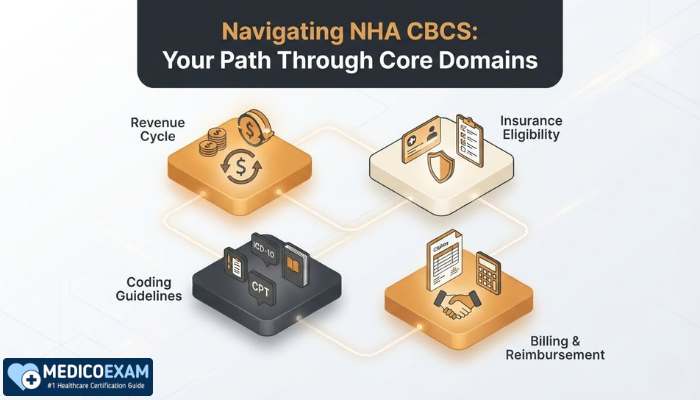
An isometric illustration depicting four interconnected blocks representing the core domains of the NHA CBCS syllabus, highlighting structured learning and conceptual flow.

The NHA Certified Billing & Coding Specialist (CBCS) certification validates expertise in managing the intricate financial aspects of healthcare, from patient registration to claims processing and reimbursement. This credential, offered by the National Healthcareer Association (NHA), is designed for professionals seeking to demonstrate advanced proficiency in medical billing, coding, and regulatory compliance within a dynamic healthcare environment. Candidates who pursue the CBCS certification are typically those aiming to solidify their foundational knowledge, expand their career opportunities, and become pivotal assets in medical practices, hospitals, and various healthcare organizations. This comprehensive article delves into the intricacies of the NHA CBCS exam (Code: CBCS), providing an advanced guide to its structure, content, benefits, and strategic preparation methodologies for experts.

NHA CBCS Certification Exam Syllabus

NHA CBCS syllabus for NHA Certified Billing & Coding Specialist (CBCS) preparation

Welcome to the official MedicoExam syllabus guide for the NHA Certified Billing & Coding Specialist certification. This page delivers a clear, structured overview of the NHA CBCS exam, including key exam details, syllabus topics, and preparation references to support effective study planning. The NHA Certified Billing & Coding Specialist (CBCS) is intended for professionals pursuing roles aligned with Administrative & Information Management, with assessment centered on applied competencies such as coding application, claims processing, reimbursement compliance within real-world settings like hospitals, physician offices, insurance companies and related settings.

The syllabus outline below reflects the core domains and expectations defined by the official NHA certification framework and aligns with the cognitive and professional standards assessed in the NHA CBCS exam. Candidates can use this guide alongside official vendor resources and structured practice to align their preparation with current exam standards and professional expectations for medical billing specialist, medical coding specialist, revenue cycle support roles

NHA CBCS Exam: Certified Billing & Coding Specialist Complete Study Guide & FAQ

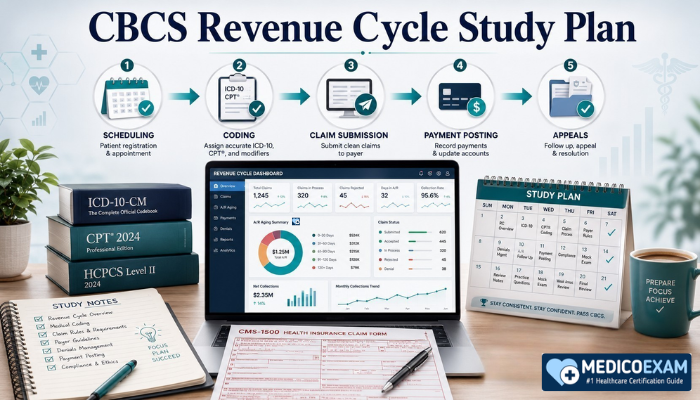
CBCS revenue cycle study plan illustration with claim workflow, coding notes, laptop dashboard, and exam preparation materials.The NHA Certified Billing & Coding Specialist (CBCS) exam is a multiple-choice certification exam administered by the National Healthcareer Association (NHA) for entry-level medical billing and coding professionals. Based on NHA's current public CBCS test plan and 2024 CBCS FAQ, the exam includes 100 scored items plus 25 pretest items, has a 3-hour testing window, and no longer allows candidates to bring coding manuals into the exam room. All code information needed for application-style coding items is provided within the exam question.

The CBCS validates your ability to support the complete healthcare revenue cycle, including patient intake, insurance verification, coding guidelines, claims submission, reimbursement, denial management, and compliance. According to NHA's 2024 pass-rate report, the CBCS had a 73.82% passing percentage across 6,905 exams administered, with 16,700 active certifications as of December 31, 2024. This guide covers the current official domain outline, eligibility requirements, scoring, CMS-1500 and 837P basics, coding systems, salary data, and an 8-week study plan.

Syndicate content