NHA CCMA Exam: Study Guide, Practice Questions & First-Attempt Pass Strategy
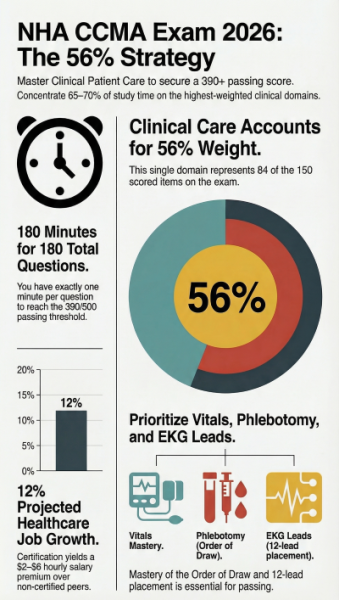
 Passing the National Healthcareer Association (NHA) Certified Clinical Medical Assistant (CCMA) exam requires focused study of its seven content domains, with Clinical Patient Care accounting for 56% of the scored exam. The exam consists of 150 scored questions plus 30 unscored pilot items, has a 3-hour time limit, and requires a scaled score of at least 390 out of 500 to pass — the equivalent of correctly answering approximately 78% of scored questions.
Key Facts: NHA CCMA Exam 2026
| Data Point | Detail |
|---|---|
| Total Questions | 180 (150 scored + 30 unscored pretest/pilot items) |
| Time Limit | 3 hours (180 minutes) |
| Passing Score | 390 out of 500 (approximately 78%) |
| Score Range | 200–500 |
| Exam Cost | $155 for initial exam; recertification fee applies separately |
| Recent Pass Rate | 80% in 2024; 77% in 2023 |
| Number of Domains | 7 content domains |
| Highest-Weight Domain | Clinical Patient Care (56% of scored exam) |
| Question Format | Multiple-choice |
| Testing Modes | PSI testing centers or online proctored |
| Certification Renewal | Every 2 years |
| Certifying Body | National Healthcareer Association (NHA) |
What Is the NHA CCMA Exam?
The Certified Clinical Medical Assistant (CCMA) exam is administered by the National Healthcareer Association (NHA), the largest medical assistant certification body in the United States. The CCMA credential validates that a medical assistant possesses the clinical, administrative, and interpersonal skills necessary to work in physician offices, outpatient clinics, urgent care centers, hospitals, and other healthcare settings.
Medical assistants perform a uniquely broad scope of duties — from taking vital signs and assisting with examinations to performing phlebotomy, running EKGs, managing patient records, and handling insurance documentation. The CCMA exam tests all of these competencies across seven weighted domains that reflect the real-world responsibilities of a clinical medical assistant.
According to the Bureau of Labor Statistics, employment of medical assistants is projected to grow 12% from 2024 to 2034, much faster than the average for all occupations, with 112,300 openings projected each year. This strong job outlook makes the CCMA credential especially valuable for entry-level healthcare professionals.
The CCMA is one of the most accessible healthcare certifications, with multiple eligibility pathways including completion of a training program or qualifying work experience. Unlike more advanced credentials that require college degrees or licensure, the CCMA offers a direct route into the healthcare workforce for candidates with a high school diploma or GED plus relevant preparation.
What Is the CCMA Exam Format?
The CCMA exam is a computer-based, multiple-choice test consisting of 180 total questions — 150 scored items and 30 unscored pretest (pilot) questions. Candidates have 3 hours (180 minutes) to complete the exam.
CCMA Exam Format Summary
| Component | Detail | ||||
|---|---|---|---|---|---|
| Scored Questions | 150 multiple-choice | ||||
| Unscored Pilot Questions | 30 (interspersed randomly; used by NHA to evaluate items for future exams) | ||||
| Total Questions | 180 | ||||
| Time Limit | 3 hours (180 minutes) | ||||
| Average Time Per Question | 1 minute per question | ||||
| Question Format | Multiple-choice with 4 answer options | ||||
| Scoring |
Scaled score from 200–50
With 180 questions in 180 minutes, you have an average of exactly 1 minute per question. This pace is manageable for most candidates if they have mastered the foundational content areas and have practiced timed mock exams. However, slow readers or candidates unfamiliar 0with lab values, order of draw, EKG lead placement, or common abbreviations often struggle to finish. |
The scoring system uses a scaled score (200–500) rather than a raw percentage to ensure fairness across different exam versions. A passing score of 390 is required. Although NHA does not publish the exact raw-to-scaled-score conversion, most prep providers estimate that this corresponds to roughly 78% of scored items answered correctly.
What Are the 7 CCMA Exam Domains?
The CCMA exam (version 3.0) is organized into seven content domains, each weighted according to its importance in real-world clinical medical assisting.
Full CCMA Exam Domain Breakdown (2026)
| # | Domain | # of Scored Items | % of Scored Exam | Key Topics |
|---|---|---|---|---|
| 1 | Foundational Knowledge and Basic Science | 15 | 10.0% | Medical terminology, healthcare systems, basic pharmacology, common diseases |
| 2 | Anatomy and Physiology | 8 | 5.3% | Body structures, organ systems, pathophysiology, disease processes, microbiology |
| 3 | Clinical Patient Care | 84 | 56.0% | See sub-domain breakdown below |
| — | 3A. Patient Intake and Vitals | 14 | 9.3% | Vital sign measurement, normal ranges, documentation |
| — | 3B. General Patient Care | 28 | 18.7% | Patient assessment, assisting with procedures, medication administration |
| — | 3C. Infection Control and Safety | 15 | 10.0% | Standard/transmission-based precautions, OSHA, sharps disposal |
| — | 3D. Point of Care Testing and Lab Procedures | 9 | 6.0% | Specimen collection, CLIA-waived tests, quality control |
| — | 3E. Phlebotomy | 12 | 8.0% | Order of draw, venipuncture technique, tube additives, complications |
| — | 3F. EKG and Cardiovascular Testing | 6 | 4.0% | 12-lead placement, artifact recognition, rhythm strip basics |
| 4 | Patient Care Coordination and Education | 12 | 8.0% | Care transitions, referrals, preventive screenings, patient education, telehealth |
| 5 | Administrative Assisting | 12 | 8.0% | Scheduling, EHR documentation, insurance basics, billing terms, medical records |
| 6 | Communication and Customer Service | 12 | 8.0% | Professional communication, active listening, managing difficult interactions, boundaries |
| 7 | Medical Law and Ethics | 7 | 4.7% | HIPAA, informed consent, advance directives, scope of practice, ethical decision-making |
| TOTAL (Scored) | 150 | 100% |
The critical takeaway: Clinical Patient Care (Domain 3) alone accounts for 84 of the 150 scored questions — 56% of the entire exam. If your study time is not heavily concentrated on vitals, infection control, phlebotomy, EKG, patient intake, and procedure assistance, you are not studying efficiently.
A practical study rule: spend 65–70% of your study time on the top five weighted domains (Clinical Patient Care, Foundational Knowledge, Patient Care Coordination, Administrative Assisting, and Communication). This leaves the remaining 30–35% for Anatomy/Physiology and Medical Law/Ethics.
What Are the High-Yield Topics?
To secure a passing score of 390, you must master specific clinical skills that appear repeatedly across exam questions.
Vital Signs (9.3% of Exam)
Normal vital sign ranges are tested extensively. Memorize these values:
| Vital Sign | Normal Adult Range | Key Exam Focus |
|---|---|---|
| Blood Pressure | Systolic: 90–120 mmHg; Diastolic: 60–80 mmHg | Hypertension stages, orthostatic measurement, correct cuff sizing |
| Heart Rate | 60–100 bpm | Tachycardia vs. bradycardia thresholds, apical vs. radial pulse |
| Respiratory Rate | 12–20 breaths/min | Tachypnea in adults, pediatric normal ranges differ |
| Temperature (Oral) | 97.8–99.1°F (36.5–37.3°C) | Fahrenheit-to-Celsius conversion, route-specific variations |
| Oxygen Saturation (SpO2) | 95–100% | Hypoxemia threshold (<90%), pulse oximeter placement |
| Pain Scale | 0–10 numeric rating | Fifth vital sign, documentation requirements |
EKG Lead Placement (4.0% of Exam)
Proper 12-lead EKG placement is a high-frequency topic. Know the exact positions:
-
V1: 4th intercostal space, right sternal border
-
V2: 4th intercostal space, left sternal border
-
V3: Between V2 and V4
-
V4: 5th intercostal space, midclavicular line
-
V5: Anterior axillary line (same horizontal level as V4)
-
V6: Midaxillary line (same horizontal level as V4 and V5)
-
Limb leads: RA (right arm), LA (left arm), RL (right leg — ground), LL (left leg)
You must also recognize common EKG artifacts: wandering baseline (caused by patient movement or loose electrodes), somatic tremor artifact, and AC interference. Misidentifying lead placement is a common exam mistake.
Phlebotomy Order of Draw (8.0% of Exam)
The order of draw prevents cross-contamination of tube additives. Memorize this sequence:
-
Blood cultures (yellow or yellow-black tops) — sterile collection first
-
Light blue top (sodium citrate) — coagulation tests (PT, PTT, INR)
-
Red top (no additive or clot activator) — serum chemistry, serology
-
Gold/SST (serum separator tube) — most chemistry panels
-
Green top (lithium heparin) — STAT chemistry, electrolytes
-
Lavender/Purple top (EDTA) — CBC, hemoglobin A1C
-
Gray top (sodium fluoride/potassium oxalate) — glucose, blood alcohol
Know the correct number of inversions for each tube (typically 5–10 gentle inversions). Understand complications: hematoma, hemolysis, syncope, and prolonged bleeding.
Injection Techniques
| Injection Type | Needle Gauge | Insertion Angle | Common Sites | Volume Limit |
|---|---|---|---|---|
| Intradermal (ID) | 25–27 gauge, 3/8"–5/8" | 10–15 degrees | Inner forearm, upper back | 0.1–0.5 mL |
| Subcutaneous (Sub-Q) | 25–27 gauge, 5/8" | 45 degrees (or 90° with pinched skin) | Abdomen, upper arm, thigh | 0.5–1.0 mL |
| Intramuscular (IM) | 20–23 gauge, 1"–1.5" | 90 degrees | Deltoid, vastus lateralis, ventrogluteal | Up to 3 mL (deltoid: 1 mL max) |
Infection Control
Distinguish between the three types of transmission-based precautions:
| Precaution Type | Transmission Method | PPE Required | Example Conditions |
|---|---|---|---|
| Airborne | Aerosolized particles (<5 μm) | N95 respirator, negative pressure room | TB, measles, varicella |
| Droplet | Large respiratory droplets (>5 μm) | Surgical mask, eye protection | Influenza, pertussis, meningitis |
| Contact | Direct/indirect physical contact | Gown and gloves | MRSA, C. difficile, scabies |
Standard precautions (hand hygiene, gloves for all blood/body fluid contact) apply to ALL patients regardless of diagnosis.
How Much Does the CCMA Exam Cost?
The CCMA exam fee is $155 for the initial certification attempt. Recertification costs are separate and due every 2 years.
Complete CCMA Exam Cost Breakdown
| Cost Component | Amount |
|---|---|
| CCMA Exam Fee | $155–$160 |
| PSI Testing Center Convenience Fee (if applicable) | $33 |
| NHA Study Materials (optional) | $50–$150 |
| Recertification (every 2 years) | $169–$179 |
| Retake Fee (if needed) | $155–$160 |
Unlike the AAPC CPC exam, the NHA CCMA does not require a separate membership fee — the exam fee is all-inclusive for the certification attempt. This makes the CCMA one of the more affordable healthcare certification pathways.
What Are the CCMA Eligibility Requirements?
The NHA offers two primary eligibility pathways for the CCMA exam.
Pathway 1: Training Program Graduate
-
Possess a high school diploma, GED, or high school equivalency (or be scheduled to earn one within the next 12 months)
-
Complete a medical assistant training or education program within the last 5 years
Pathway 2: Work Experience
-
Possess a high school diploma, GED, or high school equivalency
-
Have at least 1 year of supervised work experience in a medical assisting field within the last 3 years, OR
-
Have at least 2 years of supervised work experience in a medical assisting field within the last 5 years
Important notes:
-
There is no specific degree requirement — a high school diploma or GED is sufficient
-
You do not need to complete an accredited program specifically; however, training programs that prepare you for the NHA exam may improve pass rates
-
Military medical training and experience may qualify under the work experience pathway
-
NHA does not require any prerequisite exams or prerequisite certifications
This accessibility makes the CCMA one of the most attainable healthcare certifications. For individuals seeking to enter healthcare quickly, it provides a practical, low-barrier route into both outpatient and ambulatory care settings.
How Long Should You Study for the CCMA?
The recommended study duration depends on your background and recency of training. Recent training program graduates typically need 2 to 4 weeks of focused review. Candidates with no recent coursework or weaker clinical skills often benefit from 4 to 6 weeks of study.
CCMA Study Plan (2–6 Weeks)
| Timeframe | Week | Focus Area | Key Activities | Hours/Week |
|---|---|---|---|---|
| Short Plan (2 weeks) | Week 1 | Clinical Patient Care + Phlebotomy/EKG | Review vital signs, injection techniques, order of draw, EKG placement; take diagnostic practice test | 15–20 |
| Week 2 | All Remaining Domains + Mock Exams | Administrative, communication, law/ethics review; 2 full-length timed practice exams | 15–20 | |
| Standard Plan (4 weeks) | Week 1 | Foundations + Anatomy/Physiology | Medical terminology, body systems, pathophysiology, pharmacology basics | 10–12 |
| Week 2 | Clinical Patient Care (Part 1) | Vital signs, patient intake, general patient care, infection control, OSHA | 10–15 | |
| Week 3 | Clinical Patient Care (Part 2) + Phlebotomy/EKG | Order of draw, venipuncture, EKG lead placement, artifact recognition, POC testing | 10–15 | |
| Week 4 | Administrative, Communication, Law/Ethics + Mock Exams | Scheduling, EHR, insurance, HIPAA, informed consent; 2 full timed practice exams | 10–15 | |
| Extended Plan (6 weeks) | Weeks 1–2 | Foundations, A&P, Medical Terminology | Deep dive into terminology (prefixes, roots, suffixes), all body systems, disease processes | 8–10 |
| Weeks 3–4 | Clinical Patient Care (All Sub-Domains) | Vital signs, procedures, infection control, POC testing, phlebotomy, EKG — one sub-domain per session | 10–12 | |
| Week 5 | Administrative, Coordination, Communication, Ethics | Administrative duties, patient education, referral processes, HIPAA, scope of practice | 10–12 | |
| Week 6 | Comprehensive Review + 3 Full Mock Exams | Focus on weakest domains; take 3 timed practice exams (aim for 80%+ on each) | 12–15 |
What Score Do You Need to Pass?
You need a scaled score of at least 390 out of 500 to pass the CCMA exam. This translates to correctly answering approximately 78% of scored questions, though the exact raw percentage varies slightly depending on exam form difficulty.
The 80% practice exam benchmark: Do not schedule your official CCMA exam until you are consistently scoring 80% or higher on timed practice tests. This provides a buffer above the estimated passing threshold and reduces the risk of exam-day underperformance.
How to Interpret Your Score Report
After completing the exam, your NHA score report includes:
-
Overall scaled score (pass or fail)
-
Domain-level performance indicators — each domain is marked as "above," "near," or "below" the passing standard
-
No question-by-question breakdown is provided
If you do not pass, use the domain-level indicators to focus your retake preparation. Prioritize any domain marked "below standard."
Where Can You Take the CCMA Exam?
The NHA CCMA exam is available through two testing modes:
Option 1: PSI Testing Centers
PSI operates a global network of testing centers. In the United States, testing centers are available in most metropolitan regions. Testing center appointments provide a controlled environment and may reduce the risk of technical issues.
Option 2: Online Proctored (Live Remote)
The NHA offers an online proctored option that allows you to take the CCMA exam from home or another secure, private location. Requirements typically include:
-
A computer with a working webcam and microphone
-
A stable internet connection
-
A quiet, private room with no other people present
-
A clean desk with no study materials or reference items
-
Valid government-issued photo ID
Both testing modes deliver the same exam content, question count, time limit, and scoring criteria. Choose the mode that best suits your environment, internet reliability, and test-taking preferences.
Scheduling Tips
-
Schedule your exam at least 2 weeks in advance to secure your preferred date and location
-
Morning testing appointments are generally recommended, as cognitive performance tends to be highest in the morning
-
If testing at a PSI center, visit the location beforehand to know the route and parking situation
How Does CCMA Certification Affect Your Career?
CCMA certification provides measurable career advantages in compensation, employability, and advancement opportunities.
Salary Impact
According to the Bureau of Labor Statistics, the median annual wage for medical assistants is $44,200 ($21.25/hour). CCMA-certified candidates typically earn a modest but meaningful premium over non-certified peers.
| Career Stage | Annual Salary Range | Hourly Rate |
|---|---|---|
| Non-certified Medical Assistant | $32,000–$38,000 | $15–$18 |
| CCMA-Certified (Entry-Level) | $36,000–$42,000 | $17–$20 |
| CCMA-Certified (2–5 years experience) | $40,000–$48,000 | $19–$23 |
| CCMA-Certified (Specialized/Lead) | $45,000–$55,000 | $22–$26 |
| New York (metro average) | $45,909 | $22.07 |
The CCMA salary premium of $2–$6 per hour translates to $4,000–$12,000+ additional annual earnings. Over a 5-year career span, this can represent a strong return on investment for a certification that costs under $200 to obtain.
Employment Advantages
-
89% of healthcare organizations request or require medical assistant certification
-
35% of employers note an increase in responsibilities (and associated pay) for certified medical assistants
-
12% projected job growth (2024–2034) for medical assistants, much faster than the average for all occupations
-
112,300 annual job openings projected each year through 2034
Career Advancement Pathways
-
Specialized certifications: After gaining experience, pursue additional NHA credentials such as Certified Phlebotomy Technician (CPT), Certified EKG Technician (CET), or Certified Medical Administrative Assistant (CMAA)
-
Clinical advancement: Move into lead medical assistant, clinical coordinator, or practice manager roles
-
Further education: Use your clinical experience as a foundation for nursing (RN/LPN), medical coding (CPC/CCS), or healthcare administration pathways
-
Recertification: CCMA certification must be renewed every 2 years, requiring continuing education credits and a renewal fee
Expert Insight
"The CCMA exam is a clinical-skills exam disguised as a multiple-choice test. Over half the questions are about Clinical Patient Care, so candidates who focus too much on low-weight law/ethics topics and not enough on vitals, phlebotomy, infection control, and EKG will underperform. The best strategy is simple: spend most of your study time on the tasks a real medical assistant performs every day."
Frequently Asked Questions
1. How many questions are on the NHA CCMA exam?
-
The CCMA exam contains 180 total questions: 150 scored questions and 30 unscored pretest (pilot) questions. The pilot questions are randomly distributed and are not identified during the exam.
2. What is the passing score for the CCMA exam?
-
You need a scaled score of 390 out of 500 to pass the CCMA exam. The scaled scoring system (range: 200–500) is used to ensure scoring consistency across exam forms.
3. What is the current pass rate for the CCMA exam?
-
According to NHA data compiled by industry prep providers, the CCMA pass rate was 80% in 2024 and 77% in 2023. These rates are significantly higher than those of more advanced healthcare certification exams, reflecting the CCMA's entry-level design.
4. How long do I have to complete the CCMA exam?
-
Candidates have 3 hours (180 minutes) to complete all 180 questions. This gives you an average of exactly 1 minute per question.
5. How much does the CCMA exam cost?
-
The NHA CCMA exam fee is generally listed at $155 for the initial attempt, with recertification costing separately every two years.
6. Which section of the CCMA exam is the largest?
-
Clinical Patient Care (Domain 3) is by far the largest section, accounting for 84 of the 150 scored questions — 56% of the exam.
7. Do I need to memorize the phlebotomy order of draw?
-
Yes, absolutely. The order of draw is one of the most frequently tested topics on the CCMA exam within the Phlebotomy sub-domain.
8. Can I take the CCMA exam online?
-
Yes. The NHA offers both PSI testing center appointments and online proctored exams. Online proctoring allows you to take the test remotely if you meet the technical and environmental requirements.
9. How long should I study for the CCMA exam?
-
If you recently completed a medical assistant training program (within the last 6 months), 2 to 4 weeks of focused review is usually sufficient. If your coursework is older or your clinical skills are rusty, a 4–6 week plan is safer.
10. What happens if I don't pass the CCMA exam?
-
If you do not achieve a score of 390 or higher, you can retake the CCMA exam. NHA requires a waiting period before retaking and charges a new exam fee.
Ready to Pass the CCMA Exam?
The CCMA exam rewards candidates who combine clinical knowledge with structured practice. With 56% of the exam concentrated in Clinical Patient Care, the smartest approach is not to study everything equally — it is to prioritize the domains that drive the most points.
Try MedicoExam's simulation-based CCMA practice tests to identify your domain-level strengths and weaknesses, benchmark your score against the 390 passing standard, and walk into exam day knowing you are ready. Start your preparation now at MedicoExam.com.
Written by the MedicoExam Content Team — Healthcare Education Specialists at MedicoExam.com
Last Updated: April 2026
Disclaimer: This article is for educational purposes only. MedicoExam does not provide actual NHA CCMA exam questions, exam recalls, or proprietary certification content. Always refer to the official NHA website for the most current exam policies.
- NHA Clinical Medical Assistant Practice Test |
- NHA CCMA Question Bank |
- NHA CCMA Eligibility & Requirements |
- NHA CCMA Exam Cost |
- NHA CCMA Registration Process |
- NHA Clinical Medical Assistant Study Guide |
- NHA CCMA Recertification |
- NHA CCMA Certification Overview |
- NHA Clinical Medical Assistant Syllabus |
- NHA CCMA Preparation Time |
- NHA CCMA Passing Score |
- NHA CCMA Exam Format |
- NHA Clinical Medical Assistant Sample Questions |
- NHA CCMA Career Opportunities |
- NHA CCMA Exam Difficulty


