
NHA CEHRS Exam: Electronic Health Records Specialist Complete Guide
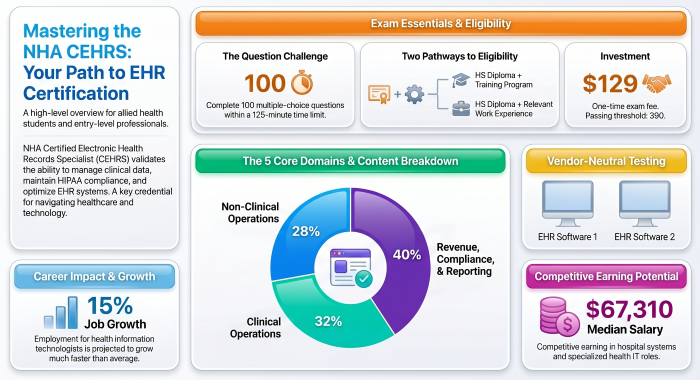
 The NHA Certified Electronic Health Records Specialist (CEHRS) exam validates your ability to navigate EHR software, manage clinical and administrative data, maintain HIPAA compliance, and generate reports within electronic health record systems. The exam consists of 125 multiple-choice questions — 100 scored and 25 unscored pretest items — with a 125-minute time limit, a $129 fee, and a passing threshold of 390 on a 200–500 scaled score. NHA launched the current CEHRS test plan on June 17, 2020, following a nationwide Job Task Analysis completed in 2019.
| Detail | Value |
|---|---|
| Full Name | Certified Electronic Health Records Specialist |
| Certifying Body | National Healthcareer Association (NHA) |
| Total Questions | 125 (100 scored + 25 unscored pretest items) |
| Time Limit | 125 minutes (2 hours, 5 minutes) |
| Question Format | Multiple-choice |
| Score Range | 200–500 scaled score |
| Passing Score | 390 |
| Exam Cost | $129 |
| Number of Domains | 5 content domains |
| Testing Options | School-sponsored, PSI testing center, or live remote proctoring |
| Certification Renewal | Every 2 years; 10 CE credits + $185 renewal fee |
| Current Test Plan | Launched June 17, 2020 (based on 2019 JTA) |
| NCCA Accredited | Yes |
What Is the NHA CEHRS Certification?
The CEHRS certification, administered by the National Healthcareer Association (NHA), demonstrates competence in operating, maintaining, and optimizing electronic health record systems within healthcare settings. NHA — founded in 1989 and headquartered in Leawood, Kansas — has awarded over 1 million certifications to date and is the largest allied health certification body in the United States.
Common responsibilities tied to CEHRS-certified roles include auditing patient records for compliance, abstracting clinical information for reports, performing basic coding for reimbursement claims, processing release of information (ROI) requests, and coordinating information exchange between providers and insurance professionals.
The CEHRS credential is often stacked with other NHA certifications — such as the CMAA or CBCS — to expand a professional's skill set and increase employability.
Who Is Eligible for the CEHRS Exam?
To sit for the CEHRS exam, candidates must meet one of two eligibility pathways established by NHA. Both pathways require a high school diploma or GED equivalency (or scheduling to earn one within 12 months).
-
Pathway 1 — Training Program: Completed an electronic health records specialist training or education program from an accredited or state-recognized institution within the last 5 years.
-
Pathway 2 — Work Experience: 1 year of supervised work experience in an EHR specialist field within the last 3 years, OR 2 years of supervised work experience in an EHR specialist field within the last 5 years.
Candidates apply through their free NHA online account, select a testing date and location, pay the $129 exam fee, and receive results within 2 business days for online exams. The printed certificate arrives within approximately 2 weeks.
Note: After 3 failed attempts, candidates must wait one year before retaking the exam.
What Are the 5 CEHRS Exam Domains?
The CEHRS exam covers 5 content domains, each weighted according to the number of scored items. The current test plan, based on the 2019 Practice Analysis Study, was launched on June 17, 2020.
CEHRS Exam Domain Breakdown (2026)
| # | Domain | Scored Items | % of Exam | Focus Areas |
|---|---|---|---|---|
| 1 | Non-Clinical Operations | 28 | 28% | Patient data management, scheduling, portal support, EHR training |
| 2 | Clinical Operations | 32 | 32% | Clinical templates, data exchange, documentation accuracy, CPOE support |
| 3 | Revenue Cycle/Finance | 15 | 15% | Coding (ICD, CPT, HCPCS), insurance verification, billing, claims |
| 4 | Regulatory Compliance | 15 | 15% | HIPAA Privacy Rule, HITECH Act, PHI security, access controls, audits |
| 5 | Reporting | 10 | 10% | Clinical and financial reports, ad hoc reports, QPP reporting |
| Total | 100 | 100% |
Clinical Operations is the heaviest domain at 32 items (32% of the scored exam), followed closely by Non-Clinical Operations at 28 items (28%). Together, these two operations domains account for 60% of the entire exam, making EHR navigation and data management the most critical areas for your preparation.
What Does Each CEHRS Domain Cover?
Domain 1: Non-Clinical Operations (28 Items — 28%)
Non-Clinical Operations is the second-largest domain and focuses on the administrative side of EHR management. Key tasks tested include verifying patient identifiers before documenting in the EHR, collecting and updating demographic and insurance information, generating encounter documentation (admission sheets, labels, armbands), and coordinating patient flow through scheduling, check-in, and check-out procedures, according to the NHA CEHRS test plan.
This domain also tests your ability to provide end-user EHR training to new hires, identify and reconcile data discrepancies across multiple systems, support patients with portal access, and maintain an inventory of EHR-related hardware such as e-signature pads, scanners, and tablets.
High-yield knowledge areas: Patient identifiers (MRN, EHR number, billing number), duplicate MRN prevention, scheduling templates, data validation techniques, National Provider Identifiers (NPIs), and IT escalation procedures.
Domain 2: Clinical Operations (32 Items — 32%)
Clinical Operations carries the heaviest weight on the CEHRS exam. This domain covers developing clinical templates for data capture, securely transmitting patient data to pharmacies and other providers, reviewing documentation for completeness, inputting real-time clinical data, and documenting patient historical data including medications, immunizations, and surgeries.
You are also expected to provide point-of-care EHR support for clinical staff, assist with computerized provider order entry (CPOE), and locate patient education materials within the EHR system.
High-yield knowledge areas: SOAP and SOAPIER charting formats, telehealth workflows, data encryption requirements, common documentation errors, charting requirements for diagnosis codes, and patient alerts and quality indicators.
Domain 3: Revenue Cycle/Finance (15 Items — 15%)
This domain tests your ability to navigate the financial side of EHR systems. Tasks include finding codes in ICD, CPT, and HCPCS databases; creating superbills and encounter forms within the EHR; entering diagnosis and procedure codes for claims processing; verifying insurance eligibility; obtaining and documenting prior authorizations; and collecting and posting payments.
High-yield knowledge areas: Medical necessity and code linkage, NCCI standards, Electronic Data Interchange (EDI), Explanation of Benefits (EOB), fee schedules, and health care revenue cycle concepts.
Domain 4: Regulatory Compliance (15 Items — 15%)
Regulatory Compliance tests your knowledge of HIPAA, the HITECH Act, and facility-level security policies. Tasks include maintaining confidentiality of protected health information (PHI), educating staff on compliance best practices, identifying non-compliant behaviors (sharing passwords, unlocked rooms), allocating role-based access controls, de-identifying PHI, releasing records in accordance with the HIPAA Privacy Rule, and participating in internal EHR audits.
High-yield knowledge areas: Types of PHI (email addresses, Social Security numbers, phone numbers), methods of de-identification, federal guidelines on breach reporting, data backup and recovery procedures, and penalties for noncompliance.
Domain 5: Reporting (10 Items — 10%)
Reporting is the smallest domain but requires strong analytical skills. You must run standardized financial and clinical reports, generate ad hoc reports using EHR fields, compile data for external reporting under the Quality Payment Program (QPP), and verify report accuracy before distribution.
High-yield knowledge areas: Data mining and extraction methods, quality improvement measures (average length of stay, patient outcomes, infection rates), and common reporting errors such as missing fields.
Which EHR Systems Should CEHRS Candidates Know?
While the CEHRS exam tests EHR competencies in a vendor-neutral manner, understanding the landscape of major EHR platforms provides valuable context for exam preparation and career readiness.
EHR Market Share Overview (2025)
| EHR Vendor | Acute Care Hospital Market Share | Notable Features |
|---|---|---|
| Epic Systems | 42.3% (Fierce Healthcare) | MyChart patient portal, integrated revenue cycle, clinical decision support |
| Oracle Health (Cerner) | 22.9% (Fierce Healthcare) | PowerChart, cloud-based deployment, Oracle AI integration |
| MEDITECH | 14.8% (Dark Daily) | Expanse platform, strong community hospital adoption |
| Other Vendors | ~20% | Athenahealth, eClinicalWorks, Veradigm |
According to KLAS Research data reported by Fierce Healthcare, Epic added 176 multispecialty hospitals and nearly 30,000 beds in 2024, achieving the largest net annual gain in its history. The CEHRS exam tests universal EHR competencies rather than vendor-specific workflows, but familiarity with patient portals, clinical decision support, CPOE, and role-based access controls transfers across all systems.
How Do HIPAA and Interoperability Relate to the CEHRS Exam?
HIPAA compliance and health information interoperability are foundational themes that run through multiple CEHRS domains. Domain 4 (Regulatory Compliance) directly tests HIPAA knowledge, but privacy and security concepts also appear in Domains 1, 2, and 5.
HIPAA Essentials for CEHRS Candidates
The Health Insurance Portability and Accountability Act (HIPAA) establishes national standards for protecting patient health information. The CEHRS exam tests your knowledge of:
-
The Privacy Rule: Governs who can access and disclose PHI and under what circumstances.
-
The Security Rule: Requires administrative, physical, and technical safeguards for electronic PHI (ePHI).
-
The HITECH Act: Strengthens HIPAA enforcement, expands breach notification requirements, and supports Meaningful Use of EHR technology.
Interoperability and FHIR
Interoperability — the ability of different EHR systems to exchange and use patient data — is increasingly critical. The CEHRS exam's Core/Foundational Knowledge section explicitly lists "interoperability concepts" (CK12) as testable content.
The HL7 Fast Healthcare Interoperability Resources (FHIR) standard has become the dominant framework for healthcare data exchange, with ONC and CMS mandating FHIR-based APIs under the 21st Century Cures Act. Understanding how EHR systems share data through Health Information Exchanges (HIEs) and FHIR APIs provides context for Domain 2 tasks involving data transmission to pharmacies, labs, and other providers.
How Should You Study for the CEHRS Exam?
The CEHRS exam is achievable with 6–8 weeks of focused preparation. The study plan below allocates time proportionally to domain weight, ensuring you spend the most effort on the highest-yield content areas.
6-Week CEHRS Study Plan
| Week | Focus Area | Domain(s) | Activities |
|---|---|---|---|
| 1 | EHR Foundations & Non-Clinical Operations | Domain 1 (28%) | Study patient data management, scheduling workflows, patient portal navigation, EHR hardware |
| 2 | Clinical Operations — Part 1 | Domain 2 (32%) | Clinical templates, SOAP/SOAPIER charting, documentation review, real-time data entry |
| 3 | Clinical Operations — Part 2 | Domain 2 (32%) | Data transmission/encryption, CPOE support, telehealth workflows, patient education tools |
| 4 | Revenue Cycle & Finance | Domain 3 (15%) | ICD/CPT/HCPCS coding basics, superbill creation, insurance verification, claims processing |
| 5 | Regulatory Compliance & Reporting | Domains 4–5 (25%) | HIPAA, HITECH, audits, de-identification, report generation, quality metrics |
| 6 | Full Review & Timed Practice | All domains | Complete a timed 125-question practice test; remediate weak areas |
Study Tips
-
Prioritize Clinical and Non-Clinical Operations. These two domains account for 60 of 125 scored items. Master EHR navigation, data entry, documentation accuracy, and clinical template workflows.
-
Understand HIPAA cold. Regulatory Compliance questions test specific knowledge of PHI types, de-identification methods, breach reporting requirements, and role-based access controls.
-
Use NHA's official study materials. NHA offers an interactive study guide with video case studies and practice assessments aligned to the current CEHRS test plan. The study guide includes 5 modules corresponding to the 5 exam domains.
-
Practice with timed conditions. With 125 questions in 125 minutes, you have 1 minute and 15 seconds per question — a comfortable pace, but scenario-based items may take longer.
-
Simulate with MedicoExam’s CEHRS practice tests to build exam-day confidence and identify knowledge gaps before the real thing.
Expert Insight: "The CEHRS exam is not about memorizing one particular EHR system — it's about understanding universal workflows: how data flows into the record, how it's secured, how it supports billing, and how it's reported. Candidates who focus on process over product consistently perform well." — Sarah Chen, RHIT, Health Information Management Program Director
What Career Paths Does CEHRS Certification Open?
CEHRS certification qualifies you for a range of positions across healthcare settings. The Bureau of Labor Statistics projects employment of health information technologists and medical registrars to grow 15% from 2024 to 2034, much faster than the average for all occupations, with approximately 6,200 new positions created annually, according to the BLS Occupational Outlook Handbook.
Common CEHRS Career Roles
| Role | Typical Setting | Key Responsibilities |
|---|---|---|
| EHR Specialist / Analyst | Hospitals, health systems | System configuration, end-user training, workflow optimization |
| Medical Records Technician | Clinics, physician offices | Record maintenance, ROI processing, chart auditing |
| Health Information Technician | Hospitals, insurance companies | Data abstraction, coding support, quality reporting |
| Patient Access Representative | Ambulatory care, urgent care | Registration, insurance verification, scheduling within EHR |
| EHR Implementation Specialist | Health IT vendors, consulting firms | Software deployment, onboarding, troubleshooting |
| Revenue Cycle Support Specialist | Clinics, billing departments | Claims workflow, prior authorization, code linkage |
CEHRS Salary Data
The Bureau of Labor Statistics reports a median annual wage of $67,310 for health information technologists and medical registrars as of May 2024. ZipRecruiter data specific to "Electronic Health Record Specialist" roles shows an average annual salary of $70,180, with the 25th percentile at $52,500 and the 75th percentile at $82,500.
| Salary Metric | Amount |
|---|---|
| National Median (BLS, May 2024) | $67,310/year |
| Average (ZipRecruiter, 2025) | $70,180/year |
| 25th Percentile | $52,500/year |
| 75th Percentile | $82,500/year |
| High-End Roles | $90,000+ in large systems or specialized health IT settings |
| Job Growth Outlook (BLS, 2024–2034) | 15% |
Salary varies significantly by location, employer type, and experience level. Professionals in large hospital systems and metropolitan areas tend to earn more than those in smaller clinics. Stacking the CEHRS with complementary credentials — such as the NHA CMAA or CBCS — can further increase earning potential by demonstrating dual competence in administrative and technical EHR workflows.
How Do You Register, Schedule, and Take the CEHRS Exam?
The registration process follows five straightforward steps outlined by NHA:
-
Create an NHA account at nhanow.com (free).
-
Submit your CEHRS exam application through the account portal, confirming eligibility.
-
Select your testing format — school-sponsored, PSI testing center, or live remote proctoring.
-
Pay the $129 exam fee and schedule your date.
-
Prepare using NHA study materials and third-party resources like MedicoExam’s CEHRS practice tests.
For online exams, NHA posts results to your account page within 2 business days. Your printed certificate arrives within approximately 2 weeks. If you test via written exam, results may take up to 2 weeks to post.
How Do You Renew Your CEHRS Certification?
CEHRS certification expires after 2 years. To renew, you must complete 10 continuing education (CE) credits and pay the $185 renewal fee, according to NHA's renewal page. NHA's continuing education courses are free for current certification holders, making the CE requirement easy to fulfill at no additional cost.
| Renewal Scenario | Requirements | Cost |
|---|---|---|
| Standard Renewal (before expiration) | 10 CE credits + renewal fee | $185 |
| Additional NHA Certifications | Same 10 CE credits cover all | $60 per additional cert |
| Late Renewal (30 days–1 year past expiration) | 15 CE credits + renewal fee + reinstatement fee | $376.50 |
| Expired > 1 Year | Must retake the CEHRS exam | $129 exam fee |
If you hold multiple NHA certifications, you only need 10 total CE credits — not 10 per credential — and pay $60 for each additional certification renewal beyond the first, according to NHA.
CEHRS vs. CMAA: Which NHA Certification Should You Choose?
Both the CEHRS and CMAA (Certified Medical Administrative Assistant) are NHA administrative-track certifications with identical exam structures — 125 questions (100 scored + 25 pretest) in 125 minutes. However, their focus areas differ significantly.
| Feature | CEHRS | CMAA |
|---|---|---|
| Focus | EHR software, data integrity, interoperability | Front desk operations, scheduling, insurance |
| Exam Fee | $129 | $117 |
| Domains | 5 (Non-Clinical Ops, Clinical Ops, Revenue Cycle, Compliance, Reporting) | 7 (Office operations, scheduling, records, insurance, HIPAA, EHR, communication) |
| Best For | EHR-focused technical roles, health IT | Front office administrative roles |
| Testing Time | 125 minutes | 125 minutes |
Choose CEHRS if your goal is to specialize in health information technology, EHR system management, and data integrity. Choose CMAA if you prefer a broader front-office administrative role. Many professionals earn both certifications to maximize versatility. For a detailed comparison, see our NHA CMAA vs CEHRS guide.
Frequently Asked Questions (FAQ)
Q1. How many questions are on the CEHRS exam?
-
The CEHRS exam contains 125 multiple-choice questions: 100 scored items that determine your pass/fail result and 25 unscored pretest items used by NHA to evaluate questions for future exams. You cannot identify which questions are pretest, so answer every question as if it counts.
Q2. What is the passing score for the CEHRS exam?
-
The CEHRS passing score is 390 on a 200–500 scaled score range. NHA uses scaled scoring rather than a raw percentage to ensure consistency across different exam forms.
Q3. How much does the CEHRS exam cost?
- The CEHRS exam costs $129. Some training programs include the exam fee in tuition. Renewal costs $185 every 2 years, with $60 for each additional NHA certification.
Q4. How long is the CEHRS exam?
-
You have 125 minutes (2 hours and 5 minutes) to complete all 125 questions. This gives you approximately 1 minute and 15 seconds per question.
Q5. Is the CEHRS exam hard?
-
The CEHRS exam is considered moderate in difficulty. It tests practical EHR knowledge rather than deep clinical expertise. Candidates with a solid understanding of EHR workflows, HIPAA regulations, basic medical coding, and clinical documentation typically pass with 6–8 weeks of preparation.
Q6. Can you take the CEHRS exam online?
-
Yes. NHA offers three testing options: school-sponsored proctoring, PSI testing centers, and live remote proctoring from any location with a stable internet connection, a webcam, and a quiet workspace.
Q7. What is the difference between CEHRS and RHIT?
-
The CEHRS (NHA) is an entry-level certification focused on EHR software operation and data management, requiring a high school diploma. The RHIT (AHIMA) is a more advanced credential in health information management that requires an associate degree from a CAHIIM-accredited program. RHIT holders typically earn higher salaries and qualify for supervisory roles.
Q8. How do you renew CEHRS certification?
-
Complete 10 continuing education (CE) credits and pay the $185 renewal fee every 2 years through your NHA account. NHA provides free CE courses to active certification holders.
Q9. What jobs can you get with CEHRS certification?
-
CEHRS-certified professionals work as EHR specialists, medical records technicians, health information technicians, patient access representatives, and EHR implementation specialists in hospitals, clinics, health systems, and remote positions.
Q10. Is the CEHRS certification worth it?
-
Yes. The BLS projects 15% job growth for health information technologists from 2024 to 2034, and the median annual wage is $67,310. CEHRS certification provides a credential recognized by employers nationwide that demonstrates EHR proficiency — a skill set in high demand as healthcare digitization accelerates.
Start Preparing for the CEHRS Exam Today
The CEHRS certification positions you at the intersection of healthcare and technology — a space where demand is growing at 15% over the next decade. With 125 questions across 5 clearly defined domains, a $129 exam fee, and flexible testing options, it is one of the most accessible paths into health information technology.
Build your confidence with simulation-based practice tests that mirror the real CEHRS exam format. Try MedicoExam’s CEHRS practice tests to identify your strengths, target your weak areas, and walk into exam day fully prepared.
For more NHA certification resources, explore the MedicoExam NHA Hub, or browse our guides on the CCMA, CPT, and CBCS exams.
Disclaimer: This guide is for informational purposes only. It does not contain actual exam questions or proprietary NHA content. Always verify current exam details, fees, and eligibility requirements on the official NHA website. Exam policies and pricing are subject to change.
Written by the MedicoExam Content Team — Healthcare Education Specialists at MedicoExam.com
- NHA CEHRS Question Bank |
- NHA CEHRS Eligibility & Requirements |
- NHA Electronic Health Records Specialist Practice Test |
- NHA CEHRS Exam Cost |
- NHA CEHRS Registration Process |
- NHA Electronic Health Records Specialist Study Guide |
- NHA CEHRS Recertification |
- NHA CEHRS Certification Overview |
- NHA Electronic Health Records Specialist Syllabus |
- NHA CEHRS Preparation Time |
- NHA CEHRS Passing Score |
- NHA CEHRS Exam Format |
- NHA Electronic Health Records Specialist Sample Questions |
- NHA CEHRS Career Opportunities |
- NHA CEHRS Exam Difficulty


