
Why 60% of the CRAT Exam Is Abnormal Rhythm Analysis
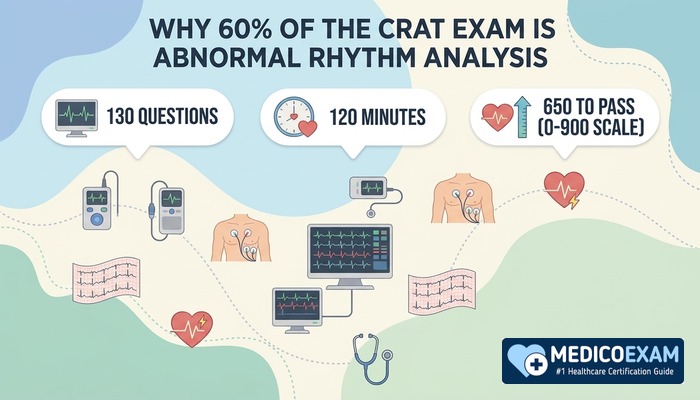
The CCI Certified Rhythm Analysis Technician (CRAT) exam has 130 questions, a two-hour limit and a passing score of 650 on a scale of 0-900. Abnormal rhythm analysis makes up 60% of it, so most of your preparation should go there. Below, the exam is taken apart area by area, and the study order follows the weightings.
Curious where you stand today? Sit the CRAT practice test cold and keep the result. Everything after this point helps you read that result.
What does the CRAT credential cover, and who is it for?
A rhythm analysis technician sits between the patient and the clinician who makes decisions. A monitoring device records the heart's electrical activity, and someone has to check that the recording is usable, recognise what it shows, and make sure the important findings reach the right person quickly. The CRAT credential is built around that job. Cardiovascular Credentialing International (CCI) awards it, and an employer reading it knows you cleared a common examination in cardiac rhythm analysis.
CCI describes the exam on its own page as one for professionals who use specialized monitoring equipment to analyze cardiac rhythms. You can read that description on CCI's Certified Rhythm Analysis Technician page, which is also where to confirm anything that can change, such as eligibility routes and fees.
The people who tend to sit this exam work in a few recurring settings. Hospital and cardiac telemetry units are the first, where monitors run around the clock. Ambulatory cardiac monitoring services are the second, where recordings arrive from patients who are at home. Cardiovascular diagnostic departments are the third. Job titles vary, and the syllabus summary on this site lists cardiac monitoring professionals, cardiovascular technologists and technicians, and allied health professionals as the typical audience.
This is exam preparation, not clinical teaching. Nothing here tells you how to treat a patient or what to do at a bedside. The exam asks you to recognise and report rhythms and to handle the monitoring workflow correctly, and that is what this guide helps you rehearse.
How is the CRAT exam structured: questions, time and scoring?
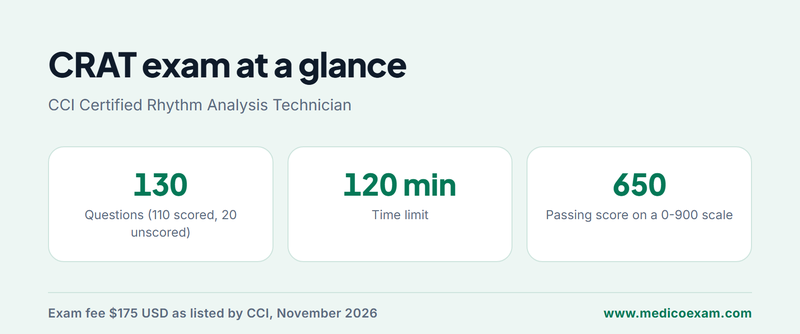
The exam has 130 questions, and you have 120 minutes to answer them. Of the 130, 110 are scored and 20 are unscored. The unscored items are not marked, yet nothing on screen identifies them, so give each question a full attempt. A passing score is 650 on a scale of 0-900, which the source sheet gives as approximately 72%.
| Item | CRAT exam detail |
|---|---|
| Certifying body | Cardiovascular Credentialing International (CCI) |
| Questions | 130 (110 scored and 20 unscored) |
| Time limit | 120 minutes |
| Passing score | 650 on a scale of 0-900 (approximately 72%) |
| Exam fee | $175 USD, as listed by CCI in November 2026 |
| Delivery | Computer-based, at Pearson test centers |
The table is only a summary; check every figure against CCI's current information before booking. One point deserves care: 650 on a 0-900 scale is a scaled result, and the approximate 72% is only a guide to its size. Scaled scoring does not map to a fixed number of right answers, so aim to finish timed practice comfortably above the line instead of calculating a minimum.
Time is not tight, but it is not generous either. Dividing 120 minutes by 130 questions gives about 55 seconds a question. Rhythm questions tend to ask you to look at a strip and decide, which most prepared candidates do quickly. Questions about monitoring procedure are wordier and take longer. If you rehearse with a timer, you will find where your own pace slows down, and that is worth knowing before exam day rather than during it.
What does the CRAT exam test, area by area?
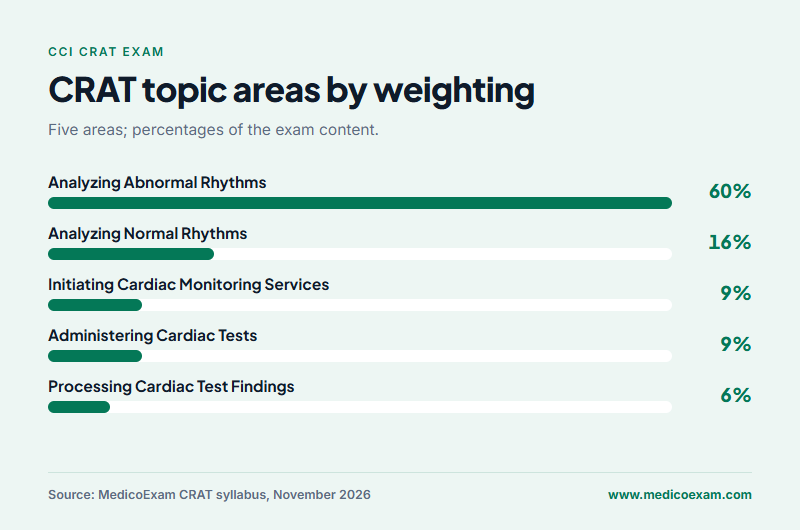
The syllabus page on this site, the CRAT exam syllabus, lists five topic areas with weightings. They add up to 100%, and the spread is very uneven.
| Topic area | Weighting |
|---|---|
| Analyzing Abnormal Rhythms | 60% |
| Analyzing Normal Rhythms | 16% |
| Initiating Cardiac Monitoring Services | 9% |
| Administering Cardiac Tests | 9% |
| Processing Cardiac Test Findings | 6% |
Analyzing Abnormal Rhythms (60%). This area is the exam. The topic list names atrial fibrillation, atrial flutter, other atrial arrhythmias, junctional arrhythmias, ventricular arrhythmias, asystole, ventricular tachycardia, ventricular fibrillation, paced rhythms, intraventricular conduction delays and AV conduction defects. It also includes recognising artifacts. Each is a recognition skill: you are shown a tracing or a description and asked to name what it is.
Analyzing Normal Rhythms (16%). You identify normal ECG components, relate the shape of the waveform to cardiac anatomy and physiology, and identify sinus rhythms by rate, regularity and wave shape. This area is smaller, but it supports the large one. You cannot reliably call a rhythm abnormal until you are sure what normal looks like on the same lead.
Initiating Cardiac Monitoring Services (9%). This is the start of the workflow. It covers verifying patient identification, reviewing the diagnosis, history or reason for monitoring, and giving education to patients or the care team about the service, the device, placement, safety and care.
Administering Cardiac Tests (9%). Here the topics are placing the monitoring device, judging the quality of the ECG, correlating patient symptoms with events or rhythms, and recognising standard ECG settings. Quality questions often involve interference and what to do about it.
Processing Cardiac Test Findings (6%). The last area covers prioritizing ECG results, compiling test findings and carrying out follow-up activities. It is the smallest, yet it is the part of the job that turns a recognised rhythm into an action that someone takes.
Read the topic list as a set of verbs. The exam asks you to identify, recognise, evaluate, correlate, prioritize and compile. Most of those are recognition and judgment tasks rather than recall of definitions, which is why practice with real-looking tracings matters more than rereading notes. When you review the syllabus, turn each bullet into a question you can answer aloud: how would I know this when I saw it, and what would I confuse it with?
It also helps to notice how the areas connect. A monitoring session starts with the right patient and a clear reason for monitoring, moves to a good-quality recording, produces rhythms that you analyze, and ends with findings that are ranked and passed on. Questions often sit at the joins between two areas, such as a poor-quality recording that hides a rhythm, or a symptom that must be matched to an event on the tracing. Studying the five areas as one workflow prepares you for those questions better than studying them as five separate lists.
Why does abnormal rhythm analysis carry 60% of the exam, and what does that mean for study?
The weighting reflects the job. A technician who watches monitors or reviews recordings is paid, above all, to notice rhythms that matter and to tell them apart from look-alikes and from noise. The exam therefore spends most of its questions on that skill, and a candidate who is strong there can absorb a weaker result elsewhere.
The practical consequence is simple. Of every ten questions you will meet, about six come from one area. If you split your hours evenly across all five areas, you will under-prepare for the part that decides the result. A better split gives abnormal rhythms the largest share of your time, normal rhythms the next, and the three workflow areas together a share that matches their combined weight.
Within the abnormal-rhythm area, group the topics by family, because the exam rewards telling similar rhythms apart. Atrial rhythms belong together: atrial fibrillation, atrial flutter and the other atrial arrhythmias. Junctional rhythms form their own family. Ventricular rhythms, including ventricular tachycardia and ventricular fibrillation, are a third. Asystole and paced rhythms are distinct enough to study on their own. The two conduction groups, intraventricular conduction delays and AV conduction defects, are a fifth. Artifacts cut across every family, because artifact can imitate several of the others.
For each family, build a short routine and repeat it on every strip. Ask whether the rhythm is regular. Ask about the rate. Look for a wave before each complex and for how the complexes relate to it. Look at the width and shape of the complex. A routine like this keeps you from jumping to the answer that looks most familiar, and it is the habit that separates a careful reader from a quick guesser.
How should you plan your study weeks for the CRAT?
Begin by sitting one complete timed paper and marking it area by area instead of as one total. The area breakdown tells you which families of rhythm you misjudge, and that is more useful than the total. Then work through the plan below, adjusting the time to your own gaps.
- Normal first. Make sure you can describe a normal tracing component by component and name the sinus rhythms by rate and regularity. Everything else is measured against this.
- Atrial and junctional rhythms. Practise telling fibrillation from flutter and both from the other atrial rhythms, then add junctional rhythms.
- Ventricular rhythms and asystole. Learn the features that separate ventricular tachycardia, ventricular fibrillation and asystole from fast rhythms that only look similar.
- Paced rhythms and conduction problems. Study what a paced tracing looks like, then the conduction delays and AV defects.
- Artifact and quality. Learn to recognise interference and what a technician does to reduce it, since this bridges the rhythm area and the testing area.
- Workflow areas. Review patient identification, placement, symptom correlation, prioritizing and follow-up.
- Mixed timed practice. Finish with full timed papers across all five areas.
Practice is the centre of this plan, not a final step. Reading about a rhythm helps you describe it, but only repeated exposure to strips teaches you to recognise it at a glance. Short daily sessions of strip recognition usually do more than a single long weekend session, because recognition improves with spacing.
A worked example of the weekly split makes the weighting concrete. Suppose you can give ten hours a week to preparation. Following the weightings, about six of those hours go to abnormal rhythms, one and a half to normal rhythms, and the remaining two and a half are shared between the three workflow areas. Adjust the figures to your baseline: if your first timed paper shows that you already handle patient identification and device placement comfortably, move those minutes to the rhythm families where your error log is longest.
Do not leave the final week for new topics. Use it to repeat full timed papers, review your log of missed features, and sleep properly. Candidates who arrive having just crammed a new rhythm family often confuse it with one they knew well the week before.
What does the CRAT cost, and how do you schedule it?
As of November 2026, CCI lists the CRAT examination fee at $175 USD. CCI states that every exam fee includes a non-refundable portion that covers the staff resources needed to review and process applications. That means a candidate who withdraws should not expect the whole fee back. Fees can change, so read CCI's own page before you pay.
The exam is computer-based and given at Pearson test centers year-round, depending on availability at each center. After CCI issues an Authorization to Test, a 90-day eligibility window begins, and the syllabus summary notes that one additional 90-day extension may be requested under CCI policy. In practice, you should not apply until your preparation is far enough along that you can use that window. Book a seat early in it, because popular slots can fill.
CCI also offers a Qualification Pathway tool on its page that asks whether you are a student or graduate of a cardiovascular or allied health training program, and uses your answers to point you to the exam pathway you qualify for. Use it, or read the qualification requirements on the CCI site, before you apply. Eligibility is set by CCI, and this site cannot decide it for you.
Which resources help, and where does practice fit?
The syllabus summary on this site lists a set of reference books for the exam. They include texts on cardiac pacing, pacemakers and resynchronization, electrocardiography for healthcare professionals, rapid ECG interpretation, the nuts and bolts of cardiac pacing, a pocket guide to basic dysrhythmias, and a self-instructional text on ECG interpretation. Choose one or two that you find readable rather than reading all of them, and use them to build the vocabulary and the reasoning that the rhythm area needs.
Reading builds understanding; questions build speed. Use the CRAT sample questions to see how items are phrased, then move to the full practice test when you are ready for timed work. Review every miss by asking which feature of the strip you overlooked. Keep a log of those features and review it before each new session.
Be careful with any preparation material that promises recalled or leaked exam questions. Ethical preparation uses practice items that teach the skill. Recalled questions break the rules of the testing program and do not prepare you for the version of the exam you will actually meet.
Use the error log as your main study tool. For each question you miss, write down the area, the rhythm family or workflow step involved, and the single feature or fact you overlooked. After a week you will see patterns, and the patterns tell you more than any total score. A candidate who keeps missing the same two or three distinctions has a short, fixable list, while one who misses things at random needs more general exposure to strips.
Which mistakes cost CRAT candidates the most marks?
Studying all five areas equally. The weighting is lopsided on purpose. Giving the 6% area the same hours as the 60% area leaves you weakest where it counts most.
Memorising pictures instead of features. A rhythm that looks a little different from the one in your notes can still be the same rhythm. Learn the features that define it, such as regularity, rate, the relationship between waves and the width of the complex, and apply them to every new strip.
Treating artifact as an afterthought. Artifact appears in the abnormal-rhythm topics and in the testing area, so it is tested twice. Candidates who cannot separate interference from a real rhythm lose marks in both places.
Skipping the workflow questions. Patient identification, device placement and follow-up carry weightings of 9%, 9% and 6%, which is nearly a quarter of the exam between them. These questions are often the most readable on paper, and they are easier to win with a little revision.
Practising without a clock. At about 55 seconds a question, you have time to think, but not unlimited time. Candidates who only practise untimed are often surprised by how long the wordier questions take.
Ignoring the unscored questions. Twenty of the 130 questions do not count, and you cannot identify them. Spending extra time hunting for them wastes minutes you need elsewhere. Answer every question as if it counts.
When is the right moment to book the CRAT exam?
Readiness is easier to judge with a rule than with a feeling. Use three tests. First, your timed practice scores should sit clearly above the 72% guide across several full papers, not just one good day. Second, your abnormal-rhythm results should be your strongest or close to it, since that is the area worth 60%. Third, your misses should be scattered. If the same family of rhythms keeps appearing in your error log, you are not ready on that family, however good the total looks.
When those three tests agree, book your seat and use the remaining days for light review rather than new material. On the last evening, check your appointment, your identification and the route to the test center, and then rest. The exam rewards a clear head and a steady routine.
To rehearse under real conditions, retake the practice test under timed conditions, compare your area scores with the weightings above, and let the gaps decide what you study next. Confirm eligibility, the current fee and the scheduling rules on the CCI website before you apply.
Frequently Asked Questions
How many questions are on the CRAT exam?
The CCI Certified Rhythm Analysis Technician exam has 130 questions and a 120-minute time limit. Of those, 110 are scored and 20 are unscored. Expect roughly 55 seconds per question, which timed practice will help you get used to.
What is the CRAT passing score?
You need 650 on the 0-900 scale, roughly 72% by the sheet we use. Because the result is scaled, no fixed number of correct answers is guaranteed to pass; keep your timed practice scores comfortably above that mark.
What topics does the CRAT exam cover?
Five areas: Analyzing Abnormal Rhythms at 60%, Analyzing Normal Rhythms at 16%, Initiating Cardiac Monitoring Services at 9%, Administering Cardiac Tests at 9% and Processing Cardiac Test Findings at 6%. Check CCI's own page for any change to this outline.
How much does the CRAT exam cost?
As of November 2026 CCI lists $175 USD for the CRAT examination. CCI says every exam fee includes a non-refundable portion for reviewing and processing applications. Fees change, so confirm the current amount on CCI's page before paying.
Where do you take the CRAT exam?
Testing happens by computer at Pearson centers throughout the year, subject to seat availability. Your window to sit runs 90 days from the Authorization to Test, with one further 90-day extension possible under CCI policy.
Which CRAT area should you study first?
Start with normal rhythms so you know the baseline, then give most of your time to abnormal rhythms, which make up 60% of the exam. Add the three workflow areas, worth 9%, 9% and 6%, and finish with mixed timed practice across all five.
- CCI CRAT Eligibility & Requirements |
- CCI CRAT Registration Process |
- CCI Rhythm Analysis Technician Study Guide |
- CCI CRAT Certification Overview |
- CCI Rhythm Analysis Technician Syllabus |
- CCI CRAT Preparation Time |
- CCI CRAT Passing Score |
- CCI CRAT Exam Format |
- CCI CRAT Certification Practice Exam |
- CCI CRAT Exam Sample Questions


