AHIMA Coding Associate Syllabus

Explore 3 resources related to AHIMA Coding Associate Syllabus on MedicoExam. These resources help certification candidates understand key aspects of exam preparation, including exam structure, study strategies, and expectations for scenario-based or applied assessments. Reviewing these materials can help improve readiness and confidence before attempting the certification exam.

AHIMA CCA vs CCS: Which Medical Coding Credential Is Right for You?

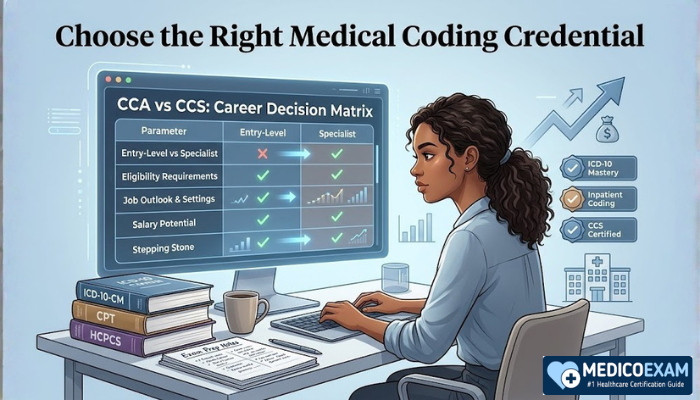
Medical coding student choosing between CCA and CCS certification with laptop, notes, and decision matrix graphic

Choose the CCA if you are an entry-level coder with no professional experience. Choose the CCS if you have 2 or more years of hands-on coding experience and want to specialize in complex hospital inpatient coding. The CCA validates foundational competency across both inpatient and outpatient settings, while the CCS is a mastery-level credential recognized as the gold standard for hospital-based medical coding. The CCS exam has a first-time pass rate estimated at just 40–50%, compared to approximately 70% or higher for the CCA, reflecting a significant gap in difficulty (AMBCI).

AHIMA CCA Certification Exam Syllabus

AHIMA CCA syllabus for AHIMA Certified Coding Associate (CCA) preparation

Welcome to the official MedicoExam syllabus guide for the AHIMA Certified Coding Associate certification. This page delivers a clear, structured overview of the AHIMA CCA exam, including key exam details, syllabus topics, and preparation references to support effective study planning. The AHIMA Certified Coding Associate (CCA) is intended for professionals pursuing roles aligned with Medical Coding, with assessment centered on applied competencies such as ICD coding, CPT coding, Health record documentation review within real-world settings like Hospitals, Physician offices, Healthcare organizations and related settings.

The syllabus outline below reflects the core domains and expectations defined by the official AHIMA certification framework and aligns with the cognitive and professional standards assessed in the AHIMA CCA exam. Candidates can use this guide alongside official vendor resources and structured practice to align their preparation with current exam standards and professional expectations for Entry-level medical coders, Health information technicians, Coding and billing professionals

AHIMA CCA Exam: What It Is, How to Prepare, and Why It Matters

CCA certification overview infographic showing eligibility, exam details, costs, and pass rate trends.Medical coding is one of the few healthcare careers where skill, certification, and accuracy directly translate into employability. If you are considering entering healthcare without years of clinical training, the AHIMA certification, specifically the Certified Coding Associate (CCA), offers a globally recognized entry point.

As someone who has guided professionals through compliance-driven certifications, I can say this clearly: coding credentials succeed when they combine technical precision with real-world healthcare workflows. That’s exactly where AHIMA’s CCA stands out.

This guide explains what the CCA certification is, how to earn it, how to prepare strategically, and whether it’s worth your time and investment especially if you’re aiming for long-term growth in health information management.

What Is AHIMA Certified Coding Associate (CCA) Certification?

The AHIMA Certified Coding Associate (CCA) certification validates foundational competency in medical coding across inpatient and outpatient healthcare settings using ICD-10-CM, CPT, and HCPCS systems.

Syndicate content