
AHIMA CCA Exam: What It Is, How to Prepare, and Why It Matters
 Medical coding is one of the few healthcare careers where skill, certification, and accuracy directly translate into employability. If you are considering entering healthcare without years of clinical training, the AHIMA certification, specifically the Certified Coding Associate (CCA), offers a globally recognized entry point.
As someone who has guided professionals through compliance-driven certifications, I can say this clearly: coding credentials succeed when they combine technical precision with real-world healthcare workflows. That’s exactly where AHIMA’s CCA stands out.
This guide explains what the CCA certification is, how to earn it, how to prepare strategically, and whether it’s worth your time and investment especially if you’re aiming for long-term growth in health information management.
What Is AHIMA Certified Coding Associate (CCA) Certification?
The AHIMA Certified Coding Associate (CCA) certification validates foundational competency in medical coding across inpatient and outpatient healthcare settings using ICD-10-CM, CPT, and HCPCS systems.
Issued by the American Health Information Management Association, the CCA is designed for early-career professionals who want employer-recognized proof of coding accuracy, compliance awareness, and reimbursement knowledge.
What the CCA Certification Covers
The CCA confirms your ability to:
-
Apply diagnosis and procedure codes correctly
-
Understand reimbursement methodologies
-
Maintain compliant health records
-
Protect patient privacy and data integrity
-
Use healthcare information technologies effectively
This makes it ideal for:
-
Medical coding beginners
-
Nursing and allied health graduates
-
Career changers entering healthcare
-
Healthcare educators validating baseline competence
The official certification overview is available on the AHIMA site and aligns with the published content outline.
How to Get AHIMA CCA Certification: Eligibility, Exam & Registration
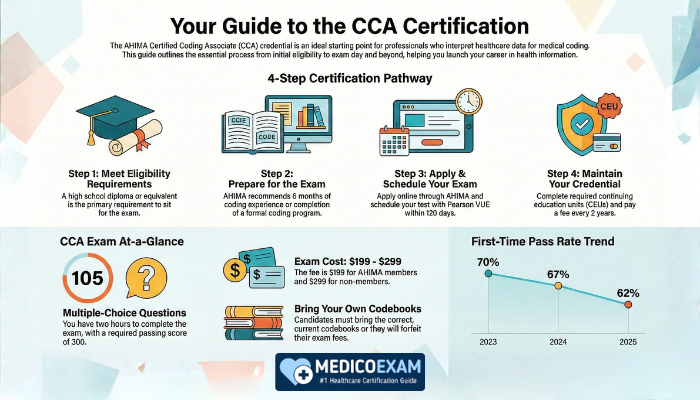
To earn AHIMA CCA certification, candidates must register with AHIMA, meet eligibility guidelines, pass the CCA exam, and adhere to AHIMA’s professional standards.
Eligibility Requirements
AHIMA does not mandate formal experience, but it strongly recommends:
-
Completion of a medical coding program or
-
At least 6 months of relevant coding experience
This flexibility allows global candidates to qualify without regional licensing barriers.
Registration Process
-
Create an account on AHIMA’s certification portal
-
Submit your CCA application
-
Schedule the exam through the approved testing provider
-
Pay the exam fee
Official application steps are published by AHIMA and updated periodically.
CCA Exam Cost
-
$199 for AHIMA members
-
$299 for non-members
-
Retake fees are the same as the original exam cost
Membership often pays for itself if you plan multiple certifications.
AHIMA CCA Exam Format, Syllabus, and Key Topics
The AHIMA CCA exam includes 105 multiple-choice questions, lasts 2 hours, and requires a scaled passing score of 300.
Exam Structure
-
Total Questions: 105
-
Scored Questions: 90
-
Pretest Questions: 15 (unscored)
-
Time Limit: 2 hours
-
Passing Score: 300
Content Domains Breakdown
1. Domain – Clinical Classification Systems (30–34%)
-
ICD-10-CM diagnosis coding
-
CPT and HCPCS procedure coding
-
Code sequencing rules
-
Official coding guidelines
2. Domain – Reimbursement Methodologies (21–25%)
-
Medicare and Medicaid basics
-
Prospective payment systems
-
DRGs and APCs
-
Medical necessity
3. Domain – Health Records and Data Content (13–17%)
-
Documentation standards
-
Data quality
-
Health record components
4. Domain – Compliance (12–16%)
-
Fraud and abuse laws
-
Coding ethics
-
Audit readiness
5. Domain – Information Technologies (6–10%)
-
EHR systems
-
Encoder tools
-
Health data workflows
6. Domain – Confidentiality and Privacy (6–10%)
-
HIPAA fundamentals
-
Data security principles
-
Patient rights
The official AHIMA content outline PDF provides authoritative topic weightings.
Best Way to Prepare for the CCA Exam: Practice Tests, Questions & Study Guide
The most effective way to prepare for the CCA exam is combining structured study with timed practice tests that simulate real exam pressure.
A Practical Study Strategy That Works
1. Master the Coding Guidelines First
Many candidates fail not due to lack of knowledge, but misapplication of rules. Focus heavily on:
-
ICD-10-CM conventions
-
CPT modifier usage
-
Sequencing principles
2. Use Practice Tests Early
A high-quality Certified Coding Associate CCA practice test helps you:
-
Identify weak domains
-
Improve time management
-
Reduce exam anxiety
Instead of waiting until the end, integrate practice questions weekly. Platforms like MedicoExam’s AHIMA practice environment allow topic-wise testing aligned with AHIMA’s blueprint.
3. Analyze Your Errors
The real learning happens after each test:
-
Why was the code incorrect?
-
Was documentation insufficient?
-
Did reimbursement logic override coding accuracy?
4. Simulate Exam Conditions
-
Complete at least two full-length CCA exam practice tests under strict timing to build confidence.
5. Use Structured Study Guides
-
A Free CCA exam study guide PDF can help with revision, but it should supplement not replace active testing.
Is CCA Certification Worth It? Career Benefits, Salary & Growth Opportunities
Yes, CCA certification is worth it for entry-level professionals seeking validated coding credentials and long-term career mobility in healthcare.
Career Advantages
-
Recognized by hospitals, clinics, and insurers
-
Signals compliance-ready coding skills
-
Improves interview shortlisting
Salary Outlook
While salaries vary by region and employer, certified coders generally earn more than non-certified peers and access better advancement opportunities.
Growth Path After CCA
The CCA often leads to:
-
CCS (Certified Coding Specialist)
-
HIM analyst roles
-
Compliance and audit positions
-
Healthcare data quality roles
For job seekers, certification reduces the “experience gap” employers often cite.
Common Mistakes Candidates Make
-
Memorizing codes instead of understanding guidelines
-
Ignoring reimbursement logic
-
Skipping compliance scenarios
-
Underestimating time pressure
Strong preparation focuses on decision-making, not rote recall.
FAQs
Q1. How difficult is the AHIMA CCA exam?
-
The CCA exam is considered moderately challenging. It tests applied coding knowledge rather than memorization. Candidates with structured preparation and regular practice tests typically find it manageable.
Q2. How long does it take to prepare for the CCA exam?
-
Preparation time varies, but most candidates spend 8–12 weeks studying. Those with healthcare or coding backgrounds may require less time, while career changers often need additional practice.
Q3. Can I retake the CCA exam if I fail?
-
Yes. AHIMA allows exam retakes, but candidates must pay the full exam fee again. Retake policies and waiting periods can change, so it’s best to review AHIMA’s current guidelines.
Q4. Is CCA certification worth it without experience?
-
CCA certification is especially valuable without experience. It demonstrates validated skills and helps employers trust your coding accuracy even if you’re new to healthcare coding.
Q5. Are practice tests really useful for CCA preparation?
-
Yes. Practice tests help identify weak areas, improve time management, and reduce exam stress. They are most effective when combined with guideline review and error analysis.
Q6. What is the passing score for the CCA exam?
-
The passing score for the CCA exam is 300 on a scaled scoring system. Raw score conversion varies by exam form.
Q7. Does the CCA certification expire?
-
Yes. AHIMA certifications typically require continuing education units (CEUs) for renewal. Renewal requirements can change, so always verify with AHIMA.
Q8. Can international candidates take the CCA exam?
-
Yes. The CCA exam is available globally through authorized testing centers, making it accessible to international healthcare professionals.
Conclusion
The AHIMA certification, specifically the Certified Coding Associate (CCA), remains one of the most practical and respected ways to enter healthcare coding. It balances technical rigor, regulatory awareness, and career flexibility qualities employers consistently value.
With disciplined preparation, strategic use of practice tests, and an understanding of real-world coding workflows, the CCA is not just an exam, it’s a career foundation.
For structured practice aligned with AHIMA’s blueprint, explore MedicoExam’s CCA preparation resources and review common questions in their certification FAQ section.
- AHIMA CCA Question Bank |
- AHIMA CCA Eligibility & Requirements |
- AHIMA Coding Associate Practice Test |
- AHIMA CCA Exam Cost |
- AHIMA CCA Registration Process |
- AHIMA Coding Associate Study Guide |
- AHIMA CCA Recertification |
- AHIMA CCA Certification Overview |
- AHIMA Coding Associate Syllabus |
- AHIMA CCA Preparation Time |
- AHIMA CCA Passing Score |
- AHIMA CCA Exam Format |
- AHIMA Coding Associate Sample Questions |
- AHIMA CCA Career Opportunities


