
AAPC vs AHIMA: Complete Comparison of Every Medical Coding Credential
 AAPC and AHIMA are the two dominant certification bodies in medical coding, but they serve different career paths. AAPC focuses on physician-office and outpatient coding with credentials like the CPC, while AHIMA covers the full spectrum of health information management — from entry-level coding (CCA) through hospital administration (RHIA). Choosing between them depends on whether you want to specialize in outpatient revenue cycle work or build a broader career in health information management.
This guide compares every credential from both organizations side by side — exam formats, costs, salary outcomes, and career paths — so you can make a confident decision in 2026.
How Do AAPC and AHIMA Compare as Organizations?
AAPC and AHIMA differ in origin, membership size, and professional focus. AAPC was founded in 1988 as the American Academy of Professional Coders, focusing on physician-based coding and revenue cycle management. It has grown to approximately 250,000 members worldwide across 41 countries. AHIMA traces its roots to 1928, making it nearly a century old, and represents over 67,000 health information professionals with more than 100,000 active credentials.
| Feature | AAPC | AHIMA |
|---|---|---|
| Founded | 1988 | 1928 |
| Full Name | American Academy of Professional Coders | American Health Information Management Association |
| Members | ~250,000 | ~67,000 (100,000+ active credentials) |
| Annual Membership | $229/year (student: $157) | $149/year Professional; $209 Premier (student: $49) |
| Primary Focus | Outpatient coding, billing, revenue cycle | Health information management, inpatient coding, data analytics |
| Total Credentials | 30+ (core + specialty) | 8 certifications |
| Exam Delivery | Pearson VUE or online proctored | Pearson VUE or remote proctored (select exams) |
| CEU Cycle | 36 CEUs every 2 years | 20–30 CEUs every 2 years (varies by credential) |
| Recertification Cost | Included with membership | $218/cycle (non-member); included for members |
| Open-Book Exams | Yes (code books allowed) | Yes (code books allowed for coding exams) |
| Headquarters | Salt Lake City, UT | Chicago, IL |
Key takeaway: AAPC is the larger organization by membership and focuses on the business side of healthcare. AHIMA is the older, more academically rooted body with deeper ties to health information management and hospital systems.
What Credentials Does AAPC Offer?
AAPC offers six core credentials that cover outpatient coding, facility coding, risk adjustment, inpatient coding, medical auditing, and billing. All AAPC core exams cost $399 for one attempt or $499 for two attempts. Active AAPC membership ($229/year) is required to sit for any exam.
| Credential | Full Name | Questions | Time | Focus Area | Passing Score |
|---|---|---|---|---|---|
| CPC | Certified Professional Coder | 100 MC | 4 hours | Outpatient/physician coding | 70% |
| COC | Certified Outpatient Coder | 150 MC | 5 hr 40 min | Facility outpatient coding | 70% |
| CRC | Certified Risk Adjustment Coder | 100 MC | 4 hours | Risk adjustment (HCC) coding | 70% |
| CIC | Certified Inpatient Coder | 60 MC + 10 coding cases | 5 hr 40 min | Inpatient/hospital coding | 70% |
| CPMA | Certified Professional Medical Auditor | 100 MC | 4 hours | Medical coding auditing | 70% |
| CPB | Certified Professional Biller | 135 MC | 4 hours | Medical billing and reimbursement | 70% |
All AAPC exams are open-book, allowing candidates to bring current CPT, ICD-10-CM, and HCPCS Level II code books. The CPC is by far the most popular credential — it is the entry point for most medical coding careers in physician-office settings.
AAPC also offers 20+ specialty credentials (e.g., COSC, CASCC, CEMC) that build on top of core certifications. These specialty exams cost $299 for one attempt.
What Credentials Does AHIMA Offer?
AHIMA offers seven primary credentials spanning entry-level coding through advanced health data analytics. Exam fees range from $199 to $329 for members and $299 to $399 for non-members. AHIMA membership is not required to sit for exams, but members receive significant discounts.
| Credential | Full Name | Questions | Time | Focus Area | Member Fee | Non-Member Fee |
|---|---|---|---|---|---|---|
| CCA | Certified Coding Associate | 105 (90 scored) | 2 hours | Entry-level coding | $199 | $299 |
| CCS | Certified Coding Specialist | 107 (97 scored) — MC + coding scenarios | 4 hours | Inpatient/outpatient hospital coding | $299 | $399 |
| CCS-P | Certified Coding Specialist — Physician-based | 121 (97 scored) — MC + coding scenarios | 4 hours | Physician-based coding | $299 | $399 |
| RHIT | Registered Health Information Technician | 150 (130 scored) | 3.5 hours | Health information technology | $229 | $299 |
| RHIA | Registered Health Information Administrator | 150 (130 scored) | 3.5 hours | HIM administration and leadership | $229 | $299 |
| CDIP | Certified Documentation Integrity Practitioner | 140 (106 scored) | 3 hours | Clinical documentation improvement | $259 | $329 |
| CHDA | Certified Health Data Analyst | ~130 | 3.5 hours | Health data analytics | $259 | $329 |
All AHIMA exams use a scaled scoring model of 100–400, with 300 as the passing threshold. The CCS and CCS-P exams include medical scenario–based coding sections in addition to multiple-choice questions, making them more complex than standard multiple-choice exams.
Important: The RHIT and RHIA credentials require completion of a CAHIIM-accredited degree program — an associate degree for RHIT and a bachelor's degree for RHIA. These are not open to candidates without specific academic backgrounds.
How Do the Coding Credentials Compare Head to Head?
The most common comparison is between AAPC's coding credentials and AHIMA's coding credentials. Here is how the primary pairs line up for candidates deciding between organizations.
CPC (AAPC) vs CCA (AHIMA) — Entry-Level Coding
Both the CPC and CCA serve as entry points into medical coding, but they differ in scope and employer perception. The CPC is the more widely recognized entry-level credential with over 200,000 holders. The CCA is AHIMA's entry-level option, designed for coders with less experience.
| Factor | CPC (AAPC) | CCA (AHIMA) |
|---|---|---|
| Focus | Outpatient/physician coding | General coding (inpatient and outpatient) |
| Questions | 100 MC | 105 (90 scored) |
| Time | 4 hours | 2 hours |
| Exam Fee | $399 | $199 (member) / $299 (non-member) |
| Eligibility | AAPC membership required; no degree needed | High school diploma; coding training recommended |
| Open Book | Yes | Yes |
| Pass Rate | ~70% (with AAPC training); ~27% overall | ~74% first-attempt (2021 data) |
| CEU Requirement | 36 CEUs / 2 years | 20 CEUs / 2 years |
| Best For | Physician offices, outpatient clinics | Entry-level hospital or clinic coding |
Verdict: The CPC is the stronger choice for most beginners because of its wider employer recognition and direct path to outpatient coding jobs. The CCA is a lower-cost starting point that can be upgraded to CCS later.
CPC (AAPC) vs CCS (AHIMA) — The Core Comparison
This is the most debated comparison in medical coding. The CPC and CCS certify different specialties and are not direct equivalents.
| Factor | CPC (AAPC) | CCS (AHIMA) |
|---|---|---|
| Focus | Outpatient/physician coding | Inpatient/hospital coding (with outpatient) |
| Questions | 100 MC | 107 total (MC + coding scenarios) |
| Time | 4 hours | 4 hours |
| Exam Fee | $399 | $299 (member) / $399 (non-member) |
| Difficulty | Moderate | Higher — includes scenario-based coding cases |
| Pass Rate | ~70% (AAPC-trained) | ~42% first-attempt (2021 data) |
| Average Salary | $67,147/year (2024 AAPC data) | ~$58,000–$70,000/year (industry estimate) |
| Code Systems | CPT, ICD-10-CM, HCPCS | ICD-10-CM, ICD-10-PCS, CPT, HCPCS |
| Best For | Physician offices, ASCs, outpatient facilities | Hospitals, health systems, inpatient facilities |
Verdict: Choose the CPC if you want to work in physician offices or outpatient settings. Choose the CCS if you want to work in hospitals and need inpatient coding expertise. The CCS is a harder exam but opens doors to higher-paying hospital positions.
CIC (AAPC) vs CCS (AHIMA) — Inpatient Coding
Both the CIC and CCS certify inpatient coding competency, making this the truest apples-to-apples comparison between the two bodies.
| Factor | CIC (AAPC) | CCS (AHIMA) |
|---|---|---|
| Questions | 60 MC + 10 coding cases | 97 scored (MC + scenarios) |
| Time | 5 hr 40 min | 4 hours |
| Exam Fee | $399 | $299 (member) / $399 (non-member) |
| Pass Rate | ~80% (AAPC-trained) | ~42% first-attempt |
| Code Systems | ICD-10-CM, ICD-10-PCS | ICD-10-CM, ICD-10-PCS, CPT, HCPCS |
| Best For | Inpatient coders who prefer AAPC | Inpatient coders in hospital/HIM departments |
Verdict: Both are respected for inpatient coding roles. The CCS has longer industry history and is preferred by many hospital HIM departments. The CIC is newer but growing in recognition, particularly among coders who already hold other AAPC credentials.
COC (AAPC) vs CCS-P (AHIMA) — Outpatient Facility and Physician Coding
The COC and CCS-P both address outpatient coding but from different angles. The COC focuses on facility outpatient coding (hospital outpatient departments, ASCs), while the CCS-P covers physician-based coding — similar to the CPC but issued by AHIMA.
| Factor | COC (AAPC) | CCS-P (AHIMA) |
|---|---|---|
| Questions | 150 MC | 121 (97 scored) — MC + scenarios |
| Time | 5 hr 40 min | 4 hours |
| Exam Fee | $399 | $299 (member) / $399 (non-member) |
| Focus | Facility outpatient coding (APC-based) | Physician-based coding across settings |
| Pass Rate | Not widely published | ~42–67% first-attempt (varies by year) |
| Best For | Hospital outpatient departments | Physician-based coding in AHIMA-oriented workplaces |
Verdict: The COC is the stronger credential for facility outpatient coding. The CCS-P is a viable choice if your employer specifically values AHIMA credentials for physician-based work, but the CPC has largely eclipsed the CCS-P in market demand.
What Are the Salary Differences Between AAPC and AHIMA Credentials?
Salary outcomes vary by credential, experience, and work setting. According to the 2025 AAPC Medical Coding and Billing Salary Report (based on 2024 data), AAPC-certified members earn an average of $65,401 annually. Certified members earn 8.9% more than uncertified peers, and members holding two or more AAPC credentials average $79,988 per year.
| Credential | Organization | Average Annual Salary (2024–2025 Estimates) |
|---|---|---|
| CPC | AAPC | $67,147 |
| CCS | AHIMA | $58,000–$70,000 (industry estimate) |
| CCA | AHIMA | $40,000–$50,000 |
| COC | AAPC | $60,000+ (industry estimate) |
| CRC | AAPC | $67,000+ (comparable to CPC per AAPC data) |
| CPMA | AAPC | $70,000–$100,000+ |
| CPB | AAPC | $50,000–$64,000 |
| RHIT | AHIMA | $46,000–$60,000 |
| RHIA | AHIMA | $70,000–$100,000+ |
| CDIP | AHIMA | $65,000–$85,000 |
| CHDA | AHIMA | $70,000–$90,000 |
Key salary findings:
The highest-earning AAPC credential is the CPMA, with experienced auditors earning $100,000+.
The highest-earning AHIMA credential is the RHIA, with HIM directors and compliance officers earning $100,000+.
Members holding three or more AAPC credentials average $84,414 annually.
Salary growth from entry-level to late career averages 42.3% for AAPC members.
"Certified professionals are consistently more valuable to employers. Our data shows year after year that credentials translate directly to higher earnings," notes the AAPC 2025 Salary Report.
Which Certification Should You Choose by Career Path?
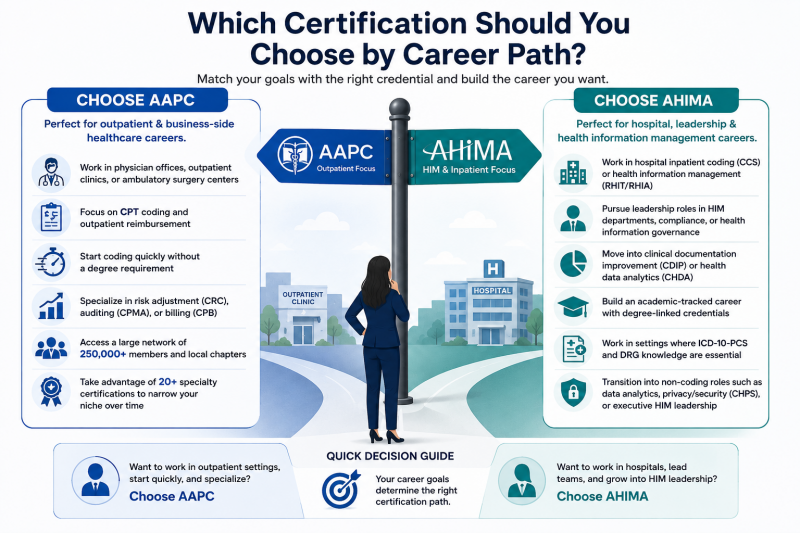
The right certification depends on where you want to work and how far you want to advance. Use this decision framework to match your goals with the right credential.
Choose AAPC if you want to:
-
Work in physician offices, outpatient clinics, or ambulatory surgery centers
-
Focus on CPT coding and outpatient reimbursement
-
Start coding quickly without a degree requirement
-
Specialize in risk adjustment (CRC), auditing (CPMA), or billing (CPB)
-
Access a large network of 250,000+ members and local chapters
-
Take advantage of 20+ specialty certifications to narrow your niche over time
Choose AHIMA if you want to:
-
Work in hospital inpatient coding (CCS) or health information management (RHIT/RHIA)
-
Pursue leadership roles in HIM departments, compliance, or health information governance
-
Move into clinical documentation improvement (CDIP) or health data analytics (CHDA)
-
Build an academic-tracked career with degree-linked credentials
-
Work in settings where ICD-10-PCS and DRG knowledge are essential
-
Transition into non-coding roles such as data analytics, privacy/security (CHPS), or executive HIM leadership
Career Path Recommendations by Role
| Target Role | Recommended Credential | Organization |
|---|---|---|
| Entry-level outpatient coder | CPC | AAPC |
| Entry-level general coder | CCA | AHIMA |
| Hospital/inpatient coder | CCS or CIC | AHIMA or AAPC |
| Physician-office coder | CPC or CCS-P | AAPC or AHIMA |
| Medical coding auditor | CPMA | AAPC |
| Risk adjustment coder (Medicare Advantage) | CRC | AAPC |
| Medical biller | CPB | AAPC |
| HIM technician | RHIT | AHIMA |
| HIM director/administrator | RHIA | AHIMA |
| CDI specialist | CDIP | AHIMA |
| Health data analyst | CHDA | AHIMA |
| Outpatient facility coder | COC | AAPC |
Is a Dual AAPC + AHIMA Certification Strategy Worth It?
Holding credentials from both AAPC and AHIMA is a proven way to maximize career flexibility and earning potential. Many experienced coders pursue dual certification to cover both outpatient and inpatient settings.
The Most Valuable Dual-Certification Combinations
| Combination | Why It Works | Ideal For |
|---|---|---|
| CPC + CCS | Covers outpatient (CPC) and inpatient (CCS) coding | Coders who want to work in any healthcare setting |
| CPC + RHIT | Combines coding expertise with HIM technical skills | Coders transitioning into HIM roles |
| CPMA + CCS | Pairs auditing expertise with inpatient coding depth | Compliance officers and coding managers |
| CRC + CCS | Risk adjustment plus inpatient coding | Coders in managed care or Medicare Advantage |
| CPC + CDIP | Outpatient coding plus CDI knowledge | CDI specialists with coding backgrounds |
The financial case for dual certification is strong. According to AAPC's 2024 salary data, members with two or more credentials earn an average of $79,988 per year — 19.4% more than single-credential holders. Those with three or more credentials average $84,414.
How to Build a Dual-Certification Path
-
Start with the CPC — It has the widest recognition and is the fastest path to employment.
-
Gain 1–2 years of coding experience in a clinical setting.
-
Add the CCS — This gives you inpatient coding capability and opens hospital positions.
-
Consider an advanced credential — CPMA (auditing), CRC (risk adjustment), or CDIP (documentation improvement) based on your interests.
The total investment for CPC + CCS dual certification is approximately $850–$1,100 (including exam fees and one year of memberships from both organizations), which typically pays for itself within the first year through salary increases.
Timing matters. Employers increasingly value versatility. A 2024 job market analysis shows that medical coding positions requiring both inpatient and outpatient experience have grown faster than single-setting roles. Holding a credential from each organization signals to hiring managers that you can handle any coding environment — from a small physician practice to a 500-bed hospital system.
Keep in mind that maintaining dual certifications does require meeting CEU requirements from both AAPC and AHIMA separately. However, many CE activities (webinars, conferences, coding workshops) can count toward both organizations' requirements, reducing the practical burden.
What Are the Total Costs for Each Credential in 2026?
Understanding the full cost — including membership, exam fees, and renewal — helps you budget accurately.
| Credential | Exam Fee | Required Membership | Year-1 Total Cost | Renewal Cost (2-year cycle) |
|---|---|---|---|---|
| CPC (AAPC) | $399 | $229/year | ~$628 | $458 (membership × 2) |
| COC (AAPC) | $399 | $229/year | ~$628 | $458 |
| CRC (AAPC) | $399 | $229/year | ~$628 | $458 |
| CIC (AAPC) | $399 | $229/year | ~$628 | $458 |
| CPMA (AAPC) | $399 | $229/year | ~$628 | $458 |
| CPB (AAPC) | $399 | $229/year | ~$628 | $458 |
| CCA (AHIMA) | $199–$299 | Optional ($149/year) | $199–$448 | $218 (non-member) or ~$149+/year (member) |
| CCS (AHIMA) | $299–$399 | Optional ($149/year) | $299–$548 | $218 (non-member recert) |
| CCS-P (AHIMA) | $299–$399 | Optional ($149/year) | $299–$548 | $218 |
| RHIT (AHIMA) | $229–$299 | Optional ($149/year) | $229–$448 | $218 |
| RHIA (AHIMA) | $229–$299 | Optional ($149/year) | $229–$448 | $218 |
| CDIP (AHIMA) | $259–$329 | Optional ($149/year) | $259–$478 | $218 |
| CHDA (AHIMA) | $259–$329 | Optional ($149/year) | $259–$478 | $218 |
Cost comparison insight: AAPC requires mandatory membership ($229/year) to sit for exams and maintain credentials, but membership includes recertification at no extra charge. AHIMA membership is optional, but non-members pay higher exam fees and a $218 recertification fee per cycle. For long-term credential holders, AAPC's all-inclusive model is often more cost-effective.
How Do CEU and Recertification Requirements Compare?
Both organizations require continuing education to maintain credentials, but the requirements and costs differ.
| Factor | AAPC | AHIMA |
|---|---|---|
| Recertification Cycle | 2 years | 2 years |
| CEUs for Primary Credential | 36 CEUs | 20 CEUs (CCA, CCS, CCS-P, RHIT) or 30 CEUs (RHIA, CDIP, CHDA) |
| Additional Credential CEUs | Additional CEUs per extra credential | +10 CEUs per additional credential |
| Recertification Fee | Included with membership | $218/cycle (non-member); varies for members |
| Free CEUs Included | 12 journal quiz + 4 webinar + chapter meeting CEUs | 5 CEUs/year (Professional); 8 CEUs/year (Premier) |
| Audit for Compliance | Random audit | Random audit |
According to professional coder community discussions, the AAPC membership at $229/year includes free recertification and generous free CEU access, while AHIMA's Professional membership at $149/year provides only 5 free CEUs and charges a separate recertification fee. For professionals maintaining multiple credentials, AAPC's model tends to cost less annually.
Frequently Asked Questions
Q1.Is AAPC or AHIMA better for beginners in 2026?
AAPC is generally better for beginners because the CPC exam has no degree requirement, a higher pass rate with proper training, and wider employer recognition for entry-level outpatient coding positions. AHIMA's CCA is a viable alternative with a lower exam fee ($199 for members), but the CPC opens more doors immediately.
Q2. Can I get both AAPC and AHIMA certifications?
Yes. Many experienced coders hold credentials from both organizations. The most popular combination is CPC (AAPC) + CCS (AHIMA), which covers outpatient and inpatient coding. Dual-credential holders earn an average of $79,988 annually.
Q3. Which certification pays more — CPC or CCS?
According to 2024 AAPC salary data, CPC holders earn an average of $67,147 per year. CCS holders working in hospital settings typically earn $58,000–$70,000. The CCS can lead to higher earnings in large hospital systems, while CPC salaries are strong in outpatient and multi-specialty practices.
Q4. Do employers prefer AAPC or AHIMA?
Employer preference depends on the work setting. Physician offices and outpatient facilities typically prefer AAPC credentials (CPC, COC, CRC). Hospitals and health systems with HIM departments often prefer AHIMA credentials (CCS, RHIT, RHIA). Many job postings accept either.
Q5. Is the CCS exam harder than the CPC?
Yes. The CCS has an estimated first-attempt pass rate of 42% (2021 AHIMA data), compared to approximately 70% for the CPC with AAPC-approved training. The CCS includes medical scenario–based coding cases that require assigning actual codes from patient records, making it more complex than the CPC's multiple-choice format.
Q6. Do I need a degree for AAPC or AHIMA certifications?
AAPC does not require a degree for any of its core coding credentials — only active membership and exam registration. AHIMA does not require a degree for CCA, CCS, or CCS-P coding exams, but the RHIT requires a CAHIIM-accredited associate degree and the RHIA requires a CAHIIM-accredited bachelor's degree.
Q7. How long does it take to prepare for these exams?
Preparation time varies by credential. The CPC typically requires 4–6 months of study. The CCA requires 2–4 months. The CCS is more demanding, with most candidates needing 8–12 weeks of focused study plus prior coding experience. Advanced credentials like CPMA, CDIP, and CHDA generally require several years of work experience before attempting the exam.
Q8. What is AAPC's membership cost in 2026?
AAPC annual membership dues are $229 for individuals and $157 for students in 2026. Membership is mandatory to take any AAPC exam and to maintain credentials.
Q10. Can I switch from AHIMA to AAPC or vice versa?
You do not need to "switch" — you can hold credentials from both organizations simultaneously. However, there is no credit transfer between the two. You must take each organization's exam independently, regardless of existing credentials from the other body.
Q11. Which organization has better study resources?
Both offer comprehensive study materials. AAPC provides official study guides, online practice exams, and instructor-led courses. AHIMA offers exam prep books and partners with approved training programs. MedicoExam offers simulation-based practice tests for both AAPC and AHIMA credentials, allowing you to practice in a realistic exam environment.
Start Your Medical Coding Certification Journey
Whether you choose AAPC, AHIMA, or both, thorough exam preparation is the key to passing on your first attempt. MedicoExam.com offers simulation-based practice tests for both AAPC certifications (including CPC) and AHIMA certifications (including CCS and CCA). Each practice exam mirrors the real test format, question types, and timing — so you walk into exam day confident and ready.
Explore MedicoExam practice tests →
Disclaimer: This article is for informational purposes only. Exam details, fees, and requirements are subject to change. Always verify current information on the official AAPC and AHIMA websites before registering. MedicoExam.com is not affiliated with AAPC or AHIMA. This content does not contain actual exam questions or proprietary material from either organization.
Written by the MedicoExam Content Team — Healthcare Education Specialists at MedicoExam.com
- American Health Information Management Association (AHIMA) |
- American Academy of Professional Coders (AAPC) |
- Healthcare Certification Prep |
- Medical Certification Practice |
- AHIMA Certification Practice Exams |
- AHIMA Test Prep |
- AHIMA Sample Questions |
- AHIMA Mock Exam |
- AAPC Certification Practice Exams |
- AAPC Test Prep |
- AAPC Sample Questions |
- AAPC Mock Exam |
- CCA |
- CCS |
- CCS-P |
- RHIT |
- RHIA |
- CDIP |
- CHDA |
- CHPS |
- CPC |
- CPB |
- CRC |
- COC |
- CEMC |
- CIC |
- CASCC |
- CANPC |
- CCC |
- CCVTC |
- CEDC


