
Beyond the CPC: What the CPMA Adds When a Coder Starts Auditing
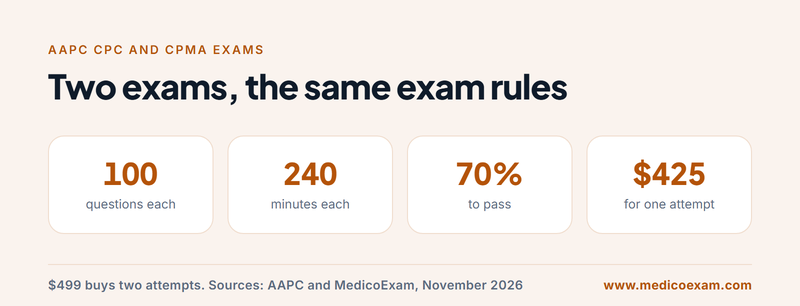
Two credentials from AAPC, the Certified Professional Coder (CPC) and the Certified Professional Medical Auditor (CPMA), share one set of exam rules: 100 questions, 240 minutes and a 70 percent pass mark each. What differs is the job. The CPC proves you can assign codes to outpatient and physician services; the CPMA proves you can review those records and judge whether the codes and the documentation are right.
If you already know which exam you are heading for, the practice tests are here: CPC and CPMA are the two practice exams MedicoExam offers. Still deciding? Keep reading. The figures below were taken from MedicoExam's exam data sheet, the AAPC pages for the CPC and the CPMA, and the MedicoExam syllabus and product pages; the few others are plain arithmetic on them.
Are the CPC and the CPMA the same kind of credential?
No. They share a certifying body, a fee and a format, but they answer different questions about a person. The CPC answers "can this person turn a medical record into correct codes?" The CPMA answers "can this person read a record and the codes someone else chose, and say whether they stand up?" One is a production skill, the other is a review skill, and employers usually ask for them at different points in a career.
On its CPC page AAPC calls the credential the most respected one in medical coding and the right starting point, since it lays groundwork for whichever coding path you pick later. Its suggested next steps run from inpatient work and risk adjustment to compliance, auditing and specialty credentials. So the certifying body itself treats auditing as a natural direction for a coder, and the CPMA is the credential made for it.
The CPMA page is written for a different reader. AAPC aims it at coders and billers ready to move into auditing roles, at auditors and compliance professionals who want formal validation, at revenue integrity specialists who monitor claim accuracy, and at administrators who oversee compliance, risk management and audit programs. The word that recurs is review: reviewing records, reviewing coding accuracy and reviewing documentation against federal rules and payer policy.
This guide is about exam preparation. It describes what each certification covers and how the exams are built, so you can choose a study path. It gives no clinical guidance, and it makes no promise about pass results, salary or jobs.
What do the two exams have in common, and where do they split?
On paper the exams are twins. Both papers run to 100 questions in a 240-minute window, both need a 70 percent mark, and both carry the same voucher price: $425 buys one try and $499 buys two. Dividing the time by the questions gives 144 seconds for every question on either exam, and a 70 percent mark on 100 questions means 70 correct answers. Those shared numbers make it tempting to treat the choice as a coin toss. It is not, because the content, the training cost and the renewal workload all differ.
| Point | CPC | CPMA |
|---|---|---|
| Full name | AAPC Certified Professional Coder | AAPC Certified Professional Medical Auditor |
| Core skill | Translating outpatient and physician services into diagnosis, procedure and supply codes | Reviewing records, coding accuracy and documentation for compliance |
| Number of questions | 100 | 100 |
| Allowed time | 240 minutes | 240 minutes |
| Pass mark | 70 percent | 70 percent |
| Voucher price | $425 (one try) or $499 (two tries) | $425 (one try) or $499 (two tries) |
| AAPC training course | From $2,799 | From $1,295 |
| Upkeep | Yearly AAPC membership plus 36 CEUs per two-year cycle | Yearly AAPC membership plus 40 CEUs per two-year cycle |
| Largest exam block | Cases, 10 questions, with the CPT surgical series at 6 each | Medical record auditing abstraction, 36 questions |
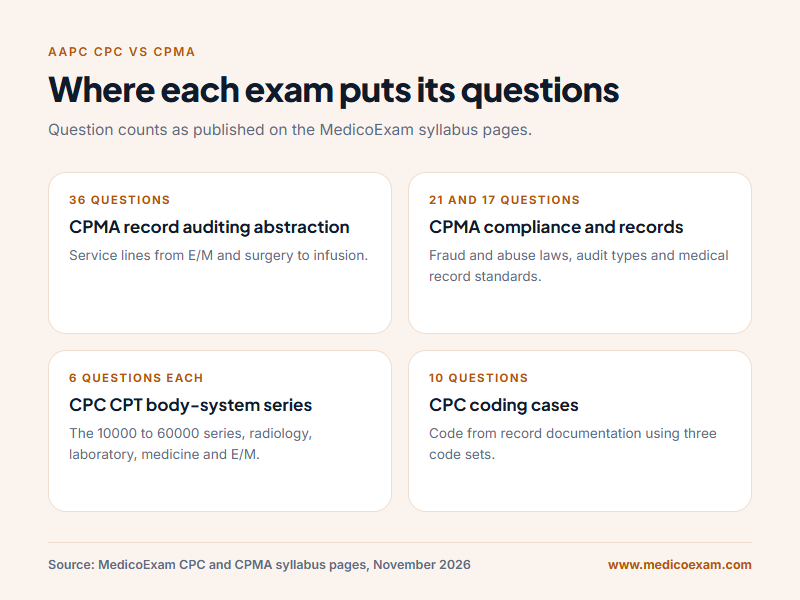
Read the last row twice. The CPC spreads its 100 questions across about twenty topic areas, none larger than ten questions. The CPMA puts more than a third of its questions into one block, audit abstraction, and puts 21 more into compliance and 17 into records standards. A broad exam rewards steady coverage; a concentrated exam rewards depth in a few places.
What does the CPC exam actually test?
MedicoExam's CPC syllabus page gives a question count for every topic area. Terminology and anatomy are worth four questions apiece; compliance is worth three, guidelines seven, ICD-10-CM five and HCPCS Level II three, which totals 26 for those first six areas. Each of six surgical CPT series (10000 through 60000) is worth 6, a subtotal of 36. Four more areas, namely radiology, lab and pathology, medicine, and E/M, are also worth 6 each, adding 24. Anesthesia has four and the coding cases ten.
Within compliance the syllabus mentions the four Medicare parts, place of service reporting, fraud and abuse, plus NCCI edits, coverage determinations, HIPAA, ABNs and RVUs. The coding guidelines area covers the ICD-10-CM Official Guidelines for Coding and Reporting, CPT guidelines and parenthetical notes, and modifier use. AAPC adds that the paper checks how well you apply procedure codes from CPT, procedure and supply codes from HCPCS Level II, and diagnosis codes from ICD-10-CM, and that candidates should arrive comfortable with terminology, anatomy and pathophysiology.
What this means for study is simple: the CPC is a breadth exam. A candidate who is strong in surgical coding but has never practised anesthesia time reporting or HCPCS supply codes gives away easy marks. The ten case questions are different again, since each hands you a record and expects every relevant code from all three code sets, so they reward habits built through practice and not through memorising lists.
What does the CPMA exam actually test?
The CPMA blueprint on the MedicoExam syllabus page has seven areas. Record standards and documentation guidelines are worth 17 questions, compliance and regulation 21, and coding and reimbursement concepts 13. Sampling and audit scope add 7, quality assurance and risk analysis 2 and reporting of findings 4. The last and biggest block, 36 questions, is audit abstraction, with service lines such as E/M, surgery, therapy, imaging, psychiatry, oncology with hematology, and infusion.
The compliance topics read like an auditor's toolkit. They include the compliance plan, penalties and false-claims law, the Stark Law, the OIG Work Plan, correct coding edits, CMS guidance on E/M documentation, integrity agreements and recovery audits. On the records side you meet HIPAA privacy, retention rules, advance beneficiary notices, legal requirements of a record and the reading of an operative report.
AAPC's own page describes the same skills in plain terms: the audit life cycle from planning through reporting and follow-up, prospective, retrospective, random and focused audits, spotting undercoding, overcoding and unbundling, and writing corrective action plans. It also states that the exam is difficult and high level and is not meant for people without training or experience, and that examinees should have training or experience in auditing physician services and be well versed in different audit types, including E/M.
Notice what changes compared with the CPC. The coding concepts are still there, but they are one of seven areas and not the whole exam. You are expected to apply them while reading someone else's record, and to explain a finding, because communication of results and sampling are on the blueprint.
Which exam is harder to prepare for?
AAPC publishes no difficulty ranking, so no honest answer says one exam is simply harder. What you can compare is the entry point. The CPC page notes that its training assumes strong terminology, anatomy and pathophysiology, and it points people without that background to prerequisite courses. The CPMA page goes further and warns that the exam is not intended for individuals lacking training or experience. If you have never coded, the CPC is the door AAPC leaves open; the CPMA expects you to arrive with audit exposure or a course behind you.
Time pressure is identical on paper, at 144 seconds a question, but it is felt differently. A CPC question can take minutes when it is a case that needs several code sets, while a recall question on a sampling term may take seconds. A CPMA abstraction question asks you to review documentation for a service type, which is slow reading. Both exams reward a first pass that banks the quick questions and returns to the slow ones, so practise with the clock on.
Delivery differs slightly in what AAPC and MedicoExam publish. For the CPC AAPC offers a choice between a remote live proctor at home and a testing center, and says to register three weeks ahead of the date you want. The CPMA is an electronic exam too, but its syllabus entry names Meazure Learning, whether you test from home or at one of its centers, and says you schedule once the voucher is bought and Meazure sends a Notice to Schedule. Read the current rules on AAPC before you buy, because scheduling terms change.
How do cost, training and renewal compare?
The voucher gives you nothing to decide on, because the two cost the same. Buying the two-try version adds $74 to the single-try price for both. Prices elsewhere differ. AAPC's training course for the CPC starts at $2,799, and the CPMA course starts at $1,295, a gap of $1,504. If you already hold a coding credential and have audit experience, the CPMA path can be the cheaper one to fund.
Renewal is where the two credentials part ways again. To keep the CPC, AAPC asks for a current yearly membership and 36 continuing education units across each two years. The CPMA asks for the membership and 40 units, four more per cycle. The CPMA page also speaks of maintaining dual credentials, so if you hold both, confirm with AAPC how your units are counted instead of assuming they simply add up.
On the MedicoExam side, each practice exam costs $41.30 and includes more than 200 questions, timed mock exams, a result history and access for two months. They are separate products, so you can begin with one and add the other later.
Should you take the CPC first, the CPMA first, or both?
For most readers the order is set by experience. Someone new to coding, or coming from an administrative or clinical support role, has a clear route: the CPC first. AAPC describes exactly those groups as its audience, and the CPC builds the vocabulary of codes and guidelines that auditing later depends on. An auditor who cannot code cannot tell whether a code is right.
A working coder with experience in physician services, who now spends time answering questions about denials or documentation, has a case for the CPMA. AAPC lists coders and billers ready to move into auditing roles as its first audience for the credential. In that position the CPC may already be behind you, and the CPMA is the step that formalises the review work.
An experienced but uncertified person is the grey area. If the day job is mostly reviewing other people's work, the CPMA matches what you do. If the day job is mostly coding, the CPC does. Ask what you do on a normal day, not what you hope to do in five years, and sit the exam that describes that day.
Holding both is a normal outcome, not a trick. The two blueprints overlap in CPT, ICD-10-CM, HCPCS and evaluation and management, so the study for one carries into the other. Plan the CEUs for both from the start, since each credential has its own count, and check with AAPC how your continuing education is applied when you hold more than one.
How should you prepare for each exam?
Start from the blueprints, not from a book. Print the syllabus topic list for the exam you chose and rate yourself on every row as strong, weak or untouched. Spend your first sessions on the untouched rows, since those are where marks are lost fastest. AAPC asks candidates to prepare with approved material, so use the preparation links on its pages for your main study sources and treat practice tests as the way to find gaps, not the source of knowledge.
For the CPC, build a weekly rotation through the body-system series. Every series carries the same weight, so a candidate who spends every week on the surgical series and skips radiology, laboratory or medicine is trading a sure return for a hard one. Keep time every week for the compliance and guideline topics, because they feed the cases as well as their own questions. When you practise cases, code from the documentation only and write down why you rejected each alternative code.
For the CPMA, put your hours where the marks are. Abstraction by service type is the largest block, so practise reviewing documentation across each of those service lines. The compliance and records areas together are larger than the abstraction block when added up, so learn the named laws and programs well enough to say what each one is for. Then rehearse the communication part: state a finding, the evidence in the record and the corrective step in two or three plain sentences.
Whichever exam you choose, take timed sets. A full session at 144 seconds a question teaches pacing in a way that untimed study cannot. Review each wrong answer by finding the guideline or rule behind it and writing it in your own words. Repeat the weak topics a few days later rather than the same day, so you test recall and not short-term memory.
What mistakes do candidates make when choosing between them?
- Choosing by prestige. AAPC calls the CPC its most respected coding credential, but a respected credential is not the right one if your work is auditing, and the reverse holds too.
- Treating the shared numbers as a sign of equal difficulty. The 100 questions, 240 minutes and 70 percent are the same, yet the CPMA expects training or experience in auditing physician services and says so plainly.
- Ignoring the renewal load. The difference between 36 and 40 CEUs is small, but a second credential doubles the paperwork if you hold both.
- Studying the wrong layer of coding. A CPMA candidate who only memorises code descriptions will struggle with sampling, compliance programs and report writing, which are on the blueprint.
- Skipping the official page. Fees, training prices and scheduling rules are set by AAPC and can change after this guide is published, so read its pages before you pay.
Which credential suits you? A short decision guide
Choose the CPC if you are starting in medical coding, if you code outpatient or physician services every day, or if you want the foundation AAPC says other coding paths grow from. Choose the CPMA if you already code with confidence and your work is moving toward reviewing records, checking compliance and reporting findings. Choose both, in that order, if you plan a long career that moves from production coding into audit and compliance.
Neither exam is a shortcut. Each rewards structured preparation against its own blueprint. When you are ready to test yourself, the CPC practice test and the CPMA practice test let you rehearse the timing and the scenario style before you pay for the real attempt with AAPC. Check the final requirements on AAPC's CPC page and CPMA page before you register.
Frequently Asked Questions
Is the CPMA harder than the CPC?
AAPC publishes no difficulty ranking, so neither is officially harder. Both have 100 questions in 240 minutes and a 70% pass mark. The CPMA page does say the exam is difficult and high level, and not meant for people without auditing training or experience, while the CPC offers prerequisite courses for beginners.
Do you need the CPC before the CPMA?
AAPC does not list the CPC as a requirement on its CPMA page. It does expect training or experience in auditing physician services and knowledge of audit types, including E/M. Many candidates hold a coding credential first because coding knowledge supports auditing, but check AAPC's current rules before you plan.
How much do the CPC and CPMA exams cost?
Each voucher costs $425 for a single try or $499 for a pair of tries. AAPC training courses cost more and differ: the CPC course starts at $2,799 and the CPMA course at $1,295. Confirm current prices on the AAPC pages before paying, since vendors can change fees.
What is the pass mark for the CPC and the CPMA?
Both need 70%, meaning 70 right answers out of 100, and the 240 minutes allow 144 seconds a question. Because the pass mark and format match, the real difference between the two exams is the content tested, not how they are scored.
How do you renew the CPC and the CPMA?
AAPC states that the CPC needs annual AAPC membership and 36 CEUs every two years. For the CPMA it states annual membership and 40 CEUs every two years. If you hold both credentials, ask AAPC how your CEUs are counted before you plan your renewal.
Is this guide medical or career advice?
No. It compares two certification exams and suggests how to prepare. This guide gives no clinical advice and promises no pass, pay or job outcome. Check every requirement and fee with AAPC before you apply or pay.
- AAPC CPC Exam Cost |
- AAPC CPC Passing Score |
- AAPC Professional Coder Study Guide |
- AAPC CPC Recertification |
- AAPC CPC Exam Format |
- AAPC CPC Certification Overview |
- AAPC CPC Question Bank |
- AAPC CPC Eligibility & Requirements |
- AAPC Professional Coder Practice Test |
- AAPC CPC Registration Process |
- AAPC Professional Coder Syllabus |
- AAPC CPC Preparation Time |
- AAPC CPMA Question Bank |
- AAPC CPMA Eligibility & Requirements |
- AAPC Professional Medical Auditor Practice Test |
- AAPC CPMA Exam Cost |
- AAPC CPMA Registration Process |
- AAPC Professional Medical Auditor Study Guide |
- AAPC CPMA Recertification |
- AAPC CPMA Certification Overview |
- AAPC Professional Medical Auditor Syllabus |
- AAPC CPMA Preparation Time |
- AAPC CPMA Passing Score |
- AAPC CPMA Exam Format


