
How Much Do NE-BC vs NEA-BC Certified Nurses Earn?
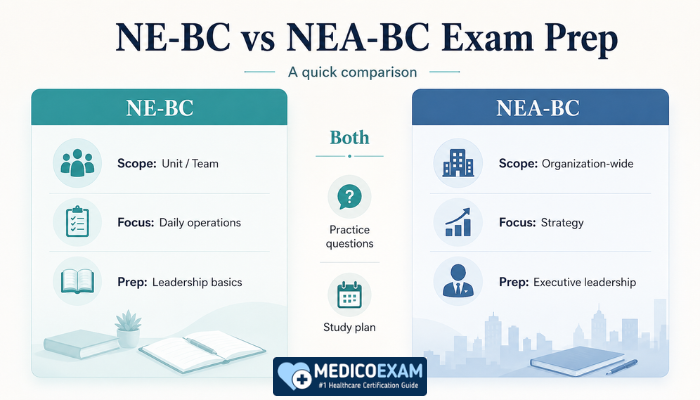 Salary is one of the most compelling reasons to pursue either credential, and the difference between the two reflects the increased scope and responsibility that comes with the advanced certification.
Public labor-market sources show that nurse executive compensation varies widely by role level, organization size, geography, education, and years of leadership experience. For context, the U.S. Bureau of Labor Statistics reports that medical and health services managers earned a median annual wage of $117,960 as of May 2024.
| Role Level | Typical Certification | Salary Range |
|---|---|---|
| Nurse Manager / Unit Director | NE-BC | $90,000–$130,000 |
| Director of Nursing / Senior Director | NE-BC or NEA-BC | $120,000–$170,000 |
| VP of Nursing / CNO (community hospital) | NEA-BC | $165,000–$220,000 |
| CNO / Chief Nurse Executive (large system) | NEA-BC | $220,000–$300,000+ |
Expert Insight: "The NE-BC validates that you can run a department. The NEA-BC signals you can run an enterprise," says Dr. Patricia Thompson, DNP, RN, NEA-BC, a health system vice president. "When hiring committees see the NEA-BC credential, they know this nurse has both the education and strategic experience to lead at the organizational level. It changes the conversation from operations to vision."
Should You Get the NE-BC or the NEA-BC First?
The NE-BC and NEA-BC form a natural career ladder. Most nursing leaders pursue the NE-BC first as they move into their initial management roles, then progress to the NEA-BC once they advance to organization-wide positions and complete a graduate degree.
Choose the NE-BC if you:
-
Currently serve as a nurse manager, assistant director, supervisor, or clinical coordinator
-
Hold a BSN and have not yet completed a graduate degree
-
Are responsible for the daily operations of a specific unit, service line, or department
-
Want to validate your operational leadership competencies early in your management career
Choose the NEA-BC if you:
-
Currently serve (or are moving into) a CNO, VP of Nursing, or system-level executive role
-
Hold an MSN, MHA, DNP, PhD, or another qualifying graduate degree
-
Are responsible for organization-wide or system-wide nursing operations and outcomes
-
Want to demonstrate strategic leadership capability to boards, hiring committees, and professional peers
There is no requirement to hold the NE-BC before sitting for the NEA-BC. If you already meet the NEA-BC eligibility requirements — graduate degree, system-level experience, and continuing education — you can apply directly. However, many nurses find the NE-BC valuable as an intermediate credential during the years they are building toward executive-level positions.
How Do You Prepare for Each Exam?
Both exams align with published Test Content Outlines (TCOs) from the ANCC. Here is a preparation strategy:
-
Download the current TCO. The NE-BC TCO took effect October 15, 2025; the NEA-BC TCO took effect November 11, 2025. Both are free PDFs on the ANCC website.
-
Assess your baseline. ANCC offers a readiness test for each certification that mirrors the exam format and identifies your strong and weak domains.
-
Focus on your weakest domain. For NE-BC, candidates commonly struggle with Business Management (16%) — financial compliance, budgeting, and staffing calculations. For NEA-BC, Leadership (34%) requires command of leadership theories, strategic planning, and governance.
-
Use practice questions. MedicoExam's NE-BC practice tests and NEA-BC practice tests mirror the ANCC format and provide domain-level performance feedback.
-
Review the official reference list. ANCC publishes a reference list with each TCO. These are the primary sources for exam questions.
-
Plan for 8–12 weeks of study. Most candidates need 2–3 months of preparation, studying 5–10 hours per week.
What Are the Renewal Requirements for Both Certifications?
Both certifications renew every 5 years with identical requirements. According to ANCC renewal guidance:
-
Hold a current, active RN license
-
Complete 75 contact hours of continuing education related to your certification role and specialty
-
Complete one professional development component from the following eight categories:
-
An additional 75 contact hours of CE (beyond the mandatory 75)
-
5 semester credits or 6 quarter credits in leadership, management, or administration
-
One or more presentations totaling 5 clock hours
-
Evidence-based practice project, QI project, publication, or research
-
At least 120 hours as a preceptor for students in an academic leadership program
-
Two or more consecutive years of volunteer service with healthcare-related organizations
-
At least 1,000 practice hours in leadership, management, or administration
-
Pass the current NE-BC or NEA-BC certification exam
The renewal fee is $350 for non-members and as low as $250 for ANA members. You may submit a renewal application up to 1 year before your certification expiration date.
How Does the NE-BC Lead to the NEA-BC on a Career Path?
The progression from NE-BC to NEA-BC mirrors the typical nurse executive career trajectory:
-
Stage 1: Clinical Excellence — Build a strong clinical foundation as a staff nurse, charge nurse, or clinical lead (3–5 years).
-
Stage 2: Unit-Level Leadership (NE-BC) — Move into a nurse manager or department supervisor role. Earn the NE-BC to validate operational leadership. Pursue or complete a graduate degree during this phase (3–7 years).
-
Stage 3: Multi-Department Leadership — Advance to Director of Nursing, Associate CNO, or VP of Patient Care Services. Transition from managing one unit to overseeing multiple departments.
-
Stage 4: Executive Leadership (NEA-BC) — Step into a CNO, Chief Nurse Executive, or system VP role. Earn the NEA-BC to validate strategic leadership. DNP or dual-degree holders (MSN/MBA, MSN/MHA) often differentiate themselves here.
The BLS projects employment of medical and health services managers to grow 23% from 2024 to 2034, much faster than the average for all occupations. This strong demand creates abundant opportunities for certified nurse executives at both levels.
Explore all ANCC certification pathways on MedicoExam to see how the NE-BC and NEA-BC fit alongside other nursing specialties like the MEDSURG-BC, NI-BC (Nursing Informatics), and NPD-BC (Nursing Professional Development).
Frequently Asked Questions
Q1: Can I take the NEA-BC exam without first earning the NE-BC?
Yes. There is no prerequisite requiring NE-BC certification before applying for the NEA-BC. If you meet the NEA-BC eligibility requirements — a graduate degree, 2,000 hours of organization-wide or system-wide leadership experience within the last 3 years, 30 hours of relevant CE, and an active RN license — you can apply directly for the NEA-BC through the ANCC.
Q2: What is the pass rate for the NE-BC vs NEA-BC exams?
According to 2025 ANCC Certification Data, the first-time pass rate for the NE-BC is 63% (907 of 1,443 candidates passed), while the NEA-BC pass rate is 73% (706 of 973 candidates passed). The higher NEA-BC pass rate likely reflects the more experienced candidate pool — these nurses already hold graduate degrees and have extensive executive experience.
Q3: How much does each certification exam cost?
Both the NE-BC and NEA-BC cost $395 for non-members and $295 for ANA members. Prices include a $140 non-refundable administrative fee. Renewal costs $350 for non-members and as low as $250 for ANA members. Discounts must be claimed within 5 business days of ANCC receiving the application.
Q4: Do the NE-BC and NEA-BC have the same exam format?
Yes, the format is identical: 150 multiple-choice questions (125 scored + 25 pretest), 3 hours, computer-based testing at Prometric centers, and a passing score of 350 on a scale of 500. The difference lies in the content domains — the NE-BC emphasizes operational management while the NEA-BC emphasizes strategic leadership.
Q5: What degree do I need for each certification?
The NE-BC requires a baccalaureate or higher degree in nursing (BSN minimum). The NEA-BC requires a graduate degree, and either your baccalaureate or graduate degree must be in nursing. For example, a nurse with a BSN and an MBA, MHA, or MPH would qualify for the NEA-BC. A nurse with only a BSN would not qualify for the NEA-BC regardless of experience.
Q6: How much more do NEA-BC certified nurses earn than NE-BC certified nurses?
Salary ranges overlap but skew higher for NEA-BC holders. NE-BC-certified nurses commonly align with manager, director, and department-level leadership roles, while NEA-BC-certified professionals are more often positioned for VP, CNO, and system-level executive roles. At the top end, CNOs at large health systems can earn $220,000–$300,000+ depending on location, organization size, and experience.
Q7: How long is each certification valid, and what do I need to renew?
Both certifications are valid for 5 years. Renewal requires 75 contact hours of continuing education plus one professional development component (such as additional CE hours, academic credits, presentations, research, or 1,000 practice hours). You may also renew by retaking the current exam. Renewal applications can be submitted up to 1 year before expiration.
Q8: Which certification should a new nurse manager pursue first?
A new nurse manager should pursue the NE-BC first. It is designed for professionals responsible for unit- or department-level operations and requires only a BSN. As you gain experience, complete a graduate degree, and move into organization-wide roles, you can then pursue the NEA-BC. Think of the NE-BC as validating what you do today and the NEA-BC as validating where you are going.
Ready to Start Preparing?
Whether you are targeting the NE-BC or NEA-BC, simulation-based practice is one of the most effective preparation strategies. MedicoExam offers exam-style practice questions mapped to the official ANCC test content outlines for both certifications:
-
NE-BC Practice Tests — Domain-specific questions covering Human Resource Management, Quality and Safety, Business Management, and Health Care Delivery
-
NEA-BC Practice Tests — Questions aligned to Leadership, Quality and Safety, Human Capital Management, and Health Care Delivery
Each practice session provides instant score breakdowns by domain so you can focus your study time where it matters most. Start your free practice session today at MedicoExam.com.
Disclaimer: This article is for informational purposes only. It does not contain actual exam questions or proprietary ANCC content. Always verify current eligibility requirements, exam details, and pricing directly with the ANCC before applying.
Written by the MedicoExam Content Team — Healthcare Education Specialists at MedicoExam.com
- ANCC NE-BC Question Bank |
- ANCC NE-BC Eligibility & Requirements |
- ANCC Nurse Executive Practice Test |
- ANCC NE-BC Exam Cost |
- ANCC NE-BC Registration Process |
- ANCC Nurse Executive Study Guide |
- ANCC NE-BC Recertification |
- ANCC NE-BC Certification Overview |
- ANCC NEA-BC Question Bank |
- ANCC NEA-BC Eligibility & Requirements |
- ANCC Nurse Executive Advanced Practice Test |
- ANCC NEA-BC Exam Cost |
- ANCC NEA-BC Registration Process |
- ANCC Nurse Executive Advanced Study Guide |
- ANCC NEA-BC Recertification |
- ANCC NEA-BC Certification Overview


