
Documentation Integrity Credentials Compared: CDIP, CDEO or CDEI?
The AHIMA Certified Documentation Integrity Practitioner (CDIP), the AAPC Certified Documentation Expert Outpatient (CDEO) and the AAPC Certified Documentation Expert Inpatient (CDEI) are three credentials for people who work on the quality of clinical documentation, but they are built for different readers. The CDIP has 140 questions in 180 minutes and a scaled passing score of 300. The CDEO and the CDEI each have 100 questions in 240 minutes and need 70 percent.
Already decided? Go straight to a practice test for the CDIP, the CDEO or the CDEI. Still choosing? This guide lays all three out together. The numbers come from MedicoExam's exam data sheet, from the pages published by AHIMA and AAPC (AHIMA's CDIP page, AAPC's CDEO page and AAPC's CDEI page), from MedicoExam's syllabus and product pages, or from simple sums on those values.
Which documentation credential should you earn: the CDIP, the CDEO or the CDEI?
The right one depends on where you work and which certifying body your employer names. All three credentials show that you can review a health record, spot what is missing or unclear and ask the provider a compliant question. None of them is the best choice for everyone, and nothing here ranks one ahead of the others.
AHIMA describes the CDIP as a credential that can be held by health information professionals, nurses and physicians, and says CDIP holders are known for CDI guidance and for knowing the documentation requirements behind compliant coding and billing. AAPC describes the CDEO as validating a medical coder's advanced expertise in clinical documentation improvement in the outpatient setting. AAPC describes the CDEI as the same kind of expertise for the inpatient setting, with ICD-10-CM, ICD-10-PCS and MS-DRG assignment at its centre.
The first difference, then, is the career path each credential has in mind. The CDIP speaks to someone with a health information, nursing or clinical background who wants a CDI career. The CDEO and CDEI speak to coders and auditors who want to move from assigning codes to improving the documentation behind them. Everything here is exam preparation and carries no clinical advice.
How do the CDIP, CDEO and CDEI exams compare at a glance?
The three exams differ most in length and time per question. The table lists the published details side by side, and the figures match the MedicoExam exam data sheet and the certifying bodies' pages.
| Detail | CDIP (AHIMA) | CDEO (AAPC) | CDEI (AAPC) |
|---|---|---|---|
| Setting | Clinical documentation integrity across the health system | Outpatient documentation | Inpatient documentation |
| Questions | 140, made up of 106 scored items and 34 pretest items | 100, including 10 cases worth 20 questions | 100 |
| Time allowed | 180 minutes (three hours) | 240 minutes | 240 minutes |
| Passing score | 300 on AHIMA's 100 to 400 scale (about 66 percent by the MedicoExam record) | 70 percent | 70 percent |
| Exam fee | $259 for AHIMA members, $329 for non-members | $425 for one attempt, $499 for two | $425 for one attempt, $499 for two |
| Required books on test day | None | Not stated on the saved pages | Not stated on the saved pages |
| Where it is taken | Pearson VUE test centre or online with OnVUE | From home under live remote proctoring, or at a testing centre | Live remote proctor or testing centre |
| Credential cycle | Two years | Two years | Two years |
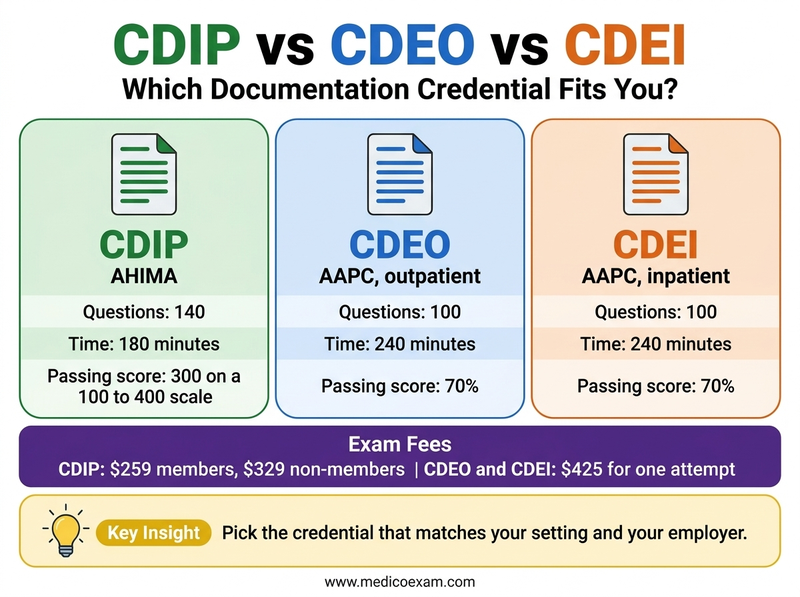
The shared pattern is time. The CDIP gives you 180 minutes for 140 questions, which is about 77 seconds for each question. The CDEO and CDEI give you 240 minutes for 100 questions, which is 144 seconds for each question, so each answer can lean on longer reading and on checking your references.
Who is each credential built for?
The CDIP is open to people who hold an associate's degree or higher, and that is the main difference in entry rules. AHIMA's page gives three ways in: hold an associate's degree or higher; finish an HIM certificate or post-baccalaureate programme approved by CAHIIM; or already hold the CCS, CCS-P, RHIT or RHIA. AHIMA also recommends, but does not require, two years of CDI experience, a degree in a health care or allied health field, and coursework in medical terminology, anatomy and physiology, pathology and pharmacology.
That list tells you the CDIP is pitched at someone with a health information or clinical background, and AHIMA says nurses and physicians can hold it too. A coder without a degree may need to check the eligibility routes first, since the exam application depends on them.
AAPC's pages for the CDEO and CDEI name coders, auditors, compliance professionals and CDI specialists. The CDEO page lists professional coders in physician practices, multispecialty groups or outpatient facilities, auditors and compliance professionals, CDI specialists focused on outpatient records, and experienced coders who want to expand into documentation review. The CDEI page lists the same groups for hospitals and inpatient facilities. Both pages warn that the exam is difficult and high-level, and not intended for people with limited CDI background. AAPC says candidates should have CDI training, experience, or both.
For a closer look at one credential, MedicoExam has an earlier article on the career value of the AHIMA route and a piece on how AI is changing documentation work. If you work in an outpatient practice, the CDEO is closest to your daily records. If you work in a hospital coding or CDI department, the CDEI or the CDIP is the closer match.
What does each exam actually cover?
The CDIP covers five weighted domains, the CDEO covers nine sections counted in questions, and the CDEI covers four areas without question counts. Each body lays out its blueprint in a different way, which changes how you should plan your study time.
AHIMA's CDIP outline has five domains, and each carries a percentage of the questions. Record Review and Document Clarification is the largest at 27 to 33 percent, covering how to find documentation gaps, develop and apply queries, obtain provider responses and handle items such as present on admission status and acuteness. Education and Leadership Development follows at 21 to 26 percent: promoting CDI across the organisation, building working relationships, developing CDI policies and procedures, and teaching providers. Compliance is 18 to 23 percent, including ethical CDI practice, clinical validation queries, non-compliant queries and the risks of technology such as electronic health records and computer-assisted coding. Clinical Coding Practice is 15 to 18 percent, including principal and secondary diagnoses, code sequencing and the working and final DRG. CDI Metrics and Statistics is the smallest at 8 to 11 percent.
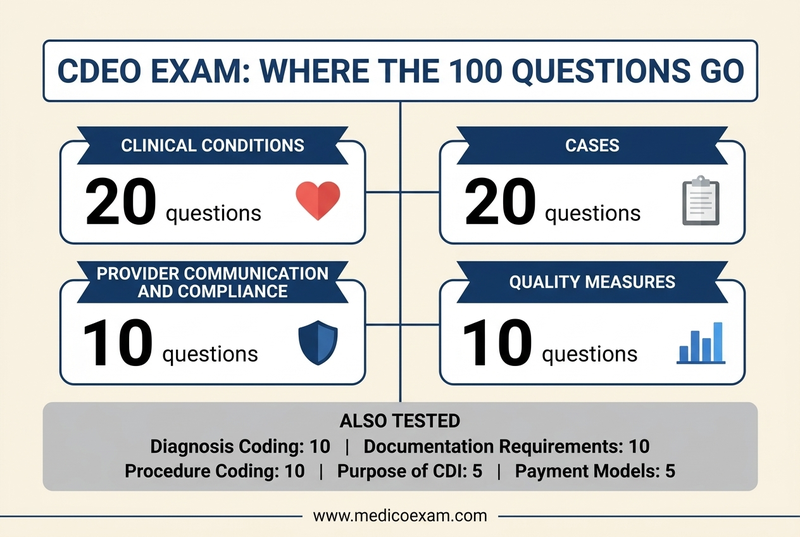
On AAPC's CDEO, the syllabus gives a number of questions for each section. Clinical conditions is the largest at 20 questions, and the Cases section is 10 cases worth 20 questions. Provider communication and compliance, Diagnosis coding, Documentation requirements, Procedure coding and Quality measures each have 10 questions. Purpose of CDI and Payment models have five each. Added together, the sections come to the 100 questions of the exam.
On AAPC's CDEI, the saved pages list four areas: core documentation review, inpatient coding and compliance, clinical documentation improvement practices, and provider communication and education. They name ICD-10-CM and ICD-10-PCS coding, MS-DRG assignment, and severity of illness and risk of mortality indicators as skills the credential proves. The saved pages do not give question counts for these areas, so build your plan from AAPC's own outline instead of guessing weights.
Is the CDIP inpatient, outpatient or both?
The CDIP is not tied to one setting in its published outline, though its coding domain refers to hospital course, working and final DRG and principal diagnosis. AHIMA's CDIP outline mentions ICD-10-CM and ICD-10-PCS and the assignment of DRGs, which are hospital concepts. The MedicoExam syllabus page names hospitals and health systems, outpatient and physician practices, consulting and revenue cycle organisations as the settings for the work.
The CDEO is specific to outpatient records. Its blueprint covers E/M documentation, including medical decision making and time, HCPCS Level II, risk adjustment and HCC documentation, and quality measures such as HEDIS. The CDEI is specific to the inpatient stay and its payment, with MS-DRG and ICD-10-PCS in the foreground.
Weigh this difference before committing months of study. A coder with only outpatient experience may find the CDEI procedure-coding material the steepest climb, and a hospital CDI specialist may find the CDEO's E/M and HEDIS sections unfamiliar.
One practical point for all three: the question styles differ. AHIMA says its exams use a variety of item types that ask you to use knowledge, skills or experience to select the best answer. The CDEO adds 10 cases, where you work from a documentation excerpt to spot deficiencies, choose an applicable provider query and select supporting regulations. Practising that sequence on sample records is different from memorising facts, so give case work its own study sessions rather than leaving it to the final week.
How is each exam taken on the day?
The CDIP can be taken at a Pearson VUE authorised test centre or online with OnVUE remote proctoring. AHIMA says there are no required books or resources for exam day. You can move back and forth between items as long as an answer has been selected, flag items and return to them at the end if time remains. Each AHIMA exam mixes scored questions with pretest questions spread at random, and the pretest items do not count towards your score.
The CDEO is offered online from home with a live proctor watching remotely, or on a computer at a testing centre. The CDEI syllabus page lists live remote proctored or testing centre delivery and notes that you schedule after buying the voucher and receiving a notice to schedule from Meazure Learning. The saved pages do not state a code book rule for either exam, so check AAPC's current candidate rules before the day.
Both formats reward steady pacing. With 77 seconds for each CDIP question, a long scenario has to be read quickly. With 144 seconds for each CDEO or CDEI question, the risk is spending too long on early items and rushing the cases at the end.
What do the exams cost, and how are the credentials renewed?
For the CDIP, AHIMA's fee is $259 if you are a member and $329 if you are not, a $70 difference. Retake fees match the exam fee. After an unsuccessful CDIP attempt there is a 90-day wait before a retake application is approved. AHIMA's CDIP Preparation Course has five modules, one for each domain, plus a practice exam, and earns 7.5 CEUs for people who already hold an AHIMA credential. AHIMA does not require it.
An AAPC voucher for either the CDEO or the CDEI costs $425 with one attempt included, or $499 with two, which makes the extra attempt $74. A non-member CDIP candidate pays $96 less than the AAPC single-attempt price, and a member pays $166 less. AAPC's CDEO course starts at $1,195 and its CDEI course at $1,199, Course fees dwarf the exam fee, so budget for them separately if you take that route.
All three credentials run on two-year cycles. For the CDEO and CDEI, AAPC requires you to keep your annual membership and earn 36 CEUs in each cycle. AHIMA ties the CDIP to the continuing education units and recertification fee it sets for the two-year period, so check AHIMA's Recertification Hub for the counts.
How do you decide between the CDIP, CDEO and CDEI?
Answer the following in order; your answers should narrow things to a single credential.
- Which body do the employers you want to join name? Read a few local job postings. A named credential in several of them usually decides the matter.
- Which setting do you work in? Outpatient records point to the CDEO, hospital stays point to the CDEI, and a health-system CDI programme may point to the CDIP.
- Do you meet the entry rules? The CDIP asks for a degree, an approved programme or a listed credential. AAPC's pages ask for training or experience in CDI instead.
- Which exam format suits you? The CDIP is one set of questions graded on a scaled score. The CDEO adds 10 cases, which make up 20 of its 100 questions.
- What can you spend? Start with the exam fees above, then add training and membership.
- Will you hold more than one credential? Their two-year cycles run separately, so ask AHIMA and AAPC how your continuing education is counted before aiming for two.
Which preparation mistakes should you avoid?
The commonest error is studying from the wrong blueprint. A CDIP candidate who spends weeks on HEDIS measures is working on a topic the CDIP outline does not list, and a CDEO candidate who ignores clinical conditions is skipping the biggest section of that exam. Let each body's published outline be your study map.
Another error is ignoring the exam's setting. A CDEI candidate who only practises outpatient E/M levels is missing MS-DRG and ICD-10-PCS, and a CDEO candidate who only knows inpatient records will struggle with outpatient guidelines.
The third is treating compliant querying as a side topic. The CDIP outline gives Compliance 18 to 23 percent and lists clinical validation queries and non-compliant queries by name, and the CDEO gives provider communication and compliance 10 questions, including how to write a non-leading provider query.
Finally, many candidates misread the pass mark. The CDIP scale of 100 to 400 and the passing score of 300 are not a raw 300 answers, and the MedicoExam record translates it to about 66 percent. The CDEO and CDEI are a flat 70 percent, which is 70 correct answers out of 100.
How should you prepare after choosing?
Start with the outline your certifying body has published, and rewrite each line as a question you could answer unaided. For the CDIP, give the most time to Record Review and Document Clarification, then Education and Leadership Development, then Compliance. For the CDEO, start with the 20 clinical conditions questions and the 20 case questions. For the CDEI, work through the four areas AAPC names and practise MS-DRG and ICD-10-PCS reasoning on complete hospital records.
Then rehearse under exam conditions. Timed practice shows how long you spend on each question, and the 77-second and 144-second averages are useful benchmarks. MedicoExam's CDIP practice test lists 435+ exam-style questions, and its CDEO and CDEI practice tests list 200+ each, with 2 months of access. Trace each wrong answer back to the guideline instead of memorising the key.
Last, sort out logistics. Book once your practice scores have levelled off, and read the cancellation rules. AHIMA allows a free cancellation or reschedule up to 15 business days ahead, and a Pearson VUE fee applies after that.
Which reader should pick which credential?
The CDIP fits you if you come from health information management, nursing or another clinical background, if you want a credential that centres on queries, CDI leadership and compliance, or if AHIMA membership and its lower member price appeal to you.
The CDEO fits if you code or audit outpatient records, if you work with E/M documentation, risk adjustment and quality measures, or if the practices you are targeting name AAPC.
The CDEI fits if you work in a hospital and want a credential that speaks to MS-DRG assignment, inpatient coding and documentation integrity.
Whatever you choose, plan your study from AHIMA's or AAPC's own page and use practice questions to expose weak spots. MedicoExam has no affiliation with either body, and the result depends on your own effort. Confirm today's fees, rules and eligibility with the body before paying.
Frequently Asked Questions
Is the CDIP, CDEO or CDEI harder?
Neither AHIMA nor AAPC ranks its exams by difficulty, and the three test different things. The CDIP has 140 questions in 180 minutes, while the CDEO and CDEI each have 100 questions in 240 minutes. AAPC calls its two exams difficult and high-level, so compare your own practice results with each blueprint instead.
How much do the CDIP, CDEO and CDEI exams cost?
AHIMA's CDIP fee is $259 for members and $329 for everyone else. AAPC prices the CDEO and the CDEI the same way, at $425 with one attempt or $499 with two. Fees change from time to time, so confirm them with both bodies first.
What score do you need to pass the CDIP, CDEO and CDEI?
The CDIP is graded on a scaled score with 300 as the pass mark on a 100 to 400 range, around 66 percent according to the MedicoExam data. The CDEO and CDEI both need 70 percent.
Who can sit the CDIP exam?
Candidates need an associate's degree or higher, a CAHIIM-approved HIM certificate or post-baccalaureate programme, or a CCS, CCS-P, RHIT or RHIA credential. Check AHIMA's current rules before applying.
How long do the CDIP, CDEO and CDEI credentials last?
All three run on a two-year cycle. AAPC asks CDEO and CDEI holders for a current membership and 36 CEUs per cycle, while AHIMA sets its own CEU count and recertification fee for the CDIP.
Is this guide medical advice?
No. It is exam-preparation reading that compares three documentation certifications, with no clinical advice and no promise of a pass or a job. Confirm each requirement with AHIMA and AAPC.
- AHIMA CDIP Question Bank |
- AHIMA CDIP Eligibility & Requirements |
- AHIMA Documentation Integrity Practitioner Practice Test |
- AHIMA CDIP Exam Cost |
- AHIMA CDIP Registration Process |
- AHIMA Documentation Integrity Practitioner Study Guide |
- AHIMA CDIP Recertification |
- AHIMA CDIP Certification Overview |
- AHIMA Documentation Integrity Practitioner Syllabus |
- AHIMA CDIP Preparation Time |
- AHIMA CDIP Passing Score |
- AHIMA CDIP Exam Format |
- AAPC CDEO Question Bank |
- AAPC CDEO Eligibility & Requirements |
- AAPC Documentation Expert Outpatient Practice Test |
- AAPC CDEO Exam Cost |
- AAPC CDEO Registration Process |
- AAPC Documentation Expert Outpatient Study Guide |
- AAPC CDEO Recertification |
- AAPC CDEO Certification Overview |
- AAPC Documentation Expert Outpatient Syllabus |
- AAPC CDEO Preparation Time |
- AAPC CDEO Passing Score |
- AAPC CDEO Exam Format |
- AAPC CDEI Question Bank |
- AAPC CDEI Eligibility & Requirements |
- AAPC Documentation Expert Inpatient Practice Test |
- AAPC CDEI Exam Cost |
- AAPC CDEI Registration Process


