
Healthcare Certification Exam Day Checklist 2026: What to Bring, Expect & Do for Every Exam
 Your healthcare certification exam day determines months of preparation — and the logistics matter as much as the studying. This universal checklist covers every major testing platform used by healthcare certification bodies in 2026, including Pearson VUE, PSI, and OnVUE remote proctoring. Whether you are sitting for the CPC, NCLEX-RN, FNP-BC, CCMA, or any other healthcare credential, follow this checklist to walk in prepared and walk out confident.
Key Facts: Healthcare Certification Exam Day at a Glance
-
Testing Platforms: Pearson VUE, PSI, Prometric, and OnVUE remote proctoring
-
Arrival Time: 30 minutes before your scheduled appointment at in-person centers
-
ID Required: 1–2 forms of valid, unexpired ID depending on sponsor policy
-
Prohibited Items: Mobile phones, smartwatches, notes, food/drinks in the testing room
-
Check-in Process: Photo capture, digital signature, and biometric scan where applicable
-
Result Delivery: Ranges from immediate to 7–10 business days depending on certification body
-
Remote Testing Option: Available for select exams via OnVUE with webcam, microphone, and stable internet
What Should You Do the Week Before Your Healthcare Certification Exam?
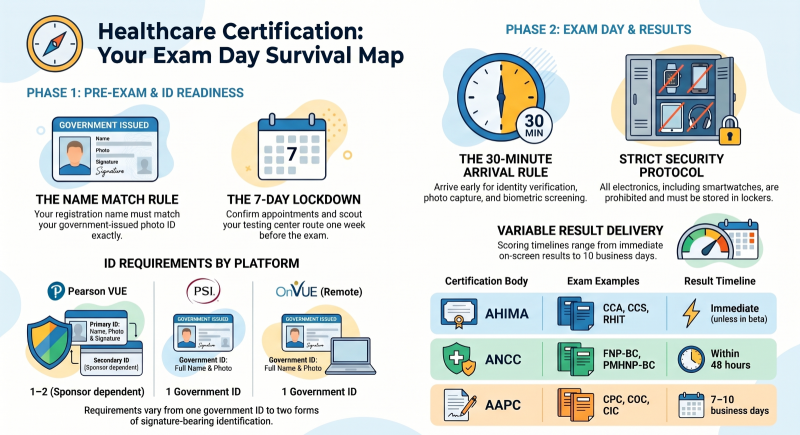
Exam day success starts 7 days out. The week before your exam is the time to lock down logistics so you can focus entirely on the test. Confirm your appointment, verify your ID, and scout your testing center.
7-Day Pre-Exam Checklist:
-
Confirm your appointment. Log into your Pearson VUE, PSI, Prometric, or OnVUE account and verify the date, time, and location.
-
Verify your ID. The name on your government-issued photo ID must match your exam registration exactly.
-
Check your ID expiration date. Expired IDs are generally not accepted unless a specific testing policy allows renewal documentation.
-
Scout the testing center. Drive the route in advance. Account for traffic, parking, and building access.
-
Gather permitted items. Identify what your exam sponsor allows, such as approved reference materials for certain coding exams.
-
Plan your breaks. Know your exam's break structure before test day.
-
Take a final practice exam. Use simulation-based tests from MedicoExam to calibrate your timing and confidence.
What ID Do You Need for a Healthcare Certification Exam?
Every testing center requires at least one valid, unexpired, government-issued photo ID. The specific number and type of IDs depend on the testing platform and exam sponsor. Bringing the wrong ID is the most common reason candidates are turned away on exam day.
ID Requirements by Testing Platform
| Requirement | Pearson VUE Policy 1S | Pearson VUE Policy 2S | PSI | OnVUE Remote |
|---|---|---|---|---|
| Number of IDs | 1 primary + 1 secondary | 2 forms required | 1 government-issued photo ID | 1 government-issued photo ID |
| Primary ID Must Include | Name, photo, signature | Name, photo, signature | Full name, photo | Full name, photo |
| Acceptable Primary IDs | Driver's license, passport, military ID, state ID | Driver's license, passport, military ID | Driver's license, passport, state/national ID | Driver's license, passport, state ID |
| Secondary ID Must Include | Name + signature OR name + photo | Name + signature OR name + photo | N/A; some sponsors require secondary | N/A |
| Name Match Rule | Must match registration exactly | Must match registration exactly | Must match registration exactly | Must match registration exactly |
| Expired IDs Accepted? | No; renewal paperwork may help where allowed | No | No | No |
Which exams use which platform:
-
Pearson VUE: AHIMA, NREMT, NBRC, AACN, and select certification sponsors
-
Prometric: ANCC nursing certification exams
-
OnVUE Remote: Available for select exams from approved certification sponsors
Pro Tip: If you recently changed your name, update your exam registration to match your current ID at least 5 business days before your test.
What Should You Bring to the Testing Center?
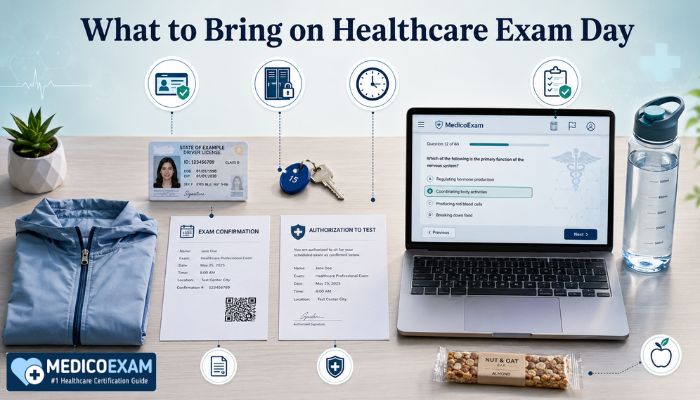
Bring only essentials. Testing centers enforce airport-level security, and every extra item increases your check-in time. All major platforms provide secure lockers, but space is limited.
Bring These Items:
-
Valid, unexpired government-issued photo ID and secondary ID if required
-
Exam confirmation or appointment details
-
Authorization to Test letter if required
-
Snacks and water for break consumption, stored in locker
-
Personal medication with documentation if applicable
-
Light layers of clothing
Leave These at Home: Study materials, personal calculators, bulky bags, smartwatches, fitness trackers, headphones, and earbuds.
What Items Are Prohibited in the Testing Room?
Testing centers maintain strict security protocols. Bringing prohibited items into the testing room — even accidentally — can result in exam termination, score invalidation, and forfeiture of your exam fee.
| Category | Prohibited Items |
|---|---|
| Electronics | Mobile phones, smartwatches, fitness trackers, tablets, USB drives, recording devices, pagers |
| Study Materials | Books, notes, flashcards, papers, pens, pencils, highlighters |
| Accessories | Headphones, earbuds, Bluetooth devices, sunglasses, non-religious hats |
| Apparel | Coats, jackets, bulky clothing, large jewelry, large hair clips, wide headbands |
| Food/Drink | All food and beverages; must remain in locker for break access |
| Other | Wallets, purses, bags, weapons, writing instruments of any kind |
Medical devices, mobility aids, and comfort items may be permitted with prior approval from your exam sponsor — contact them well before exam day.
What Does the Exam Day Timeline Look Like?
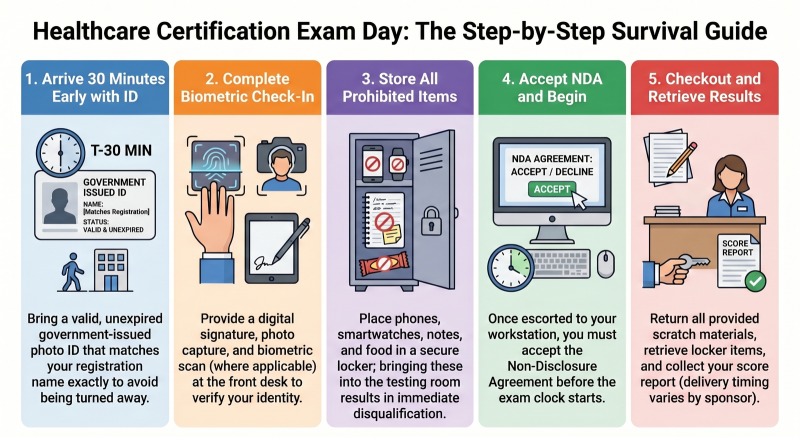
A typical exam day follows a structured sequence from arrival to results. Plan for 30 minutes of check-in before your exam clock starts. The entire visit takes 1–2 hours longer than your actual exam time.
Step-by-Step Exam Day Timeline:
-
Arrive 30 Minutes Early: Pearson VUE, PSI, and Prometric all recommend arriving 30 minutes before your scheduled appointment.
-
Check In at the Front Desk: Present your ID and confirmation. The administrator verifies your identity, captures a photo and signature, and may complete biometric screening.
-
Store Personal Belongings: Place all personal items in the provided secure locker and complete security screening.
-
Enter the Testing Room: You will be escorted to your workstation and given approved writing materials if permitted.
-
Accept the NDA and Begin: You must accept the exam non-disclosure agreement before starting.
-
Take Breaks If Permitted: Break policies vary by exam sponsor and may count against total testing time.
-
Finish and Check Out: Return all materials, retrieve your belongings, and collect any score report provided.
How Does OnVUE Remote Proctoring Work for Healthcare Exams?
OnVUE remote proctoring allows candidates to take select healthcare certification exams from home. A live proctor monitors you via webcam and microphone in real time. You must provide a private room, a cleared desk, a computer with webcam, and a stable internet connection.
OnVUE System Requirements
| Requirement | Specification |
|---|---|
| Operating System | Windows 10/11 or macOS 14+ |
| Internet Speed | 6 Mbps download, 2 Mbps upload; wired connection recommended |
| Webcam | Forward-facing webcam |
| Audio | Built-in or external microphone and speaker; no headphones |
| Display | Single monitor only |
| Browser | Latest supported browser version |
| Prohibited | VPNs, virtual machines, touch screens, dual monitors, corporate firewalls |
OnVUE Room Requirements:
-
Enclosed, private room with a closed door
-
Well-lit space with no backlighting from windows
-
Cleared desk with no books, notes, papers, or writing tools
-
No one else in the room, including pets
-
Phone placed out of arm's reach
-
Walls free of whiteboards, notes, or posted materials
OnVUE Check-In Process: Check in begins 30 minutes before your appointment via the OnVUE app. You photograph your ID, take a selfie, and capture photos of your testing environment. A greeter reviews your photos, connects you with a live proctor, and launches your exam.
When Do You Get Your Healthcare Certification Exam Results?
Result delivery timelines vary significantly by certification body — from immediate on-screen results to 10 business days. Knowing the timeline prevents unnecessary anxiety during the wait.
| Certification Body | Exams | Result Timeline | How to Access |
|---|---|---|---|
| AHIMA | CCA, CCS, CCS-P, RHIT, RHIA | Immediate unless beta period | Score report at Pearson VUE; verification portal |
| ANCC | FNP-BC, PMHNP-BC, AGPCNP-BC, AGACNP-BC | Within minutes to 48 hours | Prometric portal; email notification |
| NBRC | TMC, CSE | Immediate | On-screen and email |
| NREMT | EMT, AEMT, Paramedic | 2–3 business days | National Registry account |
| AAPC | CPC, COC, CRC, CIC | 7–10 business days | MyAAPC member portal |
| NHA | CCMA, CPhT, CBCS | Within 48 hours | NHA candidate portal |
| AANPCB | FNP-C, A-GNP-C, PMHNP | Unofficial immediately; official within 1–2 weeks | AANPCB candidate account |
| BCEN | CEN, CPEN, TCRN | Immediate preliminary result | BCEN online account |
What Should You Do Immediately After the Exam?
The 30 minutes after your exam matter for administrative follow-up and mental reset. Collect your score report if provided on-site, retrieve your belongings, and resist the urge to discuss exam content online.
Post-Exam Checklist:
-
Collect your score report if provided at the testing center.
-
Retrieve your belongings from the secure locker.
-
Do not discuss exam content.
-
Log into your account within 24–48 hours to check for electronic results.
-
Document your experience while it is fresh.
-
Plan next steps based on your result.
"The biggest mistake I see candidates make is not having a post-exam plan. Whether you pass or fail, know your next move before you walk in the door." — Dr. Sarah Chen, DNP, FNP-BC, nursing education consultant
What Are the Most Common Exam Day Mistakes and How Do You Avoid Them?
Preventable exam day disruptions — ID issues, late arrivals, prohibited items — affect thousands of healthcare certification candidates each year. Every one of these mistakes is avoidable with the checklist above.
Top 8 Exam Day Mistakes:
-
Name mismatch on ID. "Robert" on your ID and "Bob" on your registration will get you turned away.
-
Expired ID. Even if it expired yesterday, you may not be admitted.
-
Arriving late. Arriving after your appointment time can mean a no-show and forfeiture of exam fees.
-
Bringing a smartwatch. Fitness trackers and smartwatches are prohibited.
-
Studying in the lobby. Studying is not allowed inside many test centers.
-
Forgetting the ATT. NREMT candidates must have their Authorization to Test accessible.
-
Eating in the testing room. Food and drinks must stay in your locker.
-
Discussing exam questions afterward. NDA violations carry severe penalties.
Frequently Asked Questions
Q1. Can I bring my phone to a testing center?
You can bring it to the building, but it must be powered off completely and stored in a secure locker before entering the testing room. At no point during the exam — including breaks — can you access your phone unless explicitly authorized by test center staff.
Q2. What happens if my ID doesn't match my registration name?
You will not be allowed to test. You will be marked as a no-show and forfeit your exam fee. Contact your exam sponsor at least 5 business days before your appointment to request a name correction.
Q3. How early should I arrive at the testing center?
Arrive 30 minutes before your scheduled appointment. This allows time for check-in, ID verification, biometric scanning, belongings storage, and security screening.
Q4. Can I take a healthcare certification exam at home?
Yes, for select exams via OnVUE remote proctoring. You need a private room, a computer with a webcam, and at least 6 Mbps download speed. Not all healthcare exams offer a remote option — check your exam sponsor's testing policy.
Q5. What happens if I fail my exam?
Retake policies vary. NREMT requires a 15-day wait and allows 6 attempts with remedial education after 3 failures. AHIMA requires a 30-day wait for CCA, CCS, RHIT, and RHIA. Review your domain-level score report to target weak areas before retesting.
Q6. Are calculators allowed in the testing room?
Personal calculators are never allowed. An on-screen calculator is provided for exams that require calculations. Some exam sponsors may provide a hand-held calculator at the center if available — but do not bring your own.
Q7. Can I wear a hat or head covering during the exam?
Non-religious head coverings are prohibited. Religious garments and head coverings are permitted at all testing centers.
Q8. What if I need a medical accommodation?
Contact your exam sponsor, not the testing center, well in advance to request accommodations under the ADA. Approval must be obtained before exam day.
Q9. Do I get scratch paper during the exam?
Pearson VUE and Prometric provide an erasable note board and marker. PSI may provide scratch paper depending on the exam sponsor. You must return all materials before leaving.
Q10. Can I leave the testing center during a break?
Policies vary by exam sponsor. Confirm with the test center administrator before leaving the building. You will need to re-present your ID and undergo security screening upon re-entry.
Ready for Exam Day? Start Practicing Now
The best way to build exam day confidence is to simulate the real testing experience. MedicoExam's simulation-based practice tests replicate the format, timing, and difficulty of actual healthcare certification exams — from AAPC CPC to ANCC FNP-BC to NHA CCMA.
Explore practice tests for your certification at MedicoExam.com.
Disclaimer: This article is for informational purposes only. Exam policies, fees, and procedures may change without notice. Always verify current requirements directly with your certification body and testing center before exam day. MedicoExam does not provide exam recalls, leaked questions, or proprietary exam content.
Written by the MedicoExam Content Team — Healthcare Education Specialists at MedicoExam.com
Last Updated: May 2026


