
How to Choose the Right Healthcare Certification in 2026: A Decision Framework by Career Stage
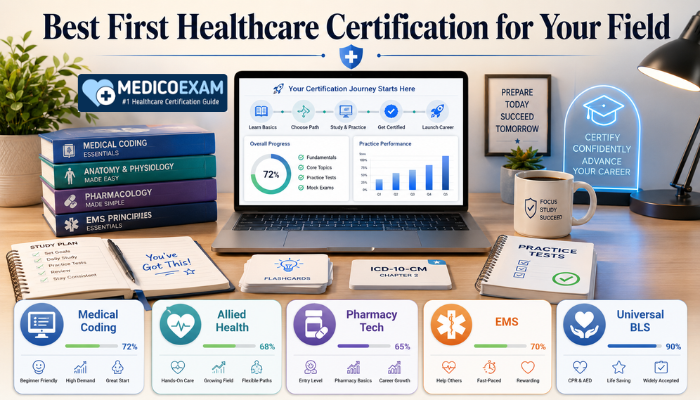 The right healthcare certification depends on your career stage, professional field, budget, and available study time. This decision framework walks you through a five-step process to identify the certification that delivers the highest return on investment for your situation.
According to the Bureau of Labor Statistics, healthcare is projected to grow 8.4% from 2024 to 2034, adding roughly 2.0 million new jobs. Certified professionals consistently earn more: AAPC salary data shows certified medical coders earn approximately 8.5% more than non-certified counterparts, while clinical research employers report paying 15–25% higher salaries to credentialed professionals.
Key Facts: Healthcare Certification Decision Framework
-
Total major U.S. healthcare certifications: 30+ across 11 certification bodies
-
Exam cost range: $104 (NREMT EMT) to $600 (ACRP-CP non-member)
-
Average salary premium for certified professionals: 8–25% above non-certified peers
-
Projected healthcare job growth (2024–2034): 8.4%, adding ~2.0 million jobs
-
Most affordable entry-level certification: NHA CPhT at $129
-
Highest-ROI beginner certification by field: CPC (coding), CCMA (allied health), BLS (universal)
-
Certification bodies covered: AAPC, AHIMA, ANCC, NHA, NBRC, NREMT, BCEN, NCC, ACRP, AMT, AANPCB
What Are the Five Steps to Choosing the Right Healthcare Certification?
Choosing the right healthcare certification requires evaluating five factors in sequence: career stage, professional field, budget, study time, and long-term goals. This HowTo framework eliminates guesswork and matches you with the highest-return credential.
Step 1: Identify Your Career Stage
Your career stage determines which tier of certification you should pursue. Students and career changers need foundational credentials. Entry-level professionals need industry-recognized certifications that unlock employment. Mid-career professionals benefit from specialty credentials, and advanced practitioners pursue leadership or subspecialty certifications.
-
Student / Career Changer: You have no healthcare work experience. Focus on entry-level certifications with no or minimal prerequisites.
-
Entry-Level (0–2 years): You hold a degree or have completed a training program. Target certifications that validate core competencies and open job doors.
-
Mid-Career (3–7 years): You have established experience. Pursue specialty or advanced certifications that increase salary and open leadership roles.
-
Advanced (8+ years): You are an experienced practitioner. Consider subspecialty, dual-certification, or management credentials.
Step 2: Match Your Professional Field
Each healthcare field has a distinct certification ecosystem. Identify your field, then narrow to the body and credential that fits your role.
Step 3: Set Your Budget
Certification costs range from $104 to $600 for exam fees alone. Factor in membership fees, study materials, and potential retake costs. Choose a certification your budget supports without financial strain.
Step 4: Assess Your Available Study Time
Some certifications require 4–6 weeks of preparation; others demand 3–6 months. Match your timeline to difficulty and existing knowledge.
Step 5: Align with Long-Term Career Goals
Consider whether the certification leads to advancement, stacks with other credentials, or meets employer requirements in your target market.
Which Healthcare Certification Should I Get as a Student or Career Changer?
Students and career changers should prioritize certifications with no work-experience prerequisites, affordable exam fees, and strong job-market demand. The best "first certification" depends entirely on your target field. The NHA CCMA costs $160 and requires no prior experience, making it the top entry point for allied health. The AHIMA CCA at $299 (non-member) is the most accessible medical coding credential. For pharmacy, the NHA CPhT exam costs just $129.
Best First Certifications for Students by Field:
| Field | Certification | Body | Exam Cost | Prerequisites | Study Time |
|---|---|---|---|---|---|
| Medical Coding | CCA | AHIMA | $299 (non-member) / $199 (member) | Coding training program | 6–8 weeks |
| Medical Coding | CPC | AAPC | $425 (1 attempt) | None required (Apprentice designation until experience met) | 3–4 months |
| Allied Health | CCMA | NHA | $160 | Medical assistant training program | 4–6 weeks |
| Pharmacy Tech | CPhT | NHA | $129 | Training program or equivalent experience | 4–6 weeks |
| EMS | EMT | NREMT | $104 | EMT course completion | 4–8 weeks |
| Universal | BLS | AHA | $65–$150 | None | 1 day |
Expert Insight: "Students often agonize over which certification to get first. My advice is always the same — pick the one that gets you employed fastest in your target field, then add specialty credentials once you have income and experience." — Sarah Mitchell, CPC, CCS, Healthcare Education Consultant
Which Certification Is Best for Entry-Level Healthcare Professionals?
Entry-level professionals with 0–2 years of experience should pursue the primary credential in their field that employers require for hiring. The CPC certification from AAPC is the most widely recognized medical coding credential, with CPC-certified professionals earning a median income of approximately $58,895 according to AAPC salary data. For nursing graduates, NCLEX-RN is mandatory, followed by specialty certifications. For respiratory therapy graduates, the NBRC TMC exam at $190 is the gateway to the CRT credential.
Entry-Level Certification Recommendations by Field:
| Field | Recommended Certification | Why This One | Exam Cost | Avg. Salary Impact |
|---|---|---|---|---|
| Medical Coding | CPC | Most employer-recognized coding credential | $425 | Median $58,895/year |
| Medical Coding | CCS | Preferred for hospital/inpatient coding | $399 (non-member) | ~$65,000/year |
| Allied Health | CCMA | Largest medical assistant certification | $160 | $35,000–$50,000/year |
| Respiratory Therapy | TMC/CRT | Required for RT practice | $190 | $55,000–$65,000/year |
| EMS | EMT → Paramedic | Progressive NREMT pathway | $104–$110 | $30,000–$50,000/year |
| HIM | RHIT | Entry-level HIM credential | $299 (non-member) | $45,000–$55,000/year |
| Clinical Research | ACRP-CP | Validates clinical research competency | $460–$600 | $50,000–$75,000/year |
What Are the Best Mid-Career Healthcare Certifications for Salary Growth?
Mid-career professionals with 3–7 years of experience gain the most from specialty and advanced certifications that command salary premiums of 15–25%. At this stage, you have the work experience to qualify for credentials with clinical-hour requirements. The ANCC FNP-BC requires a completed MSN program and 500+ clinical hours, but nurse practitioners earn a median salary of $126,260 according to BLS data. The demand for NPs is expected to grow 40% through 2034.
Mid-Career Certification Recommendations:
| Field | Certification | Body | Exam Cost | Prerequisites | Salary Range |
|---|---|---|---|---|---|
| Nursing (Primary Care) | FNP-BC | ANCC | $395 (non-member) | MSN + 500 clinical hours | $100,000–$130,000/year |
| Nursing (Psych) | PMHNP-BC | ANCC | $395 (non-member) | PMHNP MSN/DNP | $110,000–$145,000/year |
| Nursing (Emergency) | CEN | BCEN | $380 (non-member) | 2+ years ED experience | $70,000–$95,000/year |
| Medical Coding | CIC/CPMA | AAPC | $425 | 2+ years coding experience | $70,000–$90,000/year |
| HIM | RHIA | AHIMA | $299 (non-member) | Baccalaureate HIM degree | $55,000–$90,000/year |
| Respiratory Therapy | RRT (via CSE) | NBRC | $200 | CRT + TMC high cut score | $60,000–$75,000/year |
| Clinical Research | CCRA/CCRC | ACRP | $460–$600 | 3,000+ hours clinical research | $65,000–$95,000/year |
What Are the Best Advanced and Specialty Certifications for Experienced Practitioners?
Advanced practitioners with 8+ years of experience should target subspecialty credentials, dual certifications, or leadership-track certifications that position them for director-level roles. The ANCC AGACNP-BC for acute care NPs and the NCC C-EFM for labor-and-delivery nurses are high-value subspecialty credentials. Dual certification — such as holding both CPC and CCS — increases median earnings: medical coders with three certifications report earning approximately $70,600 annually according to AMBCI research.
Advanced/Specialty Certifications:
| Field | Certification | Body | Exam Cost | Key Requirement | Value Proposition |
|---|---|---|---|---|---|
| Nursing (Acute Care NP) | AGACNP-BC | ANCC | $395 | AGAC MSN/DNP + 500 clinical hours | Hospital/ICU NP roles |
| Nursing (Primary Care NP) | AGPCNP-BC | ANCC | $395 | AGPC MSN/DNP | Adult-gerontology primary care |
| Nursing (OB) | RNC-OB | NCC | $325 | 2,000+ hours OB nursing | Inpatient obstetric specialist |
| Nursing (Fetal Monitoring) | C-EFM | NCC | $210 | L&D nursing experience | Subspecialty add-on |
| Nursing (Critical Care) | CCRN | AACN | ~$360 | 1,750 hours ICU bedside care | ICU career advancement |
| Coding (Dual Cert) | CPC + CCS | AAPC + AHIMA | $425 + $399 | Experience in both settings | ~$70,600/year median |
| HIM (Leadership) | CHDA/CDIP | AHIMA | $329 (non-member) | AHIMA credential + experience | Data analytics / documentation integrity |
How Do I Choose a Certification by Professional Field?
Each healthcare field has a clear certification hierarchy. Below is the recommended path for each field.
-
Medical Coding (AAPC / AHIMA)
-
Entry → CCA ($299) or CPC-A → Core: CPC ($425) or CCS ($399) → Specialty: COC, CRC, CIC, CCS-P, CDIP → Leadership: CPMA or CHDA. AAPC dominates physician-office coding; AHIMA dominates hospital/inpatient coding.
-
-
Nursing (ANCC / BCEN / NCC / AANPCB)
-
NCLEX-RN + BLS → Specialty (2+ years): CEN, CCRN, RNC-OB → Advanced Practice: FNP-BC, PMHNP-BC, AGPCNP-BC, AGACNP-BC (ANCC) or FNP-C (AANPCB) → Subspecialty: C-EFM, NNP-BC.
-
-
Allied Health (NHA / AMT)
-
Entry: CCMA ($160) or RMA → Specialty: CPhT ($129) for pharmacy, CPT for phlebotomy → Advanced: transition to coding, HIM, or nursing with additional education.
-
-
Respiratory Therapy (NBRC)
-
TMC → CRT ($190) → CSE → RRT ($200) → Specialty: NPS, SDS, ACCS. According to the NBRC, the new Respiratory Therapy Examination replacing both exams will cost $360 starting January 2027.
-
-
EMS (NREMT)
-
EMT ($104) → AEMT ($104) → Paramedic ($110) → Supplemental: BLS, ACLS, PALS.
-
-
Clinical Research (ACRP)
-
ACRP-CP ($460 member / $600 non-member regular) → CCRA or CCRC → CPI. ACRP membership at $160/year provides significant exam discounts. Early-bird registration drops the price to $435 (member).
-
-
Health Information Management (AHIMA)
-
RHIT ($299, associate degree required) → RHIA ($299, baccalaureate required) → CDIP, CHDA, CHPS ($329 each, non-member)
-
How Does Budget Affect Healthcare Certification Choice?
Budget is a decisive factor for many candidates. Healthcare certification exam fees range from $104 (NREMT EMT) to $600 (ACRP-CP non-member regular registration). The total cost of certification includes exam fees, membership fees, study materials, and potential retake fees. The most budget-friendly path into healthcare is the NHA CPhT at $129, while the highest total investment is an ANCC NP certification at $395 plus MSN tuition.
Certification Cost Comparison Matrix:
| Budget Range | Certifications Available | Total Estimated Cost | Best Value Pick |
|---|---|---|---|
| Under $150 | BLS, NHA CPhT, NREMT EMT | $65–$129 | CPhT ($129) |
| $150–$300 | NHA CCMA, AHIMA CCA, AHIMA RHIT | $160–$299 | CCMA ($160) |
| $300–$450 | AAPC CPC, AHIMA CCS, BCEN CEN, NCC RNC-OB, NBRC TMC+CSE | $325–$425 | CPC ($425) |
| $450–$600 | ANCC NP certifications, ACRP-CP | $395–$600 | FNP-BC ($395) |
Exam fees only. Study materials, membership, and retake fees not included.
Hidden Costs to Budget For:
-
AAPC membership: $222/year (required to remove CPC-A apprentice designation)
-
AHIMA membership: ~$199/year (reduces exam fees by $70–$100)
-
Study materials: $50–$500 depending on certification and format
-
Retake fees: $129 (NHA CPhT) to $425 (AAPC CPC) per additional attempt
-
Renewal/recertification: $55 (NHA CPhT) to $375 (ANCC non-member) every 2–5 years
-
Employer Reimbursement: Many healthcare employers reimburse certification fees. According to SullivanCotter, median healthcare staff base pay rose 4.3% in 2025. Ask HR about reimbursement before paying out of pocket.
How Much Study Time Does Each Healthcare Certification Require?
Study time requirements range from a single day for BLS certification to 3–6 months for advanced practice nursing exams. The study time you need depends on the exam's difficulty, your existing knowledge, and the depth of content domains. Below is a time-investment comparison to help you plan realistically.
Study Time by Certification:
| Certification | Study Time | Questions | Duration | Difficulty |
|---|---|---|---|---|
| BLS | 1 day | Skills-based | 4–5 hr | Beginner |
| NHA CPhT | 4–6 weeks | 120 | 130 min | Beginner |
| NHA CCMA | 4–6 weeks | 150 | 3 hr | Beginner |
| NREMT EMT | 4–8 weeks | 70–120 (CAT) | 2 hr | Intermediate |
| AHIMA CCA | 6–8 weeks | 100 | 2 hr | Beginner–Intermediate |
| NBRC TMC | 6–8 weeks | 160 | 3 hr | Intermediate |
| AAPC CPC | 3–4 months | 100 | 4 hr | Intermediate |
| AHIMA CCS | 3–4 months | 97 | 3 hr 40 min | Intermediate–Hard |
| BCEN CEN | 8–12 weeks | 175 | 3 hr | Hard |
| ACRP-CP | 2–3 months | 125 | 3 hr | Intermediate |
| ANCC FNP-BC | 3–6 months | 175 | 3.5 hr | Hard |
| ANCC PMHNP-BC | 3–6 months | 175 | 3.5 hr | Hard |
What Is the Best First Healthcare Certification for Each Background?
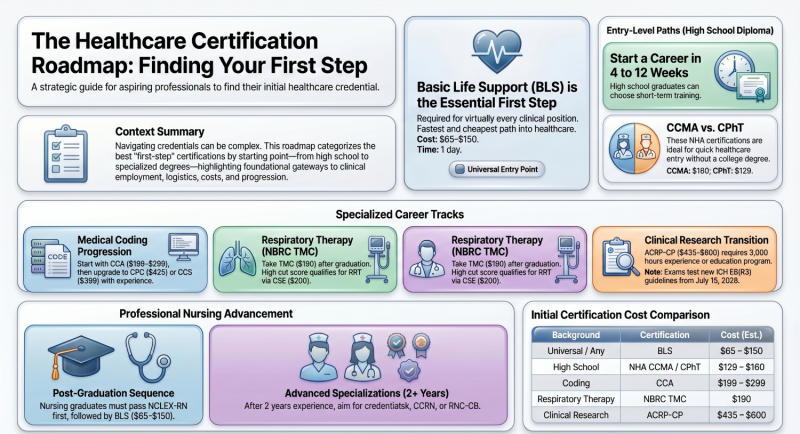
The best first certification depends on your educational background and career goals. Below are tailored recommendations for the six most common starting points.
-
High school diploma, want healthcare fast: Get the NHA CCMA ($160) or NHA CPhT ($129). Complete a training program in 4–12 weeks, then pass the exam.
-
Coding training certificate: Start with the CCA ($199 member / $299 non-member), then upgrade to CPC ($425) or CCS ($399) with experience.
-
Nursing graduate: Pass NCLEX-RN first, then BLS ($65–$150). After 2+ years, add CEN, CCRN, or RNC-OB.
-
Respiratory therapy degree: Take the NBRC TMC ($190) immediately. Aim for the high cut score to qualify for RRT via the CSE ($200).
-
Career changer into clinical research: The ACRP-CP ($435–$600) accepts qualifying education programs or 3,000 hours of experience. Note: ACRP exams test ICH E6(R3) guidelines starting July 15, 2026.
-
Fastest, cheapest path into any healthcare role: BLS certification ($65–$150, 1 day) is required for virtually every clinical position. Get it first, then pursue field-specific credentials.
Complete Healthcare Certification Comparison Matrix
This master comparison matrix covers 15+ major certifications ranked by exam fee. Use it to compare cost, time, salary, and demand at a glance.
| Certification | Body | Exam Fee | Prep Time | Renewal | Avg. Salary | Demand |
|---|---|---|---|---|---|---|
| NREMT EMT | NREMT | $104 | 4–8 wk | 2 yr | $30K–$45K | High |
| NHA CPhT | NHA | $129 | 4–6 wk | 2 yr | ~$42K | High |
| NHA CCMA | NHA | $160 | 4–6 wk | 2 yr | $35K–$50K | Very High |
| NBRC TMC | NBRC | $190 | 6–8 wk | 5 yr | $55K–$65K | High |
| NCC C-EFM | NCC | $210 | 4–6 wk | 3 yr | Add-on | Moderate |
| AHIMA CCA | AHIMA | $299 | 6–8 wk | 2 yr | $40K–$50K | High |
| AHIMA RHIT | AHIMA | $299 | 6–8 wk | 2 yr | $45K–$55K | High |
| AANPCB FNP-C | AANPCB | $315 | 3–6 mo | — | $100K–$130K | Very High |
| BCEN CEN | BCEN | $380 | 8–12 wk | 4 yr | $70K–$95K | High |
| ANCC FNP-BC | ANCC | $395 | 3–6 mo | 5 yr | $100K–$130K | Very High |
| ANCC PMHNP-BC | ANCC | $395 | 3–6 mo | 5 yr | $110K–$145K | Very High |
| AHIMA CCS | AHIMA | $399 | 3–4 mo | 2 yr | ~$65K | High |
| AAPC CPC | AAPC | $425 | 3–4 mo | 2 yr | ~$58.9K | Very High |
| ACRP-CP | ACRP | $460–$600 | 2–3 mo | 3 yr | $50K–$75K | High |
How Do I Decide Between Two Similar Certifications?
When choosing between similar certifications — such as CPC vs. CCS, ANCC vs. AANPCB, or RHIT vs. RHIA — use these four tiebreaker questions:
-
Which does my target employer prefer? Check 10 job postings in your desired role and count how many list each credential.
-
Which body has better recognition in my setting? AAPC's CPC dominates physician offices; AHIMA's CCS is preferred in hospitals. ANCC FNP-BC is accepted in all 50 states; AANPCB FNP-C costs $80 less ($315 vs. $395).
-
What is the pass rate? A lower pass rate means more study time and potential retake costs. Factor difficulty into your timeline.
-
Can I stack both eventually? Dual certification (e.g., CPC + CCS) commands the highest salaries. Start with the easier credential and build from there.
Frequently Asked Questions
Q1. What is the easiest healthcare certification to get?
BLS (Basic Life Support) is the easiest healthcare certification, requiring only a 4–5 hour course with no prerequisites. Among professional certifications, the NHA CCMA and NHA CPhT are the most accessible, requiring completion of a training program and exams with 4–6 weeks of study.
Q2. What is the cheapest healthcare certification exam?
The NREMT EMT exam at $104 per attempt is the cheapest major healthcare certification exam. The NHA CPhT exam costs $129, and the NHA CCMA exam costs $160. BLS certification through online providers starts at $65.
Q3. Which healthcare certification pays the most?
Advanced practice nursing certifications pay the most. PMHNP-BC certified psychiatric nurse practitioners earn $110,000–$145,000 annually. FNP-BC and AGACNP-BC certified nurse practitioners earn $100,000–$130,000. Among non-nursing certifications, AAPC CIC-certified inpatient coders earn $70,000–$90,000.
Q4. How long does it take to get a healthcare certification?
Timeframes range from 1 day (BLS) to 6 months (ANCC NP certifications). Most entry-level certifications (CCMA, CPhT, EMT) require 4–8 weeks of study. Mid-level certifications (CPC, CCS) require 3–4 months. This does not include prerequisite education or training program time.
Q5. Can I get a healthcare certification without a degree?
Yes. Several certifications require no formal degree: NHA CCMA, NHA CPhT, NREMT EMT, AAPC CPC (with apprentice designation), and BLS/ACLS/PALS. These require completion of training programs or equivalent experience, but not a college degree.
Q6. Is AAPC or AHIMA better for medical coding?
AAPC is better for outpatient/physician-office coding, and its CPC is the most widely held coding credential. AHIMA is better for hospital/inpatient coding and health information management. The best choice depends on your work setting. Many experienced coders hold certifications from both organizations.
Q7. How often do healthcare certifications need to be renewed?
Renewal cycles vary by body: NHA certifications renew every 2 years ($55–$179), AAPC every 2 years (36 CEUs), AHIMA every 2 years, ANCC every 5 years, BCEN every 4 years, NBRC every 5 years, and NREMT every 2 years.
Q8. Should I get certified before or after getting a job?
Get certified before applying whenever possible. Certified candidates are preferred in hiring and earn more from day one. For certifications requiring work experience (CEN, CCRN, RNC-OB), gain experience first, then certify.
Q9. What healthcare certifications can I earn online?
Most healthcare certification exams are available at Pearson VUE or PSI testing centers. Some offer online/remote proctored options. All study and preparation can be completed online through platforms like MedicoExam.com for practice tests.
Q10. How do I know if my healthcare certification is legitimate?
Legitimate certifications are issued by nationally recognized bodies accredited by organizations such as NCCA (National Commission for Certifying Agencies) or ANSI. All certification bodies covered in this guide — AAPC, AHIMA, ANCC, NHA, NBRC, NREMT, BCEN, NCC, ACRP, AMT, AANPCB — are nationally recognized.
Start Your Certification Journey with MedicoExam
Choosing the right certification is step one. Passing it is step two. MedicoExam.com offers simulation-based practice tests for certifications across AAPC, AHIMA, ANCC, NHA, NCC, NBRC, BCEN, AANPCB, AMT, and ACRP. Each practice exam mirrors real exam format, question types, and time limits so you know exactly what to expect on test day.
Ready to prepare? Explore MedicoExam practice tests and build the confidence you need to pass on your first attempt.
Disclaimer: This article is for informational purposes only. Exam fees, formats, and eligibility requirements change periodically. Always verify current details directly with the relevant certification body before registering. MedicoExam.com does not guarantee exam outcomes. This content does not contain exam recalls, leaked questions, or proprietary test material.
Written by the MedicoExam Content Team — Healthcare Education Specialists at MedicoExam.com
Last Updated: May 2026


