
150+ Terms Every Healthcare Certification Exam Candidate Should Know
 Healthcare certification exams use hundreds of specialized terms, abbreviations, and acronyms that can overwhelm first-time candidates. This glossary defines over 150 healthcare certification terms organized by category — covering 12 major certification bodies, dozens of credential abbreviations, exam-day terminology, study and prep concepts, and career and salary terms used across the healthcare credentialing landscape.
Whether you are preparing for the CPC, CCS, FNP-BC, CCMA, or any other healthcare credential, this reference guide ensures you understand every term you encounter during your certification journey.
"Understanding the language of certification is the first step toward exam success. Candidates who know exactly what terms like CAT, CEU, and NCCA mean before they start studying are already ahead." — Dr. Lisa Hernandez, DNP, RN, Healthcare Education Consultant
What Are the Major Healthcare Certification Bodies?
The United States has 12 primary healthcare certification bodies that administer credentials across medical coding, nursing, allied health, respiratory therapy, emergency medicine, infection control, and clinical research. Each organization sets its own eligibility requirements, exam formats, and renewal standards.
Certification Bodies (A–N)
| Abbreviations | Full Name | Definition |
|---|---|---|
| AACN | American Association of Critical-Care Nurses | Professional organization that administers the CCRN (Critical Care Registered Nurse) certification for ICU and critical care nurses. Founded in 1969 and headquartered in Aliso Viejo, California. |
| AANPCB | American Academy of Nurse Practitioners Certification Board | Independent nonprofit certification board offering nurse practitioner credentials including FNP-C, A-GNP-C, ENP-C, and PMHNP. Accredited by both ABSNC and NCCA. Related exams: AANPCB certifications. |
| AAPC | American Academy of Professional Coders | Largest medical coding credentialing organization in the United States with over 220,000 members. Administers the CPC, COC, CIC, CPB, CRC, CPMA, CPPM, and CDEO certifications. Related exams: AAPC certifications. |
| ABSNC | Accreditation Board for Specialty Nursing Certification | The accrediting body that evaluates and accredits nursing certification programs. ABSNC accreditation signals that a certification program meets rigorous quality standards. |
| ACRP | Association of Clinical Research Professionals | Professional organization that offers the ACRP-CP (Certified Professional) and ACRP-PM (Principal) credentials for clinical research professionals. Related exams: ACRP certifications. |
| AHIMA | American Health Information Management Association | Professional association that administers health information management and medical coding certifications including CCA, CCS, CCS-P, RHIT, RHIA, CDIP, and CHDA. Related exams: AHIMA certifications. |
| AMT | American Medical Technologists | National certifying agency that credentials allied health professionals including Registered Medical Assistants (RMA), Registered Phlebotomy Technicians (RPT), and Medical Laboratory Technicians (MLT). Related exams: AMT certifications. |
| ANA | American Nurses Association | National professional organization for registered nurses. The ANA's credentialing subsidiary is ANCC. ANA membership provides discounts on ANCC certification exams. |
| ANCC | American Nurses Credentialing Center | Subsidiary of the ANA that administers board certifications for nurse practitioners, clinical nurse specialists, and specialty nurses. Credentials include FNP-BC, PMHNP-BC, AGPCNP-BC, and AGACNP-BC. Related exams: ANCC certifications. |
| BCEN | Board of Certification for Emergency Nursing | Independent nonprofit that certifies emergency, trauma, and transport nurses through the CEN, CFRN, CPEN, CTRN, and TCRN credentials. All BCEN certifications are ABSNC-accredited. Related exams: BCEN certifications. |
| CBIC | Certification Board of Infection Control and Epidemiology | Organization that administers the CIC (Certification in Infection Control) and a-IPC (Associate — Infection Prevention and Control) credentials for infection prevention professionals. |
| CCHIIM | Commission on Certification for Health Informatics and Information Management | The body responsible for overseeing AHIMA's certification and recertification standards, ensuring credential integrity for HIM professionals. |
| NCC | National Certification Corporation | Nonprofit organization certifying nurses, nurse practitioners, and other health professionals in obstetric, neonatal, and women's health specialties. Credentials include RNC-OB, C-EFM, NNP-BC, and WHNP-BC. Related exams: NCC certifications. |
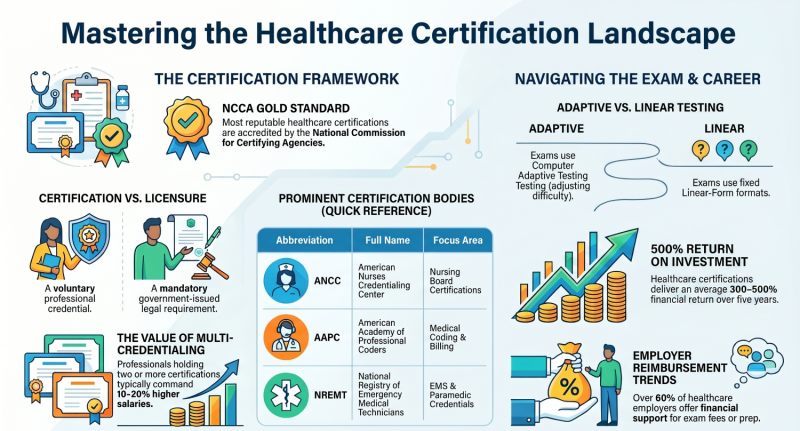
| NCCA | National Commission for Certifying Agencies | Accrediting body that evaluates certification programs against rigorous standards. NCCA accreditation is considered the gold standard for healthcare certification programs. |
| NHA | National Healthcareer Association | Credentialing organization offering 8 NCCA-accredited allied health certifications including CCMA, CPT, CPhT, CMAA, CET, CEHRS, CBCS, and CPCT/A. Related exams: NHA certifications. |
| NBRC | National Board for Respiratory Care | Sole credentialing organization for respiratory therapists in the United States. Administers the TMC exam and credentials including CRT, RRT, and specialty designations. Related exams: NBRC certifications. |
| NREMT | National Registry of Emergency Medical Technicians | National EMS certification organization that credentials Emergency Medical Responders (EMR), EMTs, Advanced EMTs (AEMT), and Paramedics (NRP). NREMT certification is recognized in 46 states. |
| PTCB | Pharmacy Technician Certification Board | Organization that certifies pharmacy technicians through the CPhT credential. The PTCB exam costs $129 and requires completion of a PTCB-recognized education program or 500 hours of work experience. |
What Do Healthcare Credential Abbreviations Stand For?
Healthcare credentials are the post-nominal letters professionals earn after passing a certification exam. Below are the most common credential abbreviations organized by specialty area.
Medical Coding and Billing Credentials
| Abbreviations | Full Name | Certification Body | Definition |
|---|---|---|---|
| CCA | Certified Coding Associate | AHIMA | Entry-level medical coding credential. The CCA exam tests knowledge of clinical classification systems, reimbursement methodologies, and compliance. Related: CCA exam guide. |
| CBCS | Certified Billing and Coding Specialist | NHA | Allied health credential for professionals handling medical billing, insurance claims, and coding in outpatient settings. |
| CCS | Certified Coding Specialist | AHIMA | Advanced hospital-based coding credential covering ICD-10-CM, ICD-10-PCS, and CPT. Considered the gold standard for inpatient coding. Related: CCS exam guide. |
| CCS-P | Certified Coding Specialist — Physician-Based | AHIMA | Specialized coding credential for physician office and outpatient settings using CPT, ICD-10-CM, and HCPCS Level II. |
| CDEO | Certified Documentation Expert — Outpatient | AAPC | Credential for professionals specializing in outpatient clinical documentation improvement (CDI). |
| CDIP | Certified Documentation Integrity Practitioner | AHIMA | Credential for professionals who ensure accuracy of clinical documentation used for coding, compliance, and quality reporting. |
| CHDA | Certified Health Data Analyst | AHIMA | Credential for professionals who acquire, manage, analyze, and interpret healthcare data. |
| CHPS | Certified in Healthcare Privacy and Security | AHIMA | Credential focused on healthcare data privacy, security, and regulatory compliance including HIPAA. |
| CIC | Certified Inpatient Coder | AAPC | Credential validating proficiency in ICD-10-CM and ICD-10-PCS coding for hospital inpatient settings. |
| COC | Certified Outpatient Coder | AAPC | Credential for coders working in outpatient hospital settings and ambulatory surgery centers. |
| CPC | Certified Professional Coder | AAPC | The most widely held medical coding certification in the United States. The CPC exam has 100 questions, a 4-hour time limit, and requires a 70% score to pass. Related: CPC exam guide. |
| CPB | Certified Professional Biller | AAPC | Credential for medical billing professionals covering insurance policies, claim processing, and the revenue cycle. |
| CPMA | Certified Professional Medical Auditor | AAPC | Credential for professionals who audit medical records for coding accuracy, compliance, and reimbursement integrity. |
| CPPM | Certified Physician Practice Manager | AAPC | Credential for healthcare practice management professionals overseeing operations, finance, and compliance. |
| CRC | Certified Risk Adjustment Coder | AAPC | Credential specializing in ICD-10-CM coding for risk adjustment payment models including Medicare Advantage and ACA plans. |
| RHIA | Registered Health Information Administrator | AHIMA | Advanced HIM credential requiring a bachelor's degree. RHIAs manage health information systems, data analytics, and compliance programs. |
| RHIT | Registered Health Information Technician | AHIMA | HIM credential requiring an associate degree. RHITs ensure medical records are accurate, complete, and properly coded. |
Nursing and Nurse Practitioner Credentials
| Abbreviation | Full Name | Certification Body | Definition |
|---|---|---|---|
| AGACNP-BC | Adult-Gerontology Acute Care Nurse Practitioner — Board Certified | ANCC | NP credential for nurses providing care to acutely ill adults and older adults in hospital, ICU, and emergency settings. Related: AGACNP-BC guide. |
| AGPCNP-BC | Adult-Gerontology Primary Care Nurse Practitioner — Board Certified | ANCC | NP credential for nurses providing primary care to adults and older adults in outpatient settings. Related: AGPCNP-BC guide. |
| A-GNP-C | Adult-Gerontology Primary Care Nurse Practitioner — Certified | AANPCB | AANPCB's NP credential for adult-gerontology primary care, equivalent in scope to ANCC's AGPCNP-BC. |
| CCRN | Critical Care Registered Nurse | AACN | Specialty certification for nurses providing direct care to acutely or critically ill patients. Requires 1,750 hours of direct bedside care, with 875 hours in the most recent year. The CCRN exam has 150 questions and a 3-hour time limit. |
| CEN | Certified Emergency Nurse | BCEN | Board certification for registered nurses working in emergency departments. The CEN exam has 175 questions (150 scored) and covers cardiovascular emergencies, neurological emergencies, trauma, and more. |
| C-EFM | Certification in Electronic Fetal Monitoring | NCC | Specialty credential for nurses, physicians, and midwives who interpret electronic fetal monitoring strips in labor and delivery. Related: C-EFM guide. |
| CFRN | Certified Flight Registered Nurse | BCEN | Certification for nurses providing care during fixed-wing and rotor-wing patient transport. |
| CPEN | Certified Pediatric Emergency Nurse | BCEN | Certification for nurses specializing in pediatric emergency care in hospital emergency departments. |
| CTRN | Certified Transport Registered Nurse | BCEN | Credential for nurses providing care during ground and air patient transport. |
| ENP-BC | Emergency Nurse Practitioner — Board Certified | ANCC | NP credential for nurses specializing in emergency care (renewal only as of 2026). |
| ENP-C | Emergency Nurse Practitioner — Certified | AANPCB | AANPCB's NP credential for emergency nurse practitioners. |
| FNP-BC | Family Nurse Practitioner — Board Certified | ANCC | NP credential for nurses providing primary care across the lifespan. The FNP-BC exam has 175 questions (150 scored) with a 3.5-hour time limit. Related: FNP-BC guide. |
| FNP-C | Family Nurse Practitioner — Certified | AANPCB | AANPCB's family nurse practitioner credential. Typically considered more clinically focused than ANCC's FNP-BC. |
| NNP-BC | Neonatal Nurse Practitioner — Board Certified | NCC | NP credential for nurses specializing in the care of critically ill neonates in NICUs. |
| PMHNP-BC | Psychiatric-Mental Health Nurse Practitioner — Board Certified | ANCC | NP credential for nurses providing psychiatric and mental health care across the lifespan. The PMHNP-BC exam has a pass rate of 83%. Related: PMHNP-BC guide. |
| PMH-BC | Psychiatric-Mental Health Nursing — Board Certified | ANCC | RN-level specialty certification (not NP-level) for psychiatric-mental health nurses. Requires 2,000 hours of clinical practice in the specialty. |
| RNC-OB | Registered Nurse Certified in Inpatient Obstetric Nursing | NCC | Specialty certification for nurses working in labor and delivery, antepartum, and postpartum settings. |
| TCRN | Trauma Certified Registered Nurse | BCEN | Certification for nurses specializing in trauma care across the continuum from resuscitation through rehabilitation. |
| WHNP-BC | Women's Health Care Nurse Practitioner — Board Certified | NCC | NP credential for nurses providing primary and specialty care in women's health. |
Allied Health, Respiratory, and EMS Credentials
| Abbreviation | Full Name | Certification Body | Definition |
|---|---|---|---|
| ACRP-CP | Association of Clinical Research Professionals — Certified Professional | ACRP | Entry-level credential for clinical research associates, coordinators, and monitors working in clinical trials. |
| ACRP-PM | Association of Clinical Research Professionals — Principal | ACRP | Advanced credential for experienced clinical research professionals in leadership roles. |
| a-IPC | Associate — Infection Prevention and Control | CBIC | Entry-level credential for professionals beginning careers in infection prevention. The a-IPC credential is valid for 3 years and is not renewable — holders must pass the CIC exam to maintain certification. |
| CCMA | Certified Clinical Medical Assistant | NHA | Allied health credential for medical assistants performing clinical and administrative duties in physician offices and clinics. Related: CCMA exam guide. |
| CET | Certified EKG Technician | NHA | Credential for technicians who perform and interpret electrocardiograms in clinical settings. |
| CEHRS | Certified Electronic Health Records Specialist | NHA | Credential for professionals managing electronic health records systems in healthcare facilities. |
| CIC (CBIC) | Certification in Infection Control | CBIC | Advanced credential for infection preventionists. The CIC exam has 150 questions (135 scored) and requires post-secondary education in a health-related field plus qualifying work experience. |
| CMAA | Certified Medical Administrative Assistant | NHA | Credential for professionals managing front-office operations including scheduling, billing, and patient communications. |
| CPhT | Certified Pharmacy Technician | NHA or PTCB | Credential for pharmacy technicians who assist pharmacists with prescription processing, medication dispensing, and inventory management. Related: CPhT exam guide. |
| CPhT-Adv | Advanced Certified Pharmacy Technician | PTCB | Advanced credential for experienced pharmacy technicians demonstrating mastery beyond entry-level competency. Requires an active CPhT plus 3 years of experience. |
| CPCT/A | Certified Patient Care Technician/Assistant | NHA | Credential for technicians providing direct patient care including vital signs, phlebotomy, and EKG procedures. |
| CPT (NHA) | Certified Phlebotomy Technician | NHA | Credential for phlebotomy technicians who collect blood specimens for laboratory testing. |
| CRT | Certified Respiratory Therapist | NBRC | Entry-level respiratory therapy credential earned by passing the TMC exam at the low-cut score. |
| EMR | Emergency Medical Responder | NREMT | Entry-level EMS credential for individuals providing immediate lifesaving care until more advanced providers arrive. |
| EMT | Emergency Medical Technician | NREMT | EMS credential for providers performing basic emergency medical care including CPR, bleeding control, and oxygen administration. |
| AEMT | Advanced Emergency Medical Technician | NREMT | Mid-level EMS credential for providers who can administer certain medications and start IV lines in addition to basic EMT skills. |
| MLT | Medical Laboratory Technician | AMT | Credential for laboratory professionals who perform routine clinical laboratory tests under the supervision of a medical technologist. |
| NRP | Nationally Registered Paramedic | NREMT | Highest NREMT certification level. Paramedics perform advanced procedures including intubation, cardiac monitoring, and medication administration. |
| RMA | Registered Medical Assistant | AMT | Allied health credential for medical assistants, an alternative to the NHA's CCMA credential. |
| RPT | Registered Phlebotomy Technician | AMT | AMT's phlebotomy credential for specimen collection professionals. |
| RRT | Registered Respiratory Therapist | NBRC | Advanced respiratory therapy credential earned by passing the TMC exam at the high-cut score. RRTs earn approximately 15% more than CRTs. |
| RRT-ACCS | Registered Respiratory Therapist — Adult Critical Care Specialist | NBRC | Specialty designation for respiratory therapists working in adult critical care and ICU settings. |
| RRT-NPS | Registered Respiratory Therapist — Neonatal/Pediatric Specialist | NBRC | Specialty designation for respiratory therapists providing care to neonatal and pediatric patients. |
| RRT-SDS | Registered Respiratory Therapist — Sleep Disorders Specialist | NBRC | Specialty designation for respiratory therapists specializing in sleep disorders testing and therapeutic intervention. |
| BLS | Basic Life Support | AHA | Foundational life support certification covering CPR, AED use, and choking relief for healthcare providers. BLS certification is a prerequisite for nearly all clinical healthcare positions. |
| ACLS | Advanced Cardiovascular Life Support | AHA | Advanced certification covering cardiac arrest algorithms, stroke protocols, and acute coronary syndromes. Required for nurses, paramedics, and physicians working in emergency and critical care settings. |
| PALS | Pediatric Advanced Life Support | AHA | Certification focused on emergency assessment and treatment of critically ill infants and children. Required for pediatric nurses, emergency physicians, and paramedics. |
| AHA | American Heart Association | — | Organization that administers BLS, ACLS, and PALS life support certifications recognized by hospitals and healthcare systems nationwide. |
| CSPT | Certified Compounded Sterile Preparation Technician | PTCB | Specialized credential for pharmacy technicians who prepare compounded sterile preparations in clean room environments. |
| CNOR | Certified Nurse, Operating Room | CCI | Certification for perioperative nurses specializing in surgical patient care. Administered by the Competency and Credentialing Institute. |
| OCN | Oncology Certified Nurse | ONCC | Certification for nurses specializing in cancer patient care. Administered by the Oncology Nursing Certification Corporation. |
| CCRN-K | Critical Care Registered Nurse — Knowledge | AACN | Certification for nurses with critical care knowledge who do not provide direct bedside care, such as educators and managers. |
| CCRA | Certified Clinical Research Associate | ACRP | Credential for clinical research monitors who oversee trial sites to ensure protocol compliance and data integrity. |
| CCRC | Certified Clinical Research Coordinator | ACRP | Credential for professionals coordinating day-to-day clinical trial operations at investigative sites. |
| CCRP | Certified Clinical Research Professional | SOCRA | Clinical research credential administered by the Society of Clinical Research Associates, alternative to ACRP credentials. |
What Do Common Exam Terminology Terms Mean?
Exam terminology covers the testing formats, scoring methods, and procedural terms you will encounter when registering for and taking a healthcare certification exam.
| Term | Definition |
|---|---|
| ATT (Authorization to Test) | An official approval issued by a certification body confirming that a candidate has met all eligibility requirements and may schedule their exam. Most ATTs are valid for 90–120 days. |
| Blueprint (Exam Blueprint) | A document published by the certification body that outlines the content domains, percentage weights, and topics covered on an exam. Also called a "content outline" or "test plan." |
| CAT (Computer Adaptive Testing) | A testing format where the computer adjusts question difficulty based on the candidate's responses in real time. If you answer correctly, the next question is harder; if you answer incorrectly, the next question is easier. Used by the NCLEX and NREMT exams. |
| CBT (Computer-Based Testing) | An exam delivered on a computer at a testing center or through remote proctoring, as opposed to paper-and-pencil testing. Nearly all healthcare certification exams use CBT as of 2026. |
| Content Domain | A major subject area or category on an exam blueprint. For example, the CCRN blueprint divides content into Clinical Judgment (80%) and Professional Caring and Ethical Practice (20%). |
| Cut Score | The minimum score required to pass an exam. Cut scores are established through psychometric analysis, not arbitrary percentage targets. The CPC exam requires a 70% cut score. |
| Item | A single question on an exam. Healthcare certification exams use various item types including multiple-choice, drag-and-drop, hot spot, and select-all-that-apply. |
| Linear-Form Exam | A traditional exam format where all candidates receive the same set of questions in a fixed order, as opposed to CAT. Most AAPC and AHIMA exams use a linear format. |
| NDA (Non-Disclosure Agreement) | A legally binding agreement candidates sign before taking a certification exam, prohibiting them from sharing exam content, questions, or answers with anyone. Violations can result in score cancellation and permanent exam bans. |
| Pearson VUE | The largest testing center network for healthcare certification exams. Pearson VUE administers exams for ANCC, AHIMA, NREMT, NBRC, and BCEN, among others. |
| Pretest Items | Unscored questions embedded in an exam for statistical analysis and future use. Candidates cannot distinguish pretest items from scored items. The ANCC FNP-BC exam, for example, includes 25 pretest items among its 175 total questions. |
| Proctored Exam | An exam administered under formal supervision, either in-person at a testing center or remotely through a virtual proctor with webcam monitoring. |
| PSI | Professional testing services company that administers exams for NHA, AMT, and other certification bodies. PSI operates both in-person testing centers and remote proctoring platforms. |
| OnVUE | Pearson VUE's remote proctoring platform that allows candidates to take exams from home or another private location. Requires a webcam, microphone, and stable internet connection. |
| Retake Policy | Rules governing when a candidate can reattempt a failed exam. Policies vary by certification body — AAPC allows retakes after 1 day with a fee of $399, while ANCC requires a 60-day waiting period. |
| Scaled Score | A score converted from raw performance to a standardized scale to account for differences in exam difficulty across test forms. The CBIC CIC exam uses a scale of 300–900, with 700 as the passing threshold. |
| Seat Time | The total time allotted for an exam, including time for the tutorial, NDA, exam questions, and survey. Seat time is longer than the actual testing time. |
| Testing Window | A designated period during which a candidate can schedule and take an exam. Some exams offer year-round testing; others have specific windows (e.g., CBIC offers testing windows in spring and fall). |
| TMC (Therapist Multiple-Choice) | The single credentialing exam administered by the NBRC for respiratory therapists. Scoring at the low cut score earns the CRT credential; scoring at the high cut score earns the RRT credential. |
| Voucher | A prepaid code issued by a certification body, employer, or educational institution that covers the exam registration fee. Exam vouchers often have expiration dates of 90–180 days. |
| ADA Accommodation | A testing modification provided under the Americans with Disabilities Act for candidates with documented disabilities. Accommodations may include extended time, a separate testing room, or assistive technology. |
| Candidate Handbook | The official document published by a certification body containing exam eligibility requirements, content outlines, registration procedures, scoring methodology, and policies. Required reading before applying for any certification exam. |
What Study and Prep Terms Should Candidates Know?
Study and preparation terminology covers the resources, methods, and requirements you will encounter while preparing for and maintaining a healthcare certification.
| Term | Definition |
|---|---|
| AMA PRA Category 1 Credit | Continuing medical education credits recognized by the American Medical Association. Many physicians and healthcare professionals use these credits for license maintenance and certification renewal. |
| ANSI | American National Standards Institute. ANSI accredits standards organizations including NCCA. ANSI accreditation adds an additional layer of quality assurance to certification programs. |
| CE (Continuing Education) | Ongoing learning activities required to maintain an active certification. Most healthcare certifications require 20–40 CE hours per renewal cycle. |
| CEU (Continuing Education Unit) | A standardized unit of measurement for continuing education activities. One CEU typically equals 10 contact hours of participation in an organized educational experience. |
| CME (Continuing Medical Education) | Structured educational activities for physicians and other healthcare professionals. CME activities must be accredited by an ACCME-recognized accreditation body. |
| Contact Hour | A unit measuring time spent in a continuing education activity. One contact hour equals 60 minutes of instruction or participation. ANCC requires 75 contact hours over 5 years for most NP certifications. |
| Content Outline | See Blueprint. The published document detailing every topic that may appear on a certification exam. |
| CPD (Continuing Professional Development) | A broader term encompassing all learning activities — formal courses, self-study, mentoring, conferences — that maintain and expand professional competence. |
| Exam Prep Course | A structured review course (live, online, or self-paced) designed to prepare candidates for a specific certification exam. Courses range from $200 to $2,000 depending on the credential. |
| Flash Cards | A study tool presenting a term, concept, or question on one side and the answer or definition on the other. Digital flash cards with spaced repetition algorithms (e.g., Anki) are widely used for healthcare certification prep. |
| IPU (Infection Prevention Unit) | The continuing education unit used by CBIC for CIC certification renewal. Certificants must earn 40 IPUs over each 5-year renewal cycle. |
| Item Writing | The process of creating exam questions. Certification bodies recruit certified professionals as subject matter experts (SMEs) to write and review items. |
| Practice Exam | A simulated test that mirrors the format, timing, and difficulty of the actual certification exam. MedicoExam offers simulation-based practice tests for multiple healthcare certifications. |
| Practice Analysis | A study conducted by certification bodies every 3–5 years to update exam content based on current job tasks and knowledge requirements in the field. Also called a "job task analysis" or "role delineation study." |
| QBank (Question Bank) | A large collection of practice questions organized by topic, difficulty, or exam domain. High-quality QBanks include detailed answer explanations and performance tracking. |
| Review Course | See Exam Prep Course. A comprehensive educational program covering all exam domains. |
| SME (Subject Matter Expert) | A certified professional with demonstrated expertise who contributes to exam development, item writing, or content validation for a certification body. |
| Spaced Repetition | A study technique that schedules review of material at increasing intervals to optimize long-term retention. Research shows spaced repetition improves recall by 200% compared to massed practice. |
| Study Plan | A structured schedule outlining which topics to study, when, and for how long during exam preparation. Effective study plans allocate time proportional to each content domain's weight on the exam blueprint. |
| Test-Taking Strategy | Techniques for approaching exam questions effectively, including process of elimination, keyword identification, and time management. |
| Active Recall | A study technique where learners actively retrieve information from memory rather than passively reviewing notes. Practice exams and self-quizzing are forms of active recall that significantly improve retention. |
| Code Books | Reference manuals containing medical coding systems (CPT, ICD-10-CM, ICD-10-PCS, HCPCS Level II) that candidates may use during open-book coding exams. AHIMA CCA and CCS exams require candidates to bring approved code books to the testing center. |
| ACCME | Accreditation Council for Continuing Medical Education. The organization that accredits providers of continuing medical education for physicians and other healthcare professionals. |
What Career and Salary Terms Are Used in Healthcare Certification?
Career and salary terms describe the professional landscape, employment requirements, and financial implications of healthcare certification.
| Term | Definition |
|---|---|
| Board Certified | A designation indicating that a professional has passed a rigorous, standardized examination in a specialty area. Board certification is voluntary but is increasingly required or preferred by employers. |
| CEH (Certified per Employer/Hiring requirement) | An informal term describing certifications that are mandated by specific employers as a condition of employment rather than by state law. |
| Certification | A voluntary credential earned by meeting education, experience, and examination requirements set by a professional credentialing organization. Certification differs from licensure in that it is not legally required to practice. |
| Certification Maintenance | The ongoing process of keeping a credential active through continuing education, practice hours, retesting, or a combination of renewal methods. |
| Credential | A formal qualification — including certifications, licenses, registrations, and academic degrees — that validates a professional's knowledge, skills, and competence. |
| FEMA | Federal Emergency Management Agency. Relevant to EMS professionals, as NREMT-certified providers often work within FEMA's emergency response framework. |
| Grandfathering | A provision that allows currently certified professionals to maintain their credential under previous requirements when certification standards change. |
| ICH-GCP (International Council for Harmonisation — Good Clinical Practice) | The international ethical and scientific quality standard for designing, conducting, and reporting clinical trials. Required knowledge for ACRP-CP certification. |
| License | A mandatory, government-issued authorization to practice a profession. Unlike certification, a license is required by law. For example, all nurses must hold a state nursing license in addition to any optional board certifications. |
| Magnet Recognition | A designation by the ANCC Magnet Recognition Program awarded to hospitals demonstrating nursing excellence. Magnet hospitals often require or incentivize specialty certifications, paying $2,000–$5,000 annual certification bonuses. |
| Multi-Credential | The practice of holding two or more professional certifications, such as CPC + CCS or FNP-BC + PMHNP-BC. Multi-credentialed professionals often command 10–20% higher salaries. |
| NPI (National Provider Identifier) | A unique 10-digit identification number assigned to healthcare providers in the United States. Required for billing and claims processing. |
| Privileging | The process by which a healthcare facility grants a provider permission to perform specific procedures or treatments based on their credentials, training, and competence. |
| Recertification | The process of renewing an expired or lapsed certification, which may require retaking the exam, completing additional CE, or meeting updated eligibility requirements. |
| Renewal | The process of extending an active certification for another cycle (typically 2–5 years) by meeting CE requirements and paying a renewal fee before the expiration date. |
| ROI (Return on Investment) | A calculation comparing the cost of obtaining a certification (exam fees, study materials, time) against the financial benefit (salary increase, job opportunities) over time. Healthcare certifications deliver an average ROI of 300–500% over 5 years. |
| Salary Premium | The additional compensation earned by certified professionals compared to non-certified peers in the same role. The average salary premium for healthcare certifications ranges from $5,000 to $20,000 per year depending on the credential. |
| Scope of Practice | The legally defined activities, procedures, and treatments a healthcare professional is authorized to perform based on their license, certification, and training. |
| Stacking Credentials | A strategy of earning multiple related certifications to build expertise and increase marketability — for example, earning CCA first, then CCS, then CDIP. |
| Compact License | A multistate license that allows healthcare professionals (primarily nurses under the Nurse Licensure Compact) to practice across participating states without obtaining additional licenses. Over 40 states participate in the NLC as of 2026. |
| Employer Reimbursement | A benefit where employers pay for certification exam fees, study materials, or CE costs. According to industry surveys, over 60% of healthcare employers offer some form of certification reimbursement. |
| Lapsed Certification | A credential that has expired because the holder did not complete renewal requirements (CE hours, fees) by the deadline. Reinstatement typically requires additional CE, retesting, or both. |
| Verification | The process by which employers, licensing boards, or other entities confirm that a professional holds an active, valid certification. Most certification bodies maintain online verification portals. |
Quick-Reference: Most Common Healthcare Acronyms
This quick-reference table covers the 25 most frequently searched healthcare certification acronyms.
| Acronym | Stands For | Category |
|---|---|---|
| AAPC | American Academy of Professional Coders | Certification Body |
| AHIMA | American Health Information Management Association | Certification Body |
| ANCC | American Nurses Credentialing Center | Certification Body |
| BLS | Basic Life Support | Life Support Certification |
| ACLS | Advanced Cardiovascular Life Support | Life Support Certification |
| PALS | Pediatric Advanced Life Support | Life Support Certification |
| CAT | Computer Adaptive Testing | Exam Terminology |
| CBT | Computer-Based Testing | Exam Terminology |
| CCA | Certified Coding Associate | Credential (AHIMA) |
| CCMA | Certified Clinical Medical Assistant | Credential (NHA) |
| CCS | Certified Coding Specialist | Credential (AHIMA) |
| CE | Continuing Education | Study/Prep Term |
| CEU | Continuing Education Unit | Study/Prep Term |
| CME | Continuing Medical Education | Study/Prep Term |
| CPC | Certified Professional Coder | Credential (AAPC) |
| CPhT | Certified Pharmacy Technician | Credential (NHA/PTCB) |
| CRT | Certified Respiratory Therapist | Credential (NBRC) |
| EMT | Emergency Medical Technician | Credential (NREMT) |
| FNP-BC | Family Nurse Practitioner — Board Certified | Credential (ANCC) |
| NRP | Nationally Registered Paramedic | Credential (NREMT) |
| NCCA | National Commission for Certifying Agencies | Accrediting Body |
| PMHNP-BC | Psychiatric-Mental Health NP — Board Certified | Credential (ANCC) |
| RHIA | Registered Health Information Administrator | Credential (AHIMA) |
| RHIT | Registered Health Information Technician | Credential (AHIMA) |
| RRT | Registered Respiratory Therapist | Credential (NBRC) |
Frequently Asked Questions
Q1. What does CPC stand for in medical coding?
CPC stands for Certified Professional Coder. It is the most widely held medical coding certification in the United States, administered by the AAPC. The CPC exam tests proficiency in CPT, HCPCS Level II, and ICD-10-CM coding systems.
Q2. What is the difference between certification and licensure?
Certification is a voluntary credential earned by passing a standardized exam administered by a professional organization (e.g., AAPC, ANCC, AHIMA). Licensure is a mandatory, government-issued authorization required by law to practice a profession. For example, nurses must hold a state license, while board certifications like FNP-BC are optional but strongly preferred by employers.
Q3. What does CAT mean on a certification exam?
CAT stands for Computer Adaptive Testing. It is a testing format that adjusts question difficulty in real time based on the candidate's responses. The NCLEX and NREMT exams use CAT, which means each candidate receives a unique set of questions tailored to their performance level.
Q4. What is the NCCA and why does accreditation matter?
The National Commission for Certifying Agencies (NCCA) is the accrediting body for certification programs in the United States. NCCA accreditation means a certification program meets rigorous standards for validity, reliability, and fairness. Employers and state licensing boards strongly prefer NCCA-accredited credentials.
Q5. What does BC mean after a nursing credential?
BC stands for Board Certified. It indicates that a nurse has passed a national board certification exam in a specialty area. For example, FNP-BC means Family Nurse Practitioner — Board Certified through ANCC.
Q6. How many CE hours do most healthcare certifications require?
Most healthcare certifications require 20–40 continuing education (CE) hours per renewal cycle. For example, AAPC requires 36 CEUs every 2 years, ANCC requires 75 contact hours every 5 years, and NBRC requires 30 CE hours every 5 years.
Q7. What is the difference between AAPC and AHIMA?
AAPC (American Academy of Professional Coders) focuses primarily on physician-based and outpatient coding, while AHIMA (American Health Information Management Association) covers hospital-based coding and health information management. Both organizations offer respected medical coding credentials.
Q8. What does NRP stand for in EMS?
NRP stands for Nationally Registered Paramedic. It is the highest certification level offered by the NREMT (National Registry of Emergency Medical Technicians). NRP-certified paramedics can perform advanced procedures including intubation, cardiac monitoring, and medication administration.
Q9. What is a scaled score on a certification exam?
A scaled score converts your raw exam performance to a standardized scale that accounts for differences in difficulty across test forms. This ensures that candidates who take harder versions of an exam are not penalized. For example, the CBIC CIC exam uses a 300–900 scale with 700 as the passing threshold.
Q10. What is the difference between FNP-BC and FNP-C?
FNP-BC (Family Nurse Practitioner — Board Certified) is awarded by ANCC, while FNP-C (Family Nurse Practitioner — Certified) is awarded by AANPCB. Both credentials certify family nurse practitioners, but the ANCC exam includes more professional practice content while the AANPCB exam emphasizes clinical skills.
Start Preparing for Your Healthcare Certification Exam
Now that you understand the terminology, take the next step toward certification success. MedicoExam.com offers simulation-based practice tests for certifications across AAPC, AHIMA, ANCC, NHA, NBRC, BCEN, NCC, AANPCB, ACRP, and AMT. Each practice exam mirrors real exam conditions — timed questions, domain-weighted content, and detailed answer explanations — so you walk into test day fully prepared.
Start your free practice exam at MedicoExam.com
Disclaimer: This glossary is for informational and educational purposes only. It does not contain exam recalls, proprietary exam content, or leaked questions. Always verify current exam requirements, fees, and policies directly with the relevant certification body.
Written by the MedicoExam Content Team — Healthcare Education Specialists at MedicoExam.com


