The AHIMA Certified Coding Specialist (CCS) exam has one of the lowest pass rates among healthcare certifications: approximately 50% of first-time test takers fail. With 107 total questions — including 33 medical coding scenarios requiring real-time abstraction — this is not an exam you can cram for. Successful candidates invest 8–12 weeks of structured preparation, practice 2 inpatient and 2 outpatient coding cases per day, and master the CCS content domains before sitting for the test. This guide gives you the exact study plan, domain strategy, and time management framework to pass on your first attempt.
Key Facts Box
-
Total Questions: 107 (97 scored, 10 pretest) — 64 multiple-choice items + 33 medical coding scenarios
-
Exam Duration: 4 hours
-
Passing Score: 300 (scaled)
-
First-Time Pass Rate: Approximately 50% (industry estimate)
-
Code Books Required: Candidates must bring approved ICD-10-CM, ICD-10-PCS, and CPT code books to the test center
-
2026 Code Book Update: Exams on or after May 1, 2026 require 2026 code books
-
Recommended Study Time: 8–12 weeks (10–15 hours per week)
-
Daily Practice Target: 2 inpatient + 2 outpatient coding cases per day

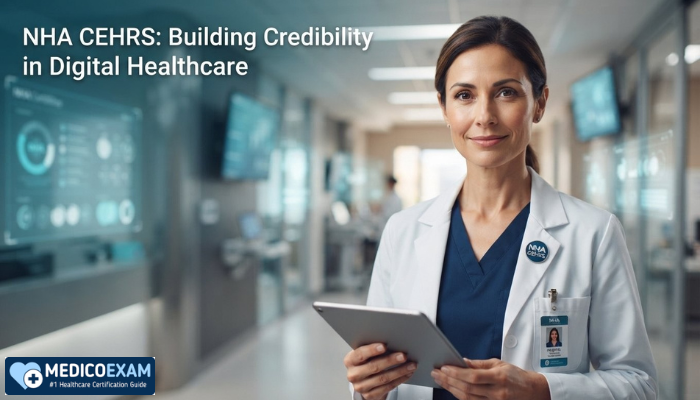
The NHA Certified Electronic Health Records Specialist (CEHRS) exam validates your ability to navigate EHR software, manage clinical and administrative data, maintain HIPAA compliance, and generate reports within electronic health record systems. The exam consists of 125 multiple-choice questions — 100 scored and 25 unscored pretest items — with a 125-minute time limit, a $129 fee, and a passing threshold of 390 on a 200–500 scaled score. NHA launched the current CEHRS test plan on June 17, 2020, following a nationwide Job Task Analysis completed in 2019.
The ANCC Informatics Nursing board certification (NI-BC) is the gold-standard credential for registered nurses working at the intersection of healthcare and information technology. The exam contains 150 questions — 125 scored and 25 unscored pretest items — and you have 3 hours to complete it at a Prometric testing center. You need a scaled score of 350 out of 500 to pass, and the certification is valid for 5 years. With employment in health information technology projected to grow 15 percent from 2024 to 2034 according to the Bureau of Labor Statistics, earning the NI-BC has never been more career-relevant.
The ANCC Gerontological Nursing certification (GERO-BC) validates that registered nurses possess the clinical knowledge and judgment to care for older adults across acute, long-term, and community settings. The computer-based exam contains 150 questions — 125 scored and 25 unscored pretest items — and must be completed within 3 hours at a Prometric testing center. With 61.2 million Americans now aged 65 and older, representing 18% of the total population, board-certified gerontological nurses are in unprecedented demand. This guide breaks down every detail you need — eligibility requirements, content domains, study strategies, and exam-day logistics — so you can earn the GERO-BC credential on your first attempt.
The NHA CBCS and the AAPC CPC serve different career paths in the medical billing and coding field. The CBCS (Certified Billing & Coding Specialist) is an entry-level credential focused on revenue cycle workflows, payer requirements, coding guidelines, and billing and reimbursement fundamentals. Based on the current MedicoExam CBCS syllabus page, the CBCS exam costs $129, runs 180 minutes, and includes 125 total questions (100 scored + 25 pretest). The CPC (Certified Professional Coder) is a physician-office and outpatient coding credential from AAPC that currently costs $425 for one attempt or $499 for two attempts, includes 100 questions, and requires a passing score of 70%.
The NHA Certified Medical Administrative Assistant (CMAA) exam contains 110 scored multiple-choice questions plus 25 unscored pretest items, and candidates have 2 hours and 15 minutes to complete it. The exam fee is
The ANCC Cardiac-Vascular Nursing Board Certification (CV-BC) validates specialized knowledge in caring for patients with heart and vascular conditions. The exam contains 150 questions (125 scored plus 25 unscored pretest items), allows 3 hours, and costs $395 for non-members or $295 for ANA members. With cardiovascular disease causing 919,032 deaths in the United States in 2023 alone — roughly 1 in every 3 deaths — demand for certified CV nurses continues to grow (CDC Heart Disease Facts). This guide covers every detail you need to earn the CV-BC credential in 2026.
The Certified in Neonatal Pediatric Transport (C-NPT) credential from the National Certification Corporation (NCC) validates specialized knowledge for clinicians who stabilize and transport critically ill neonates and children. The exam costs $210, contains 125 multiple-choice questions with 3 answer options each, and must be completed in 2 hours. Endorsed by the Air & Surface Transport Nurses Association (ASTNA), the C-NPT is the only subspecialty certification purpose-built for the multidisciplinary neonatal and pediatric transport workforce — including registered nurses, neonatal nurse practitioners, respiratory therapists, paramedics, physicians, and physician assistants.
The National Healthcareer Association (NHA) offers eight NCCA-accredited certifications spanning clinical, administrative, and pharmacy careers in allied health. NHA has awarded over 1 million certifications since its founding in 1989 and remains the largest allied health certification agency in the United States. This guide compares every NHA exam — CCMA, CET, CPCT/A, CPT, CBCS, CEHRS, CMAA, and CPhT — across cost, format, domains, eligibility, salary, and career trajectory so you can choose the right credential for your goals.